


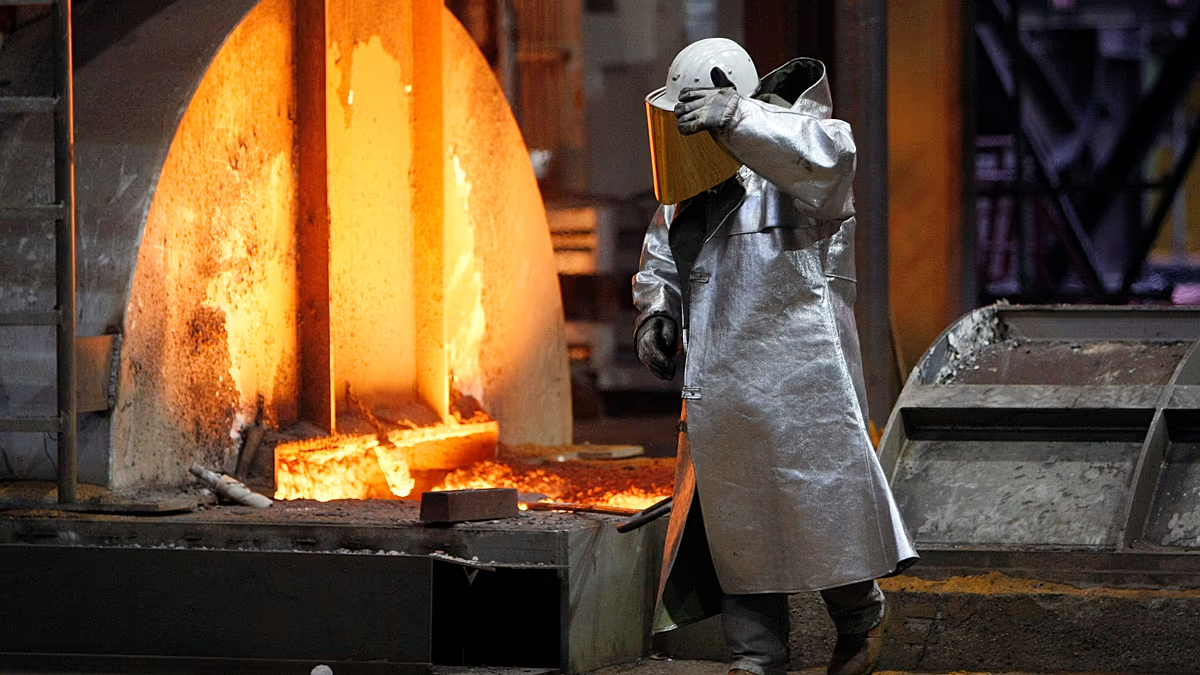
A flicker of light appeared in Germany’s industrial engine room in April, but it is a faint one, illuminating a landscape still dominated by deep shadows. According to official data released this week, industrial production in Europe’s largest economy inched 0.4% higher from March, breaking a five-month losing streak that began with the outbreak of a major conflict in the Middle East last autumn. This marginal gain was powered primarily by a welcome 2.4% surge in construction activity, while exports also offered a pleasant surprise with a 0.9% rise. For a nation whose economic identity is so deeply tied to its manufacturing prowess, any positive movement is noteworthy. However, analysts and economists are united in warning against any premature celebration. This single month’s figure is, as ING’s Global Head of Macro Carsten Brzeski put it, “simply too little” to signal a true turning point. When viewed across the entire first four months of 2026, output has effectively stagnated, and it remains a sobering 12% below pre-pandemic levels. The early-year optimism, fueled by rising order books and Chancellor Friedrich Merz’s ambitious fiscal plans for defence and infrastructure, has once again been supplanted by a familiar German angst.
The sombre reality behind the headline number is rooted in a brutal economic backdrop defined by war, energy insecurity, and evaporating confidence. Germany, as one of Europe’s largest net importers of energy, remains acutely vulnerable to global price shocks. With roughly 6% of its oil imports sourced from the Middle East, the ongoing conflict has sent energy costs spiraling upward. This pressure is acutely felt in energy-intensive industries—such as chemicals and metals—which employ nearly a million people and contribute significantly to industrial output. The consequence is painfully clear in the nation’s inflation rate, which climbed to 2.9% in April, its highest point in over two years, driven by energy prices more than 10% higher than the previous year. In this hostile environment, the government has been forced to drastically slash its growth forecast for 2026 to a meager 0.5%. The war’s ripple effects have effectively choked off the tentative recovery that seemed to be budding just months ago, placing a heavy drag on the entire economy.
Perhaps the most telling indicator of the profound challenges ahead came not from the production report itself, but from the orders data published a day earlier. New manufacturing orders plunged 3.8% in April, a disheartening reversal that exposes the fragility of recent demand. The downturn was broad-based, hitting key pillars of German industry: automotive orders fell by over 5%, while electrical equipment and machinery also posted sharp declines. Both foreign and domestic demand withered, dropping by over 4% and nearly 3% respectively. This collapse in orders is particularly jarring because it follows a period of genuine strength at the end of 2025, when orders boomed for four consecutive months. As Brzeski notes, the momentum from strategic domestic stockpiling for defence and pre-ordering to secure supply chains has now “evaporated.” What looked like the foundation for a robust industrial rebound has crumbled, leaving behind empty order books and renewed uncertainty.
The collective mood within German industry, therefore, is one of profound disappointment and resigned caution. Brzeski aptly described it as a story of “high hopes and broken dreams.” The much-anticipated industrial renaissance of 2026 has categorically failed to materialize. Instead, businesses are grappling with a triple burden: soaring input costs due to energy, a sudden drop in new orders, and the lingering structural damage from years of supply chain disruption. The Federal Ministry for Economic Affairs has acknowledged that normalizing production and untangling the complex backlog of logistical and commodity bottlenecks will “take considerable time.” There is no quick fix on the horizon. The modest April production increase, driven largely by weather-dependent construction and volatile export figures, does not alter this fundamental diagnosis. It is a statistical blip in a persistently negative trend.
Looking forward, the path for German industry remains steep and fraught with risk. The external environment offers little comfort, with geopolitical instability continuing to threaten energy markets and global trade flows. Domestically, the high cost of energy acts as a permanent brake on the competitiveness of its core industrial sectors. While the government’s planned investments in defence and infrastructure provide a crucial long-term anchor for demand, they cannot instantly offset the current slump in private sector ordering and investment. The economy finds itself in a holding pattern, waiting for a break in the clouds that does not appear imminent. The resilience of the construction sector and occasional export strength may prevent a freefall, but they are insufficient to engineer a true recovery.
In conclusion, Germany’s April industrial data offers a classic tale of a technical improvement masking a deeper, more troubling reality. The end of a five-month production decline is a necessary first step, but it is a step taken on unstable ground. With orders collapsing, energy prices elevated, and business confidence shaken, the engine of the European economy is sputtering. The nation’s industrial core, once the envy of the world, is now a focal point of its economic anxieties. Until there is a sustained resolution to the energy price crisis and a durable return of global demand—particularly from key sectors like automotive and capital goods—Germany’s industrial performance is likely to remain subdued. The dream of a powerful rebound has been deferred, replaced by the hard work of endurance and adaptation in a persistently difficult new era.