



Antoni Gaudí’s death was as unassuming as his final years had become. On a June evening in 1926, the 74-year-old architect, a figure now inseparable from Barcelona’s identity, was making his daily walk to mass in the quiet Plaça de Sant Felip Neri. As he crossed the busy Gran Via, a tragic collision with a tram left him mortally wounded. In a poignant irony, the man whose work would draw millions to the city was not initially recognized by those who came to his aid, taken first to a modest clinic before being transferred to the Hospital de la Santa Creu, where he died two days later. He was buried in the crypt of his own unfinished magnum opus, the Sagrada Família, a site roughly midway between two of his other masterpieces, Casa Milà and the basilica itself. This humble end for such a monumental artist underscores a life devoted not to public acclaim, but to an almost spiritual pursuit of craft and faith.
Gaudí’s origins were modest, rooted in the industrial transformation of Catalonia. Born in 1852 to a family of coppersmiths in Reus, he was a sickly child whose frequent rheumatic fevers kept him from regular school but allowed him to apprentice in his father’s workshop, developing a profound feel for materials and volume. This was an era of dramatic change; Barcelona’s medieval walls had fallen, making way for Ildefons Cerdà’s visionary Eixample grid, and the first railway line had just connected Barcelona to Mataró. Sensing opportunity, the Gaudí family sold property and moved to the booming capital in 1868 to educate their sons. After years of financial struggle and preparatory study, Antoni finally entered Barcelona’s School of Architecture in 1874, working as a draughtsman to support himself. His early work, like the hydraulic system for the Ciutadella park’s waterfall, already hinted at a unique synthesis of engineering and art, placing him at the dawn of the Modernisme movement.
His architectural philosophy was forged in the fires of the Renaixença (Renaissance), a powerful Catalan cultural revival that sought to establish a distinct national identity through language, literature, and art. Gaudí became its most brilliant architectural voice. His designs were not mere buildings but manifestos, blending exuberant, natural forms with deep Catalan symbolism and an innovative use of traditional craft. Even his early projects carried a social and political charge, such as the utopian Mataró Workers’ Cooperative, which provided housing and gardens for laborers. Yet, his genius was as enigmatic as it was brilliant. Upon awarding Gaudí his architecture diploma in 1879, the school’s director famously confessed, “I do not know whether we have given the title to a madman or to a genius; time will tell.”
Time quickly began to answer. Integrated into Barcelona’s intellectual and bourgeois circles, Gaudí found a lifelong patron and friend in the industrialist Eusebi Güell. Projects like the Güell Pavilions allowed him to innovate, pioneering the trencadís technique—vibrant mosaics made from broken tiles and ceramics—that would become a signature. The legend goes that, impatient with a craftsman placing tiles one by one, Gaudí smashed a handful to the ground, declaring they must be applied “by the handful, or we will never finish!” This impulsive energy characterized his work ethic. In 1883, he took over the project that would consume his life: the Expiatory Temple of the Sagrada Família. He radically transformed its initial design into a visionary forest of stone, a biblical narrative carved in light and geometry, knowing he would never see its completion.
Gaudí’s later years were marked by an intensifying maximalism in his secular work and an ascetic focus on the Sagrada Família. Masterpieces like Casa Batlló and Park Güell showcase this climax of style, where swirling forms, kaleidoscopic color, and structural genius make architecture feel alive. Yet personal loss shadowed this creative peak. The deaths of his niece, his closest collaborator, and his patron Güell plunged him into deeper religious devotion and isolation. By 1925, he had moved into a sparse room at the Sagrada Família workshop, living like a monk and dedicating every waking moment to the basilica. His appearance became so shabby that he was often mistaken for a beggar. On the day he died, he had been designing lamps for the crypt, telling an assistant as he left, “Come early tomorrow, we will be doing very beautiful things.” These words, full of unfinished promise, haunt his legacy.
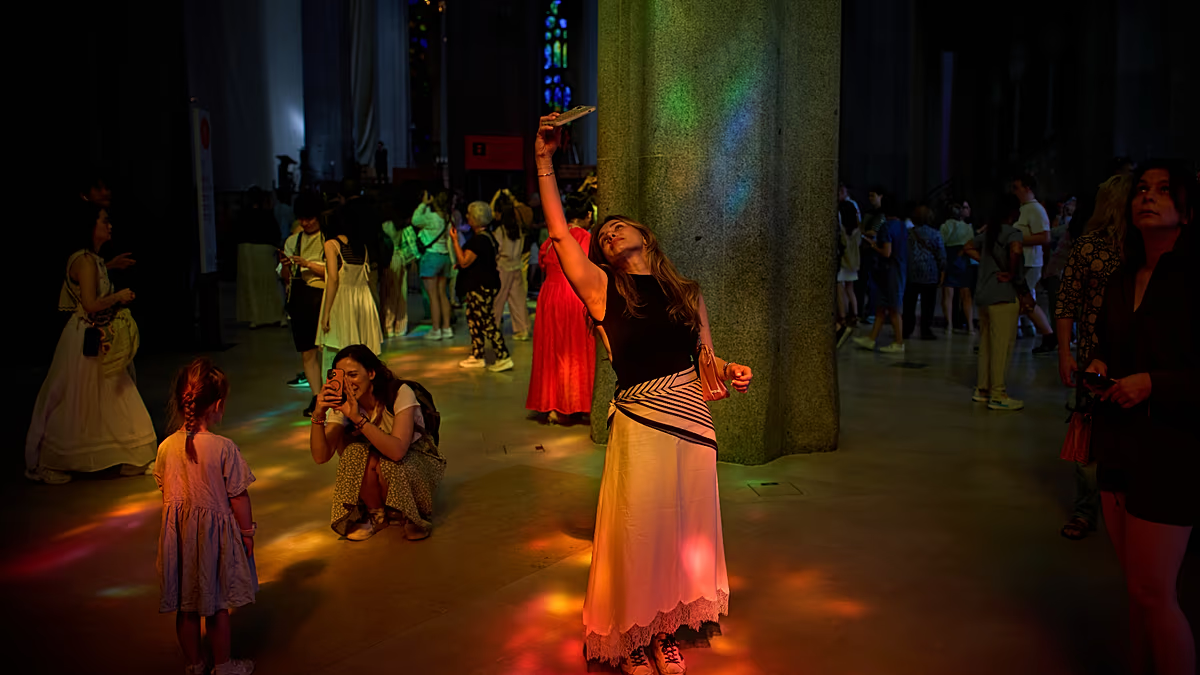
Today, Gaudí is revered as “a shaper of the collective soul of Catalonia,” a spiritual and national icon. His death in obscurity contrasts sharply with his immortal presence in Barcelona’s streets, where his buildings are pilgrimage sites. The Sagrada Família, still under construction, stands as the ultimate testament to his belief that his client—God—was in no rush. It is a metaphor for Gaudí himself: a man rooted in artisan tradition yet soaring toward the divine, a Catalan patriot whose work belongs to the world, and a genius whose beautiful, intricate visions remain, in many ways, gloriously unfinished. His life reminds us that true legacy is not in completion, but in the inspiration and identity forged in the relentless pursuit of a singular, extraordinary dream.