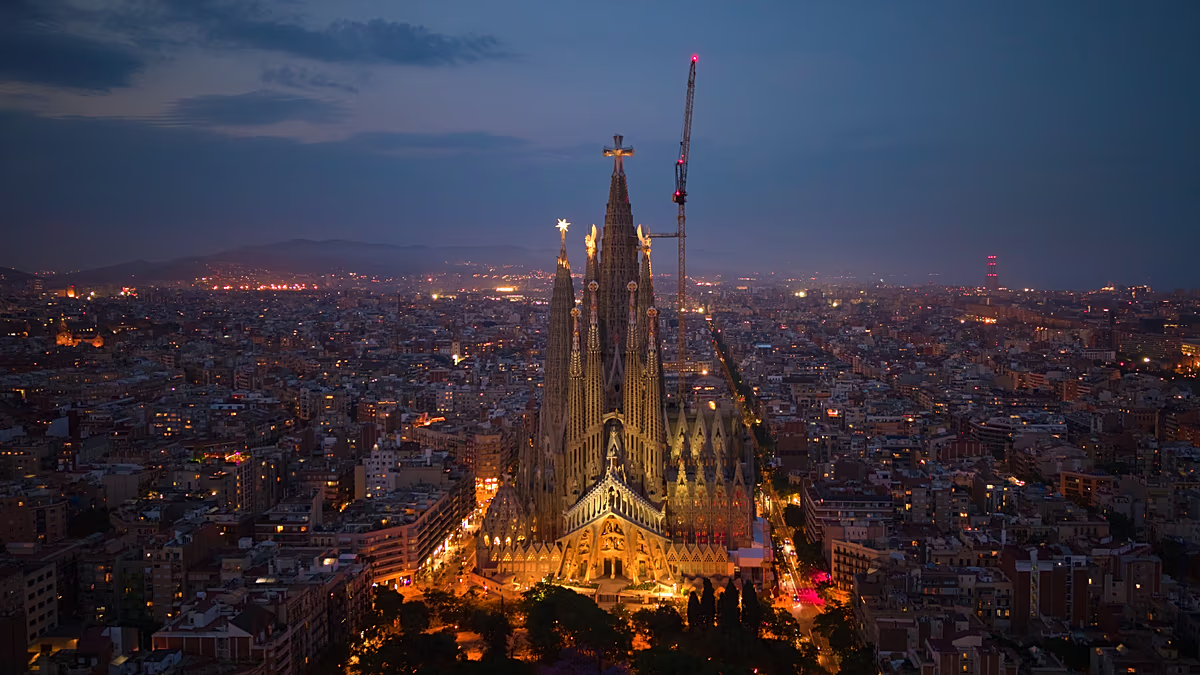




On a quiet Barcelona evening in June 1926, Antoni Gaudí, the revered architect, concluded his day’s work on the ever-evolving Sagrada Família. To a collaborator, he expressed a hopeful anticipation for the morrow: “Vicente, come early tomorrow; we are going to do very beautiful things.” These would be his last known words. As he made his customary walk to evening mass at the church of Sant Felip Neri—a tucked-away sanctuary in the Gothic Quarter—a tragic accident unfolded. While crossing the Gran Via, the elderly, distracted man was struck by a tram. Unrecognized in his plain, worn clothes, he was initially taken to a pauper’s clinic. It was only later at the Hospital de la Santa Creu that his identity was revealed. He died two days later from his injuries, at the age of 74, and was laid to rest in the crypt of his own magnificent, unfinished masterpiece, the very site of his final labors. This poignant end cemented his legend, transforming the man into a myth inextricably woven into the soul of Barcelona and Catalonia itself.
Gaudí’s journey to becoming the defining architect of Barcelona began in modest circumstances. Born in 1852 to a family of coppersmiths in Reus, Tarragona, a sickly childhood marked by rheumatic fever kept him from regular schooling but fostered a profound, observant connection with the natural world. His family’s determination to secure a university education for their sons propelled a move to Barcelona, a city then in the throes of a dramatic metamorphosis. The medieval walls had fallen, making way for Ildefons Cerdà’s visionary Eixample grid. Catalonia was the engine of Spain’s Industrial Revolution, and Barcelona was its buzzing, expanding heart. After years of preparatory study and working as a draughtsman to support himself, Gaudí finally entered the School of Architecture in 1874. His unique vision was evident even to his mentors; upon graduation, the school’s director famously remarked, “I do not know whether we have given the diploma to a madman or to a genius; time will tell.”
That genius found its first major expression as Barcelona prepared for the 1888 Universal Exposition. Gaudí assisted with the design of the hydraulic system for the monumental waterfall in the Ciutadella park, an early flourish of what would become Catalan Modernisme. This architectural movement was the physical embodiment of the Renaixença (Renaissance), a cultural revival that sought to reassert Catalan language, identity, and artistry. Gaudí did not merely build structures; he constructed a sense of collective identity in stone, tile, and iron. His work became synonymous with the region’s resurgent spirit. Furthermore, his early projects revealed a social conscience, most notably in his designs for the Cooperativa Obrera Mataronense, a utopian workers’ complex featuring a factory, affordable housing, and gardens. Though this project was never fully realized, it illustrated a belief that beauty and functionality should uplift all levels of society.
The trajectory of Gaudí’s career was forever altered by his friendship with the wealthy industrialist Eusebi Güell. Güell became a lifelong patron, granting Gaudí the creative freedom and resources to execute his most imaginative ideas. From the whimsical Pavellons Güell gatehouse with its iconic dragon to the breathtaking Park Güell—a failed housing development turned into a public park that resembles a surreal, ceramic-dappled wonderland—this partnership yielded some of Barcelona’s most beloved landmarks. It was during this period that Gaudí fully developed his signature trencadís technique, a vibrant mosaic created from broken shards of ceramic and glass. Legend has it the method was born from impatience; watching a craftsman place tiles one by one, Gaudí supposedly smashed a handful and declared they must be applied “by the handful, or we’ll never finish!” This impulsive energy translates into the explosive color and texture that defines works like Casa Batlló, with its scaly, ocean-inspired facade, and the undulating stone quarry-like form of Casa Milà (La Pedrera).
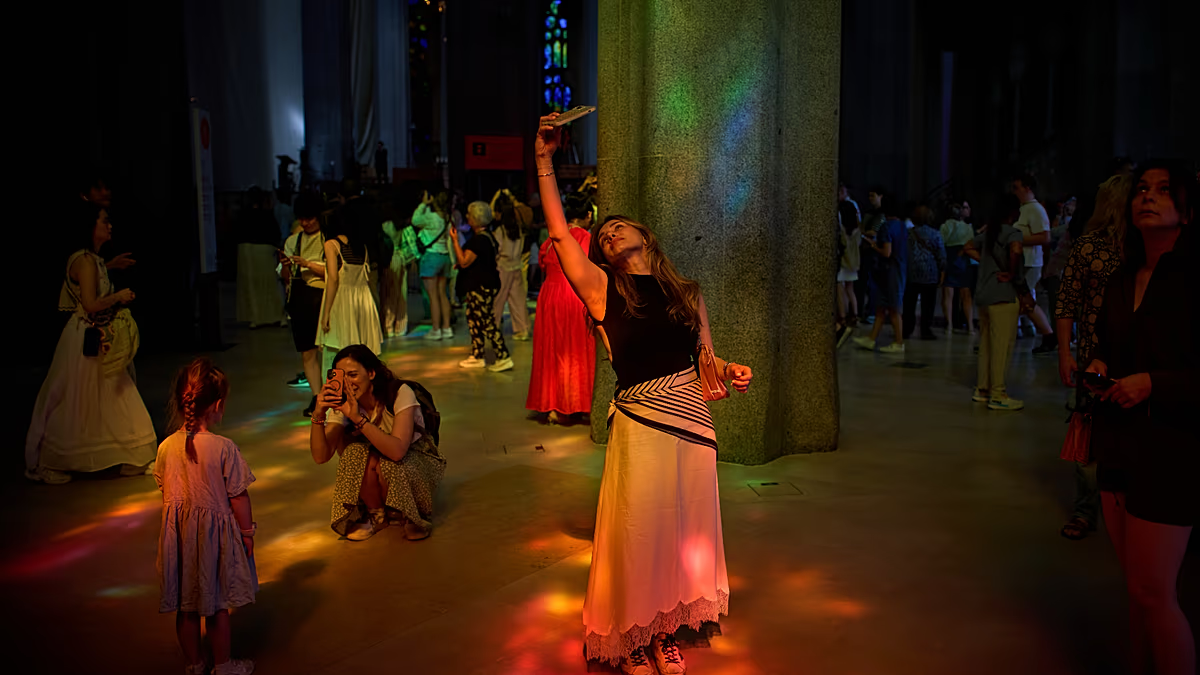
Yet, above all these secular wonders loomed the sacred, all-consuming project: the Basilica of the Sagrada Família. Taking over its design in 1883, Gaudí utterly transformed the initial Gothic revival plans into something organic, symbolic, and structurally revolutionary. The basilica became his life’s work, a “Bible in stone” where every element, from the slanting tree-like columns to the light-flooding hyperboloid vaults, served both a structural and a theological purpose. As he aged, personal losses—including his patron Güell and his chief collaborator—deepened his Catholic devotion and his monastic dedication to the project. He abandoned his home, moved into a sparse workshop at the construction site, and devoted every waking moment to the temple. His style evolved into a maximalist, spiritual naturalism, where geometry and faith merged. By the time of his death, only a fraction of his vision was built, but he left behind detailed models and concepts, knowing the work would transcend his own lifetime.
Today, Gaudí’s legacy is a living, breathing part of global culture. The Sagrada Família, still under construction and aiming for completion around 2030, is Barcelona’s most visited site, a testament to his enduring power to inspire awe. His seven buildings in Barcelona are UNESCO World Heritage Sites, celebrated not as relics but as vital urban landmarks. The initial question posed by his professor has been resoundingly answered by time: he was a genius, one whose work shaped the very “collective soul” of Catalonia. From the sickly boy observing nature in Reus to the humble, tragic figure mistaken for a pauper, Antoni Gaudí became the architect of a dream. His story is one of relentless imagination, of a deep fusion of faith and form, and of an unfinished beauty that continues to grow, captivating millions who walk through his stone forests and beneath his luminous vaults, forever reaching toward the sky.