


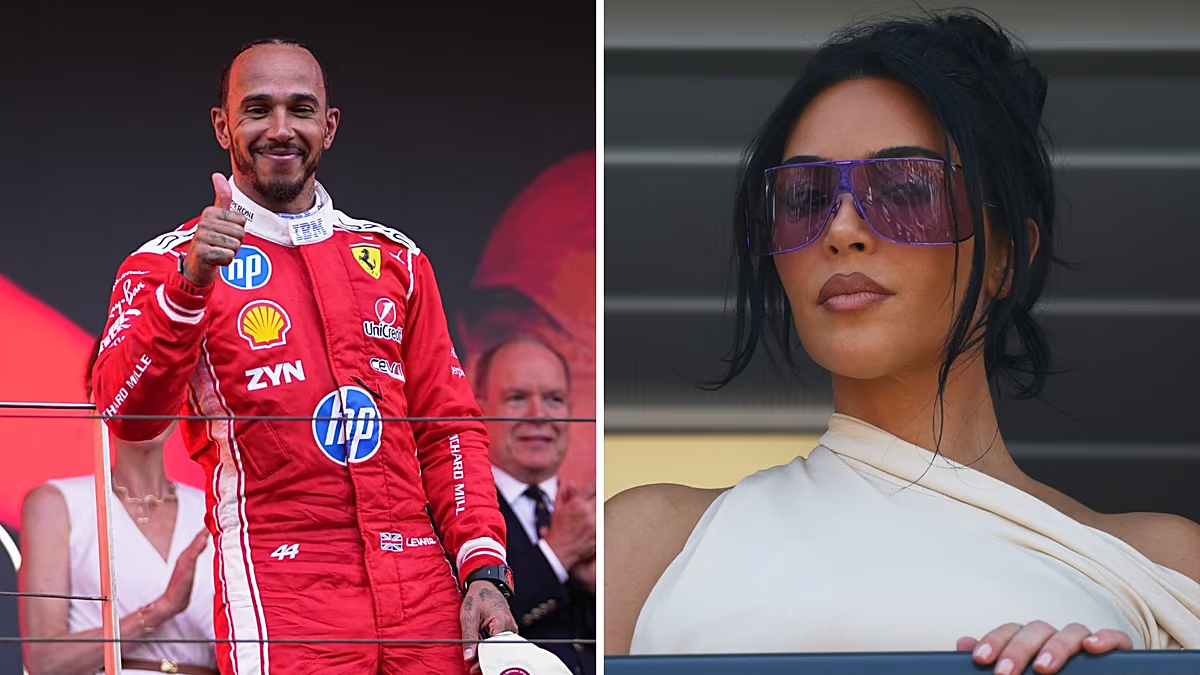
In the high-octane world of Formula 1, where success is measured in milliseconds and millions, seven-time world champion Lewis Hamilton finds himself navigating a different kind of challenging circuit in 2026: the court of public opinion. While enjoying a strong season on the track, including a recent podium finish in Monaco, Hamilton has become the focal point of a resurgent debate about wealth, privilege, and hypocrisy. The catalyst is a three-year-old interview from 2023, in which he spoke passionately about economic inequality on Jay Shetty’s “On Purpose” podcast. In that conversation, Hamilton expressed a daily struggle with the vast disparity between the rich and the poor, specifically noting the homelessness crisis in Los Angeles and controversially suggesting, “There should be a limit to how much you can have because there’s enough to go around for everyone.”
These comments, noble in intent, have collided with the present-day reality of Hamilton’s life, creating a stark contrast that many online critics find difficult to reconcile. With an estimated personal net worth of roughly $581 million, a Monaco residency favoured for its tax benefits, and a high-profile relationship with reality TV mogul Kim Kardashian, Hamilton embodies the extreme wealth he once critiqued. This dissonance has been magnified by the Monaco Grand Prix weekend, where Hamilton and Kardashian were photographed celebrating together. Kardashian, estimated to be worth $2 billion, further fueled the narrative by reportedly snubbing a veteran F1 reporter, an act perceived by fans as emblematic of an out-of-touch elite. The couple’s combined public image has led critics to question Hamilton’s awareness and credibility on the very issue he sought to highlight.
The backlash on social media has been swift and pointed, centering on accusations of profound hypocrisy. Users have juxtaposed his call for wealth limits with his own financial portfolio and lifestyle choices. Comments such as, “He’s literally dating who he’s talking about,” and “Be the change you want to see and give all of the boundless excess of cash you and your girlfriend have away,” capture the essence of the critique. The underlying sentiment is that preaching wealth redistribution while living an ultra-lavish, tax-advantaged life rings hollow. For these critics, Hamilton’s words, however well-meaning, are undermined by his actions, making him seem disconnected from the everyday struggles of those he claims to empathize with, and turning his advocacy into what some see as mere performance.
However, this narrative overlooks a more nuanced reality. To dismiss Hamilton solely as a hypocrite ignores his long-standing and tangible philanthropic efforts. Through his charity, Mission 44, he actively works to address systemic inequalities, focusing on supporting underrepresented young people in the UK through education and employment initiatives. This demonstrates a commitment to channeling his privilege toward concrete change, a step beyond mere commentary. The situation presents a complex modern dilemma: can an individual who benefits from and participates in a system also be a legitimate critic of it? Must one divest entirely from wealth to advocate for its fairer distribution, or is the more practical path to leverage that position for good, as Hamilton attempts with his foundation?
The heated reaction to Hamilton’s resurfaced words speaks to a broader societal tension. In an age of intense social media scrutiny, public figures are held to an almost impossibly pure standard. Any perceived gap between rhetoric and reality is seized upon, often oversimplifying multifaceted individuals into symbols of hypocrisy. This incident is less about Hamilton’s personal failings and more a reflection of a deeper public cynicism toward elite activism and a frustration with systemic economic inequality. The conversation has quickly shifted from the substance of wealth disparity to the persona of the messenger, highlighting how difficult it is for prominent, wealthy individuals to engage in social critique without facing charges of insincerity.
As the Formula 1 calendar moves to the next race in Barcelona, the discourse around Lewis Hamilton will inevitably shift back towards braking points and podium finishes. Yet, this episode underscores a lasting challenge in the intersection of celebrity, wealth, and activism. It reveals the precarious balance figures like Hamilton must strike—using their platform to spotlight crucial issues while living within the very structures they critique. Whether viewed as a hypocrite or a flawed but genuine advocate, his experience illuminates the intense scrutiny faced by those who speak on inequality from a position of extreme privilege. Ultimately, the debate he has inadvertently reignited says more about public expectations and the complexities of modern advocacy than it does about any single grand prix winner’s personal contradictions.