


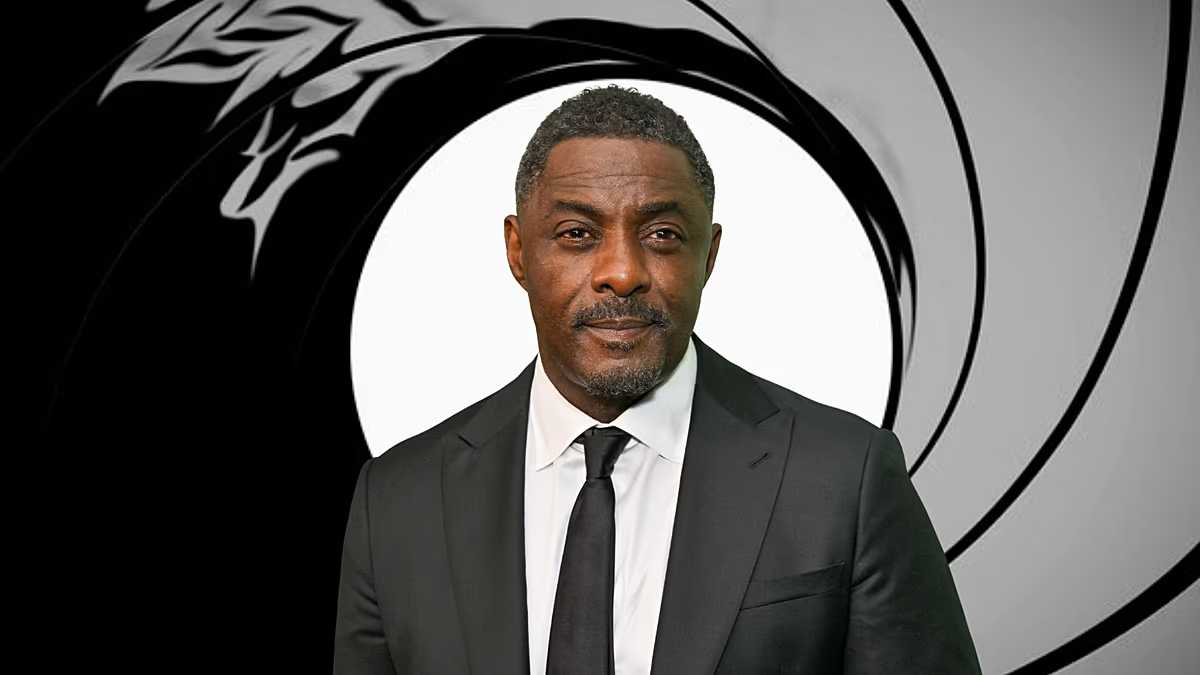
The enduring search for the next actor to portray James Bond continues to captivate the public imagination, with each passing week seemingly offering a new rumor or suggested frontrunner to succeed Daniel Craig. This ongoing speculation has become a cultural ritual, reflecting the iconic status of the role and the intense scrutiny that comes with it. Amidst the ever-shifting list of potential candidates, one name had remained a constant in conversations for over a decade: Idris Elba. The acclaimed British actor, renowned for his powerful performances in projects like Luther, had long been fan-cast as a potentially groundbreaking 007. However, in a recent and candid interview with British GQ, Elba has definitively closed the door on this possibility, offering a nuanced and personal perspective that goes beyond a simple denial.
Elba clarified that, from his point of view, the persistent rumors of his casting were “never legit” and not something he considered a realistic prospect. He then delved into the core of his reasoning, expressing a firm belief that the character of James Bond should remain true to the vision established by author Ian Fleming. “Bond is written how he was written for a reason,” Elba stated. He pointed to the practical realities of the global film market, suggesting that some international audiences would not readily accept a Black actor in the role. “I think, in realistic terms, some markets just don’t go for that,” he explained. “Bond is big all over the world. And [audiences] won’t [all] go for a Black male, an African male, playing Bond. That’s not what they like in their culture. Period.” This frank assessment highlights the complex commercial pressures that inform major franchise casting, often extending far beyond artistic merit.
Beyond the question of race, Elba articulated a broader philosophy about the essence of the Bond franchise. He pushed back against what he perceives as modern pressures to fundamentally reinvent the character for contemporary political sensibilities. “Bond is so unrealistic, so a hint of reality is good, but let’s not try and make it woke,” he said. “I think you’ve got to be pure to what it is: escapism. Don’t try and answer the world’s taste. Just be Bond.” In Elba’s view, the enduring appeal of 007 lies in his role as a fantastical, suave operative—a form of pure cinematic escape. His comments suggest a concern that over-correction or excessive modernization risks diluting the very fantasy that audiences have cherished for generations.
These reflections are not new for Elba. He echoed similar sentiments on the SmartLess podcast, where he described the hypothetical offer to play Bond as “the pinnacle” of an actor’s career. However, he also revealed the darker side of the years-long speculation, noting that the conversation around his potential casting became toxic. “Those that weren’t happy about the idea made the whole thing disgusting and off-putting, because it became about race,” he shared. “It became about nonsense and I got the brunt of it.” This admission provides crucial context, revealing how the intense public debate—fueled by both support and bigotry—ultimately made the prospect unappealing, regardless of the official offers that may or may not have been made.
With Idris Elba’s unambiguous departure from the conversation, the field is now wide open for a new generation of actors. The production machinery is actively moving forward, with the recent hiring of esteemed casting director Nina Gold to join director Denis Villeneuve and writer Steven Knight on Amazon MGM’s reboot of the franchise. This team will now sift through the current crop of rumored frontrunners, which includes names like Tom Francis, Callum Turner, Jacob Elordi, Jack Lowden, and Louis Partridge. The search has entered a more concrete phase, shifting from abstract fan desire to the practical realities of finding the right fit for a new era.
Ultimately, Idris Elba’s bowing out is more than just another name crossed off a list. It serves as a poignant commentary on the intersection of legacy, race, and pop culture in the 21st century. His respectful insistence on the character’s original conception, coupled with his weary acknowledgment of the racially charged backlash that surrounded his name, adds a significant chapter to the Bond saga. As the hunt continues for the next actor to utter “Bond, James Bond,” Elba’s words remind us that the role is not just a career-defining part, but a cultural artifact that carries immense weight, history, and complicated expectations. The next 007 will not only have to fill Daniel Craig’s shoes but will also step into a conversation that has been profoundly shaped by the years of speculation about what James Bond can, or should, be.