


Albania’s political landscape has recently been animated by a peculiar and telling clash of culture, environmentalism, and digital age politics. At its center is Prime Minister Edi Rama, a charismatic and often unconventional leader, who made headlines by reposting an AI-generated video of himself on Instagram. The video, a surreal piece of digital satire, depicted the Prime Minister wearing a leather mini-skirt and bra—a move he explicitly framed as a jab against social media influencers. With the caption “Whoever made this, well done,” Rama weaponized absurdity to make a serious point. This stunt was a direct response to influencers who have been supporting ongoing, widespread protests against a major luxury real estate development on Albania’s southern coast. The project is controversial not only for its environmental impact but also for its high-profile backers: Jared Kushner and Ivanka Trump. Rama, in a speech just days before the post, had mocked influencers for profiting from social media fame while contributing little in taxes, suggesting they should “challenge each other, one dressed as a flamingo and another dressed as me and see who wins.” This bizarre imagery was a calculated mockery, reducing a complex civic debate to what he portrayed as a shallow contest for online attention.
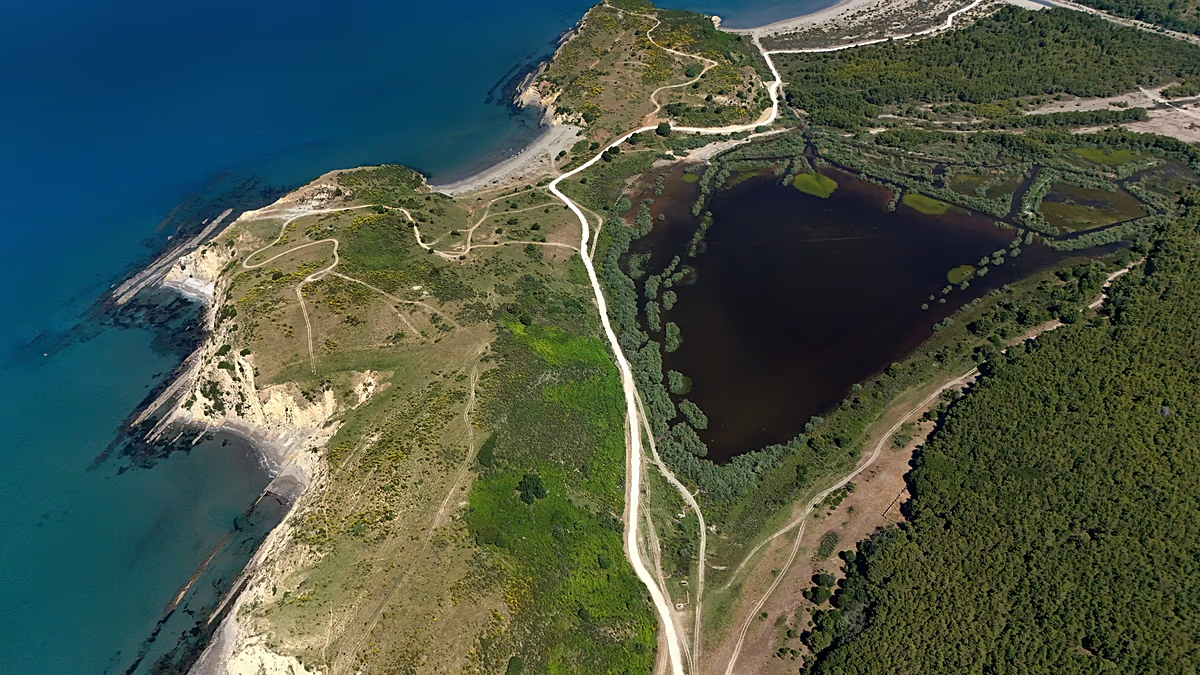
The protests Rama was lampooning are far from superficial, however. They have drawn thousands of Albanians concerned about the fate of their country’s natural heritage. For weeks, demonstrators in the capital, Tirana, have been carrying cardboard cut-outs of pink flamingos—a potent symbol of the wildlife under threat. The planned development spans two sensitive areas: a section of the Narta Lagoon, a protected wildlife reserve, and the nearby uninhabited island of Sazan, a former military base. This coastal region is a critical stopover for migratory birds along the Adriatic flyway, making it one of Albania’s most valuable biodiversity hotspots. The government, led by Rama’s Socialist Party, champions the project as a transformative boost for high-end tourism and a step toward economic modernization and European integration. Yet, environmental campaigners see it as a devastating betrayal, arguing that long-protected habitats are being “irreversibly destroyed” for the benefit of powerful foreign investors.
The involvement of Jared Kushner adds a layer of international intrigue and political tension to the controversy. Through his investment firm, Kushner was granted special status by Albanian authorities to develop a complex of hotels, villas, apartments, and a marina. This deal has raised eyebrows and stoked public suspicion about transparency and the prioritization of foreign capital over national sovereignty and ecological preservation. Albania’s 450-kilometer coastline, largely untouched during its isolated communist era, represents a final frontier of pristine Mediterranean shoreline. Many citizens fear this moment marks the beginning of a sell-off, where powerful interests can carve up the nation’s natural crown jewels with minimal oversight. This fear was visceral when video emerged of a security guard violently dragging an activist at the project site, galvanizing public anger and strengthening the resolve of the protest movement.
Prime Minister Rama’s response has been to dismiss the protesters’ credibility rather than to engage substantively with their environmental concerns. He has accused influencers of joining the rallies merely for clicks and clout, claiming they lack a real understanding of the issues. By sharing the AI video and focusing his rhetoric on the vanity of online personalities, he attempts to reframe the narrative. The strategy is a classic political maneuver: discredit the messengers to undermine the message. In the digital age, where imagery and perception are paramount, Rama—a former artist—understands the power of a striking visual. The leather-clad AI avatar was a spectacle designed to overshadow the images of flamingo cut-outs and bulldozers in protected lagoons, reducing a heated debate about conservation and sovereignty to a meme.
But beneath this war of symbols lies a tangible and accelerating reality on the ground. Since late May, excavators and heavy machinery have moved into the Narta Lagoon area, cutting access roads, digging into dunes, clearing pine forests, and erecting fences. These actions, undertaken while the project faces legal challenges and fierce public opposition, have a sense of grim inevitability. Environmental groups from across Europe have joined Albanian activists in condemnation, watching in despair as ecosystems that survived decades of communism are rapidly reshaped. The confrontation pits a vision of neoliberal progress—where economic growth is measured in luxury condos and yacht berths—against a growing, grassroots demand for sustainable development that honors and preserves Albania’s unique natural legacy.
Ultimately, this episode is a microcosm of 21st-century governance, where AI deepfakes, Instagram influencers, and global finance collide with timeless questions of public trust and environmental stewardship. Edi Rama’s leather skirt is more than a viral oddity; it is a metaphor for a political approach that dresses substantive conflict in the garb of distraction. Yet, the determined citizens carrying flamingo silhouettes through the streets remind us that some symbols cannot be so easily mocked or erased. They represent a living ecosystem and a national inheritance that many believe is not for sale. As the machinery continues its work, the fundamental question remains unanswered: Will Albania’s future be defined by exclusive deals for the powerful, or by the preserved beauty and biodiversity that belong to all its people? The clash between the bulldozer and the flamingo is far from over.