



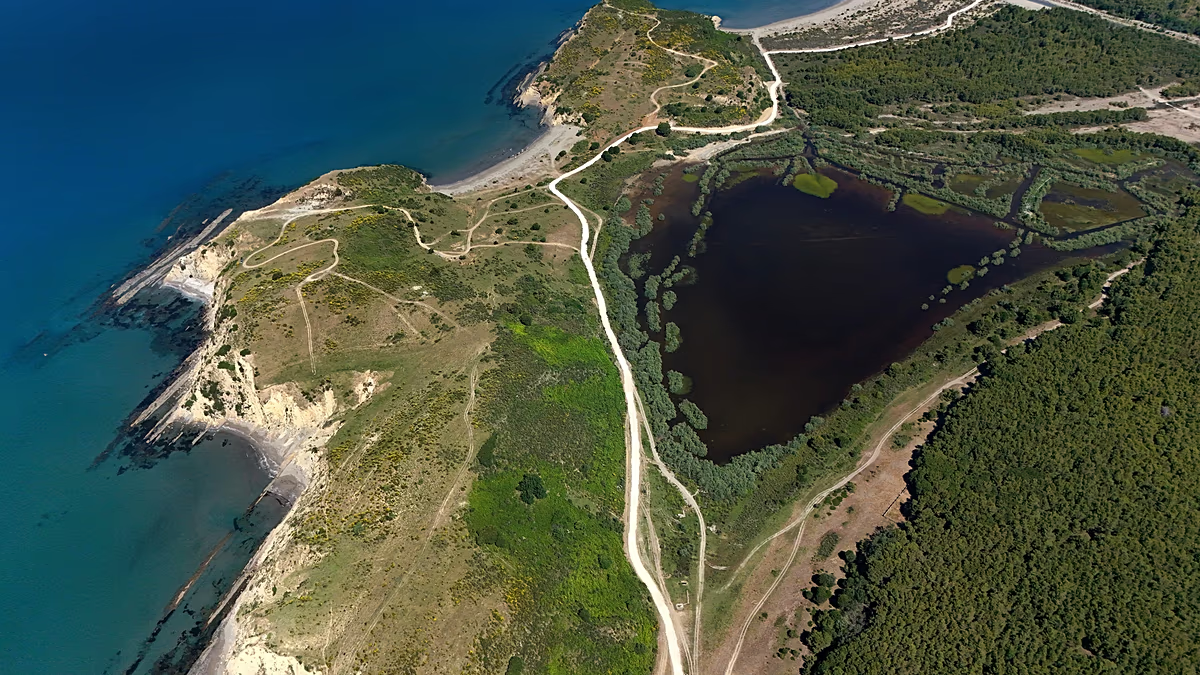
In the picturesque landscape of Albania, a nation celebrated for its rugged coastline and emerging economy, a contentious real estate project has become a crucible for national debate, foreign investment scrutiny, and a storm of dangerous misinformation. The venture, linked to Jared Kushner’s investment firm, Affinity Partners, proposes significant development on the ecologically sensitive Vjosa-Narta wetlands and the uninhabited island of Sazan. Proponents, including the Albanian government, champion it as a transformative engine for tourism and economic growth, a chance to put the country firmly on the global investment map. Conversely, environmentalists and many citizens view it as a profound betrayal, arguing it sacrifices one of Europe’s last wild river ecosystems and a vital habitat for migratory birds and nesting sea turtles at the altar of speculative foreign capital. This clash of visions has created fertile ground for public protest and, more insidiously, for a flood of fabricated narratives that seek to inflame tensions with baseless geopolitical conspiracy theories.
Amidst the legitimate protests, a separate and corrosive campaign of falsehoods has spread rapidly across social media, distorting the reality of the situation with alarming fiction. One particularly inflammatory video, purportedly showing the home of Prime Minister Edi Rama ablaze during demonstrations, was presented as evidence of violent public revolt against his government. In truth, the footage dates back to February 2026 and shows protesters associated with the opposition Democratic Party setting fire to the former villa of the late communist dictator Enver Hoxha—a potent symbol of the past, not an attack on the present leadership. This manipulation of context is a classic disinformation tactic, designed to portray the state as under siege and to radicalize public sentiment by presenting staged or repurposed events as immediate, spontaneous acts of rebellion.
The most pervasive and damaging false claims, however, inject a starkly foreign and inflammatory element into the dispute, alleging secret Israeli involvement in the Albanian project. These theories, devoid of any substantiating evidence, appear fueled by Jared Kushner’s Jewish faith, his past role as a Middle East peace negotiator, and his fund’s investments in Israel. A widely shared image depicted a barbed-wire fence adorned with Albanian and Israeli flags, falsely labeled as a new border on Zvërnec Island. This image was a digital fabrication, a piece of propaganda crafted to visually sell the idea of a foreign annexation. Similarly, videos claimed to show “Israeli settlers” being chased off Albanian land by locals. The reality was far less sensational: the clips documented a separate, local protest against a luxury resort in Velipojë, with no connection to Israel or its citizens whatsoever.
This fabricated narrative escalated to an even more grotesque level with the repeated emergence of a claim that the Kushner-backed development is a covert scheme to relocate Palestinians to Albania. Prime Minister Edi Rama directly and forcefully denied this “total fantasy,” explaining to Euronews that the story imagines a hidden deal between himself, Israeli Prime Minister Benjamin Netanyahu, and Kushner. The persistence of this baseless allegation demonstrates how local development issues can be hijacked and globally weaponized, connecting to unrelated international conflicts to generate outrage. It transforms a complex debate about ecology and economics into a simplified, emotionally charged saga of ethnic displacement and geopolitical conspiracy, making reasoned discussion nearly impossible and poisoning the public discourse.
While these digital falsehoods rage online, the actual project faces very real and serious legal scrutiny that underscores the legitimate concerns of its critics. Albania’s anti-corruption prosecutor has launched a formal investigation, not into fabricated Israeli plots, but into the tangible processes that enabled the venture. The probe focuses on the 2024 legislation that hastily loosened protections for critical ecosystems like Vjosa-Narta, examining the rapid regulatory approvals, the potential for fraudulent property titles, and the questionable transfers of public land. This official investigation validates the core argument of environmental and transparency advocates: that the deal may have advanced through compromised governance, potentially bypassing environmental safeguards and legal due process for the sake of expediency.
The situation in Albania thus presents a stark duality: a real-world confrontation over environmental sovereignty and investment transparency, happening in parallel with a shadow war of incendiary lies. The authentic debate—whether the promised economic benefits outweigh the irreversible ecological damage and whether the deal was struck with integrity—is being drowned out by noise about burning homes, foreign flags, and phantom resettlement plans. This cacophony does a disservice to the Albanian people, distracting from the substantive questions of corruption, conservation, and national interest that truly demand their attention. The path forward requires disentangling the facts from the fiction, focusing judicial and public energy on the concrete findings of the corruption probe, and ensuring that the future of Albania’s natural heritage is decided by evidence and democratic deliberation, not by digital deception or geopolitical fearmongering.