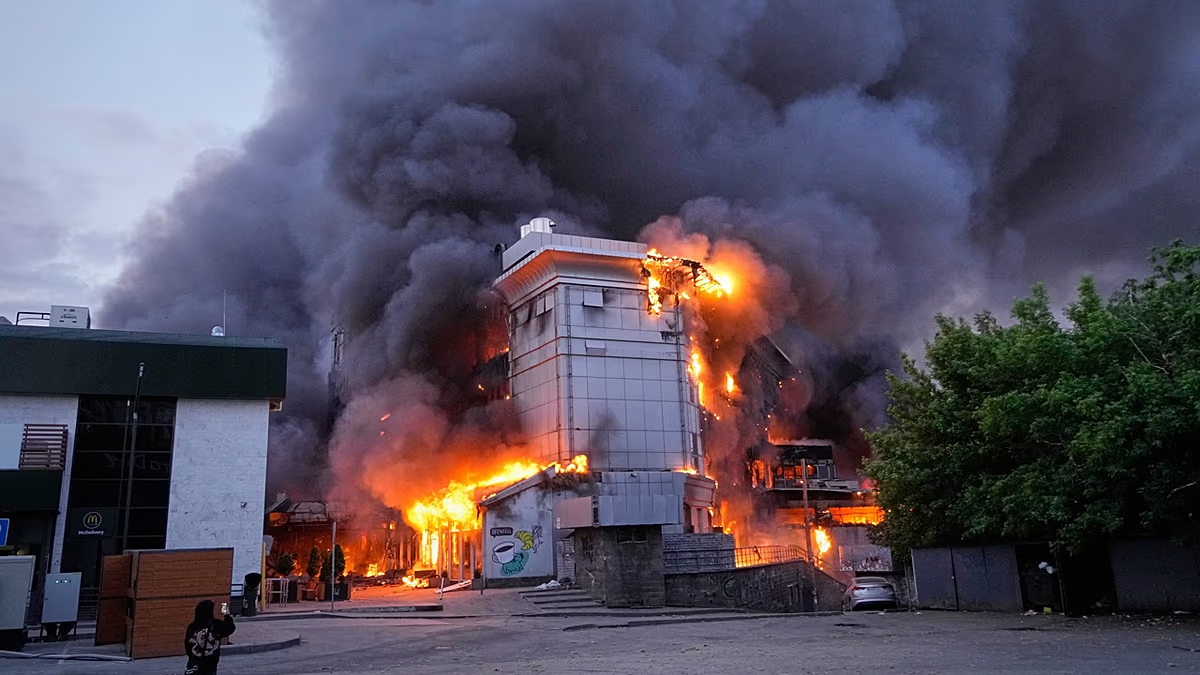



In the early hours of a Sunday morning, the familiar and dreadful sound of air raid sirens once again pierced the stillness over Kyiv. This was not an isolated strike but a massive, coordinated assault, a wave of Russian missiles and drones that descended upon the Ukrainian capital, shattering the night and continuing its terror even after sunrise. The attack, which local authorities described as involving a mix of strike drones, cruise missiles, and ballistic missiles, shook buildings across the city center. The vibrations were felt near government offices, apartment blocks, and schools—places that should be sanctuaries of daily life and governance, now transformed into targets. The human cost began to emerge as the sun rose, with at least one person reported killed and more than twenty injured, a grim tally that captured only the initial toll of a prolonged bombardment.
The damage was widespread and deeply personal, scarring at least nine districts of the capital. Mayor Vitalii Klitschko reported that in the Shevchenko district, a school building where people had sought shelter was itself damaged in the attack—a stark symbol of how war spares no haven. Across the city, the mundane infrastructure of community life, including supermarkets and warehouses, was also hit, promising further hardship in the days to come. The head of the Kyiv military administration, Tymur Tkachenko, conveyed the ongoing anxiety, noting on Telegram that more missiles and drones were expected even as the morning progressed. This relentless pressure creates a state of perpetual dread, where the all-clear signal offers only a temporary, fragile respite.
This overnight barrage occurred against a backdrop of specific and terrifying warnings from Ukrainian intelligence. President Volodymyr Zelenskyy had previously alerted the nation that Russia was preparing to deploy the “Oreshnik” missile—a hypersonic weapon whose name translates to “hazelnut tree.” First used in late 2024, this missile represents a qualitative leap in the threat faced by Ukraine. Russian President Vladimir Putin has boasted of its devastating capabilities, claiming it travels at ten times the speed of sound, “like a meteorite,” and can penetrate deep underground bunkers. Most chillingly, he has stated that several such missiles, even with conventional warheads, could inflict damage comparable to a nuclear strike, all while being, in his words, immune to existing missile defenses. While it was not confirmed if the Oreshnik was used in this particular attack on Kyiv, its looming presence adds a new layer of psychological and strategic terror to an already brutal conflict.
Moscow framed this intense retaliation as a response to what it called an “inevitable and severe punishment” for a separate event. Russian authorities accused Ukraine of striking a college dormitory in the Russian-occupied town of Starobilsk in eastern Ukraine, an attack they claimed killed 18 people. Ukraine firmly denied targeting civilians, asserting instead that its forces had hit a legitimate military target: a unit operating Russian “Rubicon” drones stationed in that area. This cycle of claim and counterclaim, of attack and reprisal, underscores the war’s brutal logic where civilian areas are repeatedly caught in the crossfire. Regardless of the specifics in Starobilsk, the assault on Kyiv fits a long-established pattern of Russian forces launching mass barrages against Ukrainian cities, consistently damaging civilian infrastructure and claiming innocent lives since the full-scale invasion began in 2022.
The relentless nature of this conflict, now stretching into its fifth year, continues amidst a concerning shift in the international diplomatic landscape. Efforts led by the United States to negotiate an end to the fighting have notably slowed in recent months. Global attention, and crucially, diplomatic bandwidth, has been diverted by other escalating crises, particularly the conflict in the Middle East. This diffusion of focus creates a dangerous vacuum, one that can be exploited by aggressors to intensify military campaigns with a perceived reduction in immediate international consequence. For the people of Kyiv, emerging from shelters to assess the damage to their schools and homes, this geopolitical shift feels distant yet profoundly personal, as it may translate to a longer war and more nights of terror.
In the end, the news from that Sunday morning is a stark snapshot of a war that has settled into a horrific rhythm. It is a story of advanced hypersonic missiles and crude drones, of geopolitical posturing and street-level devastation, of warnings issued and tragedies realized. Behind the statistics of one killed and over twenty wounded are individuals with stories abruptly altered—families grieving, neighbors injured, children whose place of learning is now a crime scene. As the world’s attention wavers and pivots, the people of Ukraine remain under the fire, their resilience tested by each new wave of attacks, their future uncertain, and their daily reality defined by the echo of explosions and the struggle to rebuild, yet again, from the rubble.