


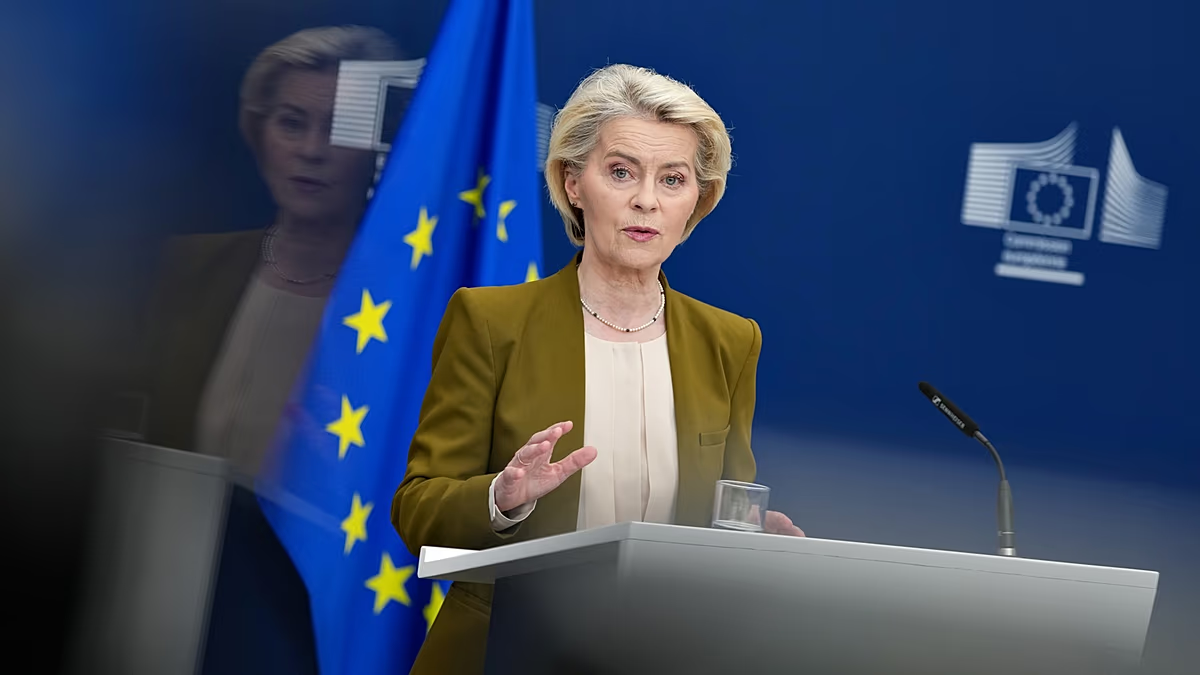
The European Commission, under President Ursula von der Leyen, has introduced a significant new proposal aimed at intensifying economic pressure on Russia. This fourteenth package of sanctions, unveiled amidst a renewed Russian offensive against Ukrainian cities, seeks to close existing loopholes and target key revenue streams still funding the Kremlin’s war machine. The overarching goal, as von der Leyen starkly stated, is to maintain the “full intensity” of Western sanctions, forcing Russia to bear an ever-heavier price for its aggression. The proposal arrives at a critical diplomatic juncture, as Ukrainian President Volodymyr Zelenskyy has called for direct negotiations with Vladimir Putin, an initiative backed by European leaders but predicated on a prior ceasefire. These new measures are thus framed not only as punitive but as a means to push Moscow toward the negotiating table by systematically weakening its economic and military foundations.
A central and strategically crucial element of this package targets the complex machinery of Russian oil exports. The EU, in alliance with the G7 and Australia, has since December 2022 enforced a price cap on Russian seaborne oil, designed to limit Moscow’s revenues while keeping crude flowing to global markets to avoid price spikes. However, recent geopolitical turbulence, particularly the blockade in the Strait of Hormuz, has driven the global price of Russia’s Urals blend to around $87 per barrel. Under the existing rules, this would trigger an automatic upward adjustment of the cap on July 15th, inadvertently granting Russia a windfall. To prevent this, the Commission proposes an unprecedented pause: freezing the cap at its current level of $44.10 per barrel and delaying any review until January 2027. This move is a frank admission that the dynamic adjustment mechanism was not designed for such market shocks and aims to preserve pressure on Russian coffers while markets stabilize.
Simultaneously, the proposal signals a tactical retreat on another front. Earlier ambitions for a comprehensive EU ban on maritime services—like insurance, shipping, and banking for Russian oil carriers—have effectively been shelved due to resistance from key member states like Greece and Malta, and a lack of enthusiasm from other G7 partners. Instead, the Commission is shifting its focus to more aggressively combat Russia’s “shadow fleet.” This clandestine armada of often dilapidated, aging tankers operates outside Western regulations, enabling Moscow to bypass the price cap. The new package seeks to blacklist 30 specific vessels from this fleet, denying them access to EU ports and services, and extends sanctions to other ships and infrastructure—like ports and refineries—that assist their operations. By targeting these tangible enablers, the EU hopes to mitigate the environmental and security risks posed by these unsafe vessels while choking off a vital artery of sanction evasion.
Beyond the energy sector, the draft sanctions cast a wide net. They propose targeting 31 Russian banks and, notably, over 20 cryptocurrency firms, platforms, and foreign oil traders accused of facilitating financial evasion. This acknowledges the evolving battlefield of finance, where digital assets have become a tool for circumventing traditional banking restrictions. On the trade front, the package includes further export bans on metals, alloys, and components critical for Russia’s defence industry. In a new move, it also envisages import bans on certain Russian fish products, directly targeting another revenue source. A particularly symbolic measure is the proposed EU-wide ban on granting Schengen area visas to Russian soldiers who have participated in the invasion, an initiative led by Estonia that translates moral condemnation into a tangible personal consequence for those directly involved in the aggression.
The path to implementing these measures, however, is fraught with the challenge of unanimous agreement among all 27 EU member states. While officials hope for approval before the July 15th deadline to avoid the automatic oil price cap adjustment, past negotiations have revealed divergent national interests. The shelving of the full maritime services ban highlights how economic stakes, such as those of coastal nations with large shipping registries, can dilute broader strategic objectives. Furthermore, the reported exclusion of European exports of alumina—a key material for arms production—from the current package, despite controversy over supplies from an Irish plant, illustrates the persistent difficulty in severing all profitable economic links. Each new sanctions round becomes a delicate balancing act between maximizing pressure and maintaining European unity.
President von der Leyen’s announcement ultimately serves as a declaration of sustained European resolve. As she asserted, the objective is clear: to keep “biting hard and cutting deep” into the economic foundations of Russia’s war effort. This package represents a nuanced, adaptive response—fortifying existing tools like the oil price cap, aggressively pursuing shadow fleet operators, and expanding into new domains like cryptocurrency and individual accountability for soldiers. It is a strategy of relentless economic attrition, launched in parallel with diplomatic support for a potential peace process. The underlying message to the Kremlin is that the costs of its war will only escalate, and the avenues to fund it will only narrow, until it chooses the path of ceasefire and genuine negotiation.