


Here is a summary and humanization of the provided content, expanded to six paragraphs.
The ongoing war in Ukraine continues to escalate beyond the frontlines, manifesting in a fierce and reciprocal campaign targeting each nation’s economic and energy infrastructure. In a strategic move designed to impose a tangible cost on Russia for its full-scale invasion, Ukrainian forces have launched a series of audacious strikes deep into Russian territory and occupied Crimea. Officials in Kyiv confirmed these operations, which specifically hit key oil facilities, including the significant Grushovaya transshipment hub in Russia’s Krasnodar region and storage bases on the Crimean Peninsula. These sites are not just economic assets; they are vital logistical nodes for the Russian military machine, making them high-value targets in Ukraine’s effort to disrupt enemy supply lines and fuel reserves.
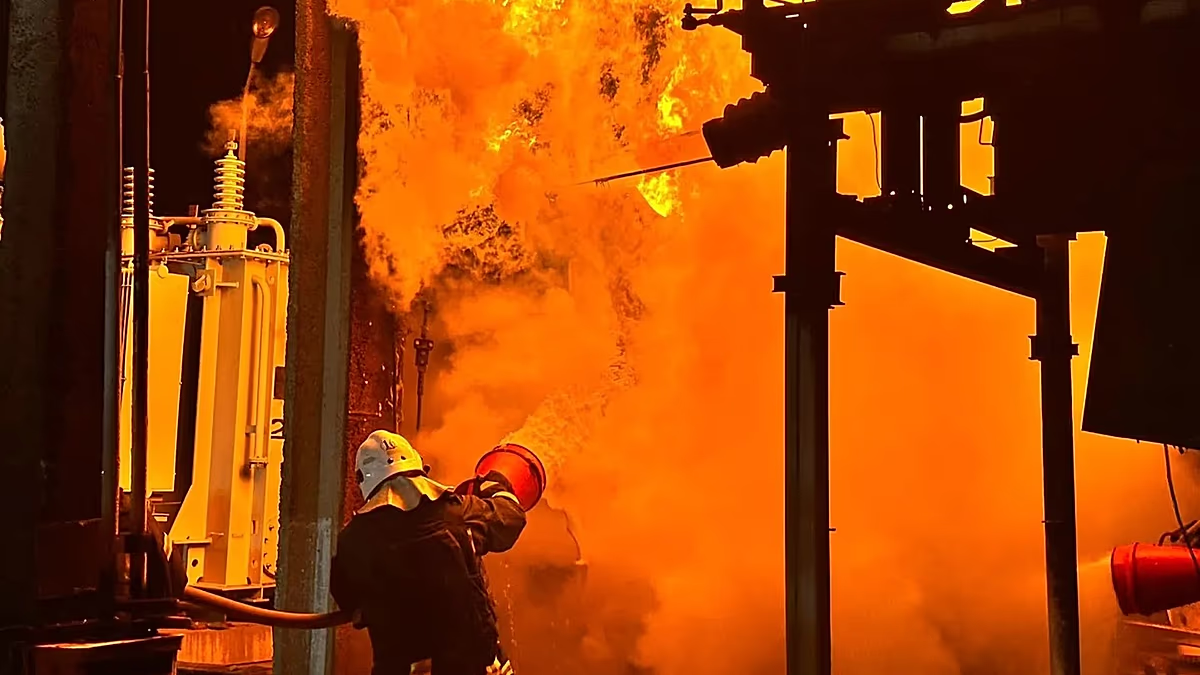
The human and immediate material impact of these Ukrainian strikes was starkly visible. In the aftermath, fires raged at multiple facilities, with images and reports confirming substantial damage. Russian regional authorities, while acknowledging the attacks and mobilizing over a hundred rescue workers to combat the blazes, sought to downplay the long-term consequences. However, the concerned response from the Kremlin itself betrayed a deeper anxiety. When questioned about emerging fuel problems in Crimea, spokesman Dmitry Peskov admitted to “certain problems,” confirming that the government was scrambling to implement countermeasures. This public admission highlighted the very real pressure Kyiv is applying, attempting to strain the Russian economy and create logistical fissures even in occupied territories.
Yet, this conflict is a tragic two-way street of devastation, and the human cost on Ukrainian soil remains agonizingly high. Even as Ukraine executed these long-range strikes, Russian forces continued their relentless bombardment of Ukrainian cities and communities. In the northeastern Kharkiv region, a brutal attack on the city of Chuguiv killed three civilians and wounded ten others. The violence was indiscriminate and devastating, destroying vehicles, shattering windows, and scarring residential buildings. This episode is not an anomaly but part of a horrific pattern that has intensified in recent months, with daily attacks claiming innocent lives and spreading terror far from the battlefield.
The staggering toll of this war on civilian life is a somber record of its inhumanity. According to United Nations estimates, at least 15,850 civilians have been killed in areas under Ukrainian control since the invasion began, with over 2,800 more dying in Russian-occupied zones. When the wounded are included, the number of non-combatants whose lives have been shattered surpasses 44,800. These are not abstract statistics; they represent individuals, families, and communities irrevocably broken, underscoring the war’s profound human tragedy that unfolds alongside the military and strategic maneuvers.
In response to Russia’s aggression, the international community continues to exert economic and diplomatic pressure through sustained sanctions. The European Union is preparing a new package aimed at further crippling Moscow’s war effort. As outlined by EU foreign policy chief Kaja Kallas, these measures target an additional 80 entities and individuals linked to Russia’s military-industrial complex, as well as its propagandists and human rights violators. The cumulative effect of Western sanctions, according to Kallas, has already cost the Russian economy an estimated $1.2 to $1.5 trillion—a massive financial drain intended to degrade its capacity to wage war.
This current phase of the conflict illustrates a grim and complex dynamic. Ukraine, defending its sovereignty, is leveraging innovative tactics to strike at the logistical and economic foundations of a much larger aggressor, aiming to balance the scales. Meanwhile, Russia persists with devastating attacks that primarily wound civilian populations. Amid this violent exchange, the international community works to uphold a rules-based order through economic means. The situation remains a volatile and painful stalemate, where strategic oil depots blaze and apartment buildings crumble, each explosion echoing the war’s dual nature as a clash of military strategy and a profound humanitarian catastrophe.