



The Oreshnik Missile and a Widening Divide: European Security Enters a New Era
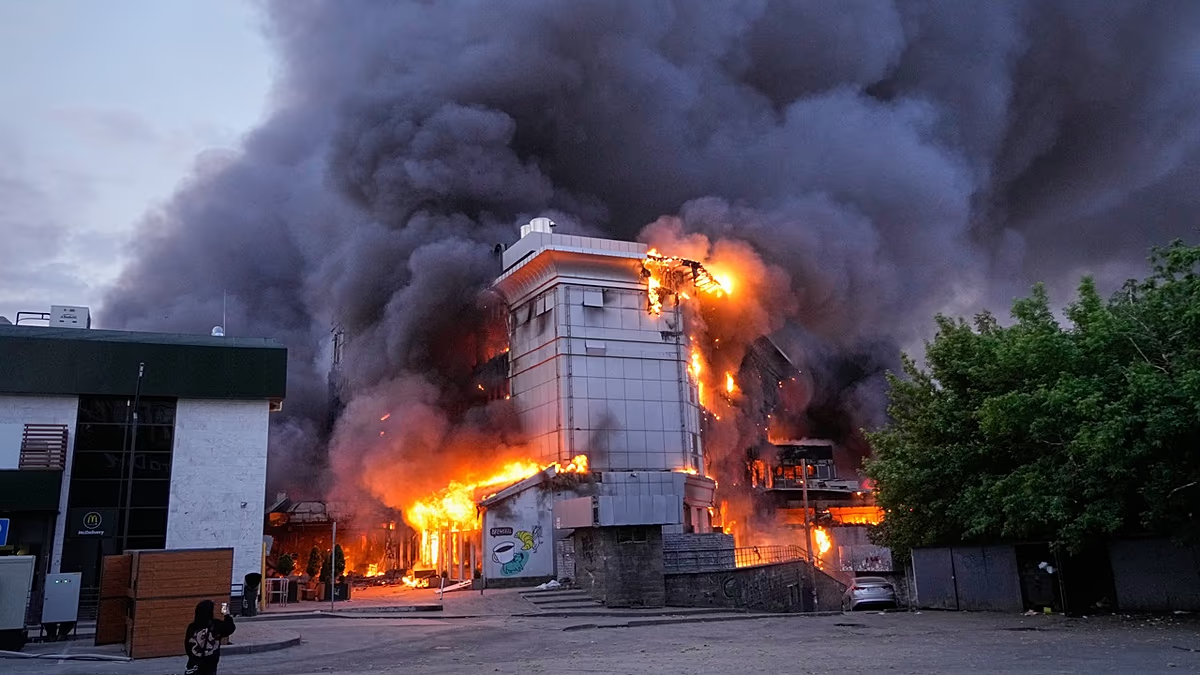
The European security landscape has been fundamentally and grimly reshaped by the overnight confirmation from Moscow that its military deployed the Oreshnik intermediate-range ballistic missile in strikes against Ukraine. This development, more than a mere tactical escalation, has ignited a political firestorm across Europe. French President Emmanuel Macron, alongside senior EU officials, reacted with “fierce criticism,” framing the use of such a weapon as a deliberate provocation that shatters established norms and redraws the boundaries of conventional warfare on the continent. The episode is not an isolated military action but a stark signal, pulling a once-shadowy weapon system into the harsh light of geopolitical reality and forcing a recalculation of national security postures from the Baltic to the Black Sea.
The Oreshnik, a name derived from the Russian word for “hazel tree,” now occupies a central and menacing position in the Kremlin’s arsenal. First unveiled in a 2024 strike on the Ukrainian city of Dnipro, it has since evolved into what analysts describe as one of Russia’s most closely monitored strategic assets. Russian President Vladimir Putin has personally championed the system, labeling it a “state-of-the-art” weapon capable of carrying multiple, independently targetable warheads and achieving hypersonic velocities. This public glorification is a key part of its utility: the Oreshnik serves as both a physical weapon and a psychological tool, designed to project an image of insurmountable technological prowess and to instill doubt in the defensive capabilities of NATO and allied nations.
The specific capabilities that make the Oreshnik a subject of such intense concern are rooted in its range and payload. Classified as an intermediate-range ballistic missile (IRBM), it boasts an operational reach estimated between 3,000 and 5,500 kilometers. This places virtually all of continental Europe, including major political and financial capitals, within its potential strike zone—a fact underscored by Belarusian leader Alexander Lukashenko’s acknowledgment of its deployment on Belarusian territory, effectively extending Russia’s strategic reach westward. Furthermore, while its initial use in Ukraine appeared to involve conventional or inert warheads, Russian authorities explicitly state the Oreshnik is nuclear-capable. This dual-capability creates a perilous ambiguity; any future launch would force targeted nations to instantly determine the nature of the incoming warhead, compressing decision-making timelines in a crisis and dramatically raising the stakes of any conflict.
Perhaps the most daunting characteristic of the Oreshnik, according to Russian claims, is its purported invulnerability to existing defensive shields. The Kremlin asserts the missile can travel at speeds approaching Mach 10, or ten times the speed of sound. At such hypersonic velocities, the window for detection, tracking, and interception by current-generation air and missile defense systems is reduced to mere seconds, calling their effectiveness into serious question. While experts from institutions like the Center for Strategic and International Studies note that achieving hypersonic speeds is not unprecedented for ballistic missile re-entry vehicles, the combination of this speed with the missile’s potential for advanced maneuverability presents a unique and formidable challenge. This perceived defensive evasion capability is central to the weapon’s strategic value, as it threatens to undermine decades of investment in continental missile defense.
The origins of the Oreshnik are shrouded in the typical secrecy of advanced Russian weapons programs, but analysis points to a deliberate and rapid development path. The U.S. Department of Defense assesses it as an experimental system evolved from Russia’s RS-26 Rubezh road-mobile intercontinental ballistic missile program. Putin, however, vehemently rejects any notion that it is merely a modernized Soviet-era design, insisting instead that it represents a completely new weapon developed under a direct order issued in 2023. This narrative of indigenous, cutting-edge innovation is politically crucial for the Kremlin, serving to demonstrate self-sufficiency, technological leap-frogging, and a resurgent military-industrial complex capable of producing weapons that define new eras of warfare.
In conclusion, the deployment of the Oreshnik missile represents a critical inflection point. It transcends the immediate tragedy of the war in Ukraine, acting as a live-fire demonstration of capabilities that directly threaten broader European security architecture. The fierce diplomatic reaction from France and the EU underscores a dawning realization: the continent is now facing a permanent, stationed threat from a class of weapons that blurs the line between conventional and nuclear conflict and challenges the very foundations of collective defense. The Oreshnik is more than a missile; it is a geopolitical statement, compelling NATO allies to urgently re-evaluate deterrence strategies, invest in next-generation defense technology, and prepare for a future where such systems are an enduring feature of a fractured and more dangerous security environment.