



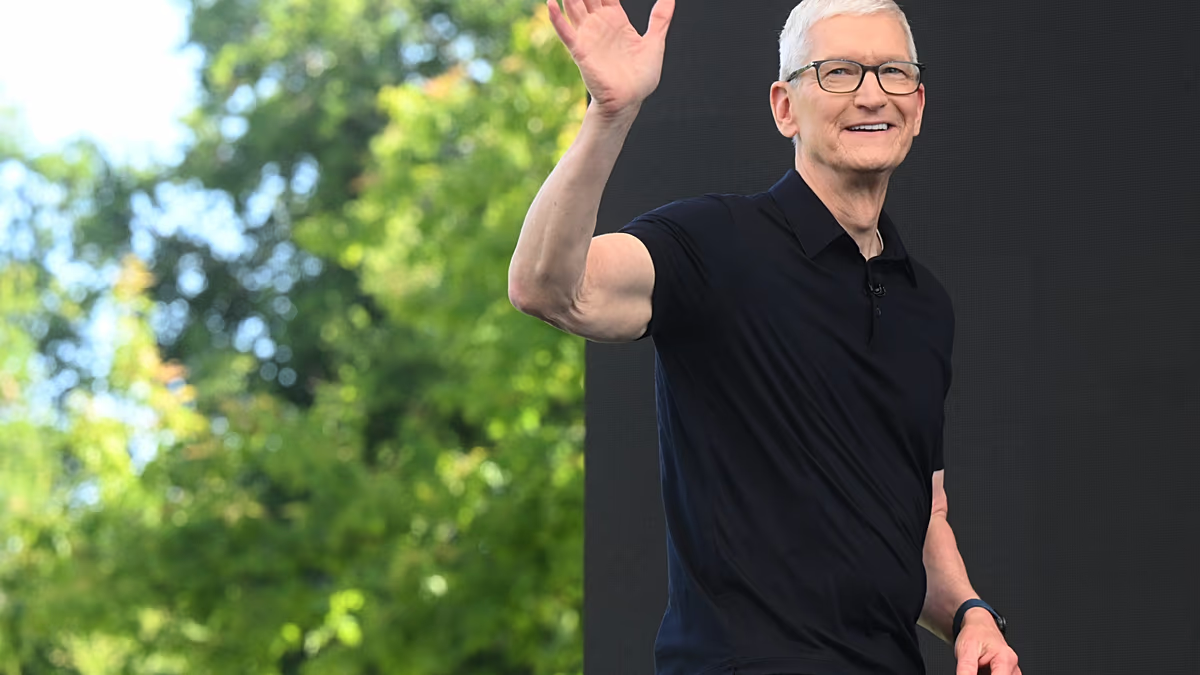
The annual World Wide Developers Conference (WWDC) is always a focal point for Apple enthusiasts and industry watchers, and this year’s event carried a unique historical weight. It served not only as a showcase for the company’s long-anticipated foray into advanced artificial intelligence but also as a poignant farewell to CEO Tim Cook. As he prepares to hand over the reins to John Ternus in September, Cook received an extended, emotional standing ovation from the audience. He expressed his deep gratitude for the journey and asserted his belief that “the best is still ahead” for Apple, even as the company navigates a critical technological transition.
The centerpiece of the announcements was a comprehensive AI overhaul, spearheaded by a transformative update to Siri. Dubbed simply “Siri AI,” this new iteration represents a quantum leap from the often-limited digital assistant of the past. It is designed to be a deeply integrated, context-aware companion. The new Siri can analyze content on a user’s screen and draw upon personal data from across Apple’s ecosystem to provide genuinely helpful assistance. Apple demonstrated this with practical examples: Siri could now plan a party menu by gathering recipes from the web and a user’s own text messages, or use the camera to identify food and provide its nutritional information. This focus on tangible, everyday utility underscored Apple’s distinct philosophy in a crowded AI field.
Indeed, Apple took clear aim at competitors during the keynote. Software chief Craig Federighi, without naming specific companies, criticized approaches that seem to prioritize technological spectacle over user benefit. He stated Apple’s conviction that “truly helpful AI should be centred around you and your needs.” This principle manifests in two key ways: deep integration into the fabric of Apple’s operating systems and an unwavering commitment to on-device processing and privacy. The company is not building an AI in isolation; it announced a partnership with Google to power some of Siri’s new capabilities, a pragmatic move to accelerate its catch-up efforts. Other AI enhancements included more powerful photo editing tools, like spatial photo reframing, which allows users to adjust a photo’s composition after the fact.
However, the rollout of these ambitious features will not be immediate or universal. Apple announced that the standalone Siri AI app and many system-wide integrations will launch in a beta test later this year. Notably, this initial release will exclude the European Union and China, as the company works through complex regulatory landscapes in those regions. This cautious, staged approach highlights the challenges of deploying powerful AI at a global scale, especially for a company that places a premium on data security and local compliance.
The transition in leadership adds another layer of significance to this moment. Tim Cook’s tenure, beginning in 2011, oversaw an era of unprecedented financial growth, with Apple’s market value soaring by trillions of dollars. Yet, his final WWDC as CEO underscored the pivotal challenge facing his successor. The disruptive wave of generative AI has reshaped the tech industry, and Apple has been perceived as a cautious follower rather than a leader in this space. John Ternus, a 25-year Apple veteran who has led hardware engineering for the iPhone, iPad, and Mac, is now tasked with steering the company through this next chapter. His absence from the main stage this year signals a continuation of Cook’s legacy, even as the baton is passed.
In conclusion, Apple’s 2024 WWDC was a defining event that balanced reflection with a roadmap for the future. It honored Tim Cook’s transformative leadership while unveiling a pragmatic, user-centric vision for artificial intelligence. By focusing on seamless integration, practical assistance, and privacy, Apple is staking its claim in the AI race on its own terms. The success of this strategy now rests on the execution by the incoming CEO and his team, as they work to prove that the company can once again redefine a technology for the masses, just as it did with the smartphone. The message was clear: Apple is entering the AI era not with flashy demos, but with a promise of building tools that thoughtfully enhance the daily lives of its users.