


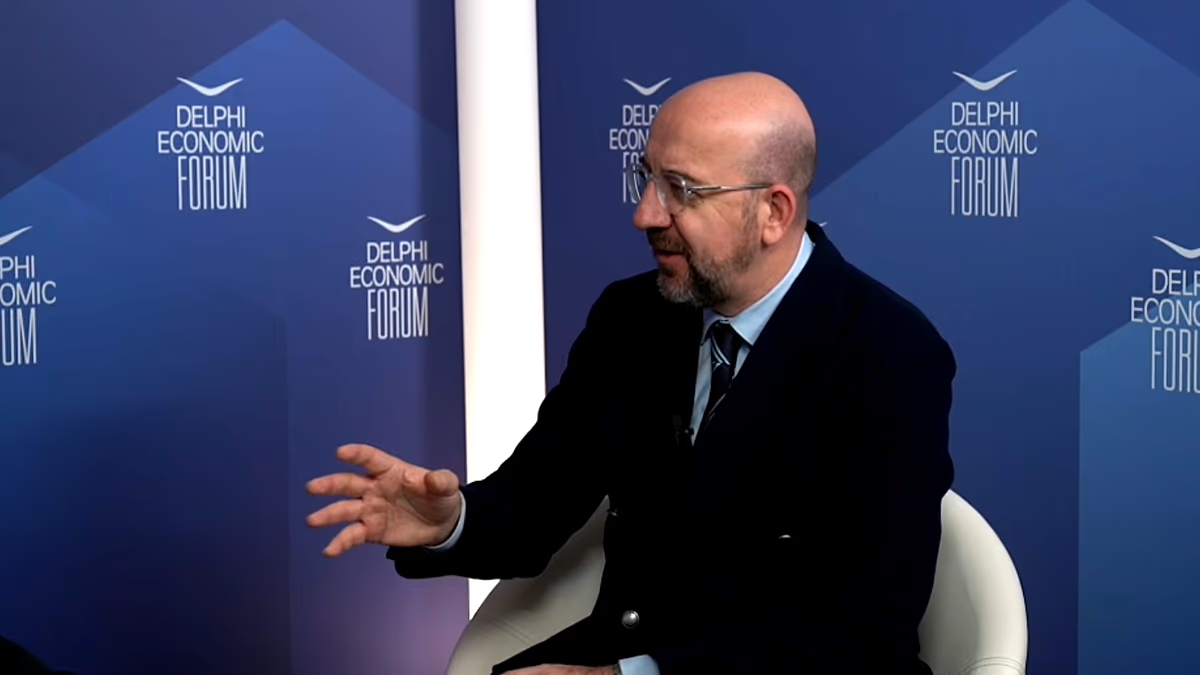
In an era of geopolitical uncertainty and internal strain, former European Council President Charles Michel has issued a thoughtful caution against a growing impulse within the European Union: the push to eliminate the national veto. Having steered the institution that brings together EU leaders from 2019 to 2024, Michel possesses a deep, operational understanding of the bloc’s complexities. He warns that the “European dream” itself is fundamentally sustained by the arduous but necessary process of achieving collective agreement among all 27 member states. His frustration is palpable for those, like himself, who are unwavering believers in the European project; they see the clear path forward yet are constantly hindered by procedural delays. Michel observes a culture of procrastination, where legitimate disagreements can sometimes serve as a convenient excuse for inaction, a tendency he finds deeply regrettable as it stalls crucial responses to global challenges.
The debate over unanimity has been sharply brought into focus by the protracted process of Ukraine’s EU membership bid. Since applying in the wake of Russia’s full-scale invasion in 2022, Ukraine’s accession talks have faced repeated delays, primarily due to vetoes from Hungary under former Prime Minister Viktor Orbán. This has led to immense frustration and sparked discussions about potential alternative membership formats should full unanimity prove impossible. Notably, Ukrainian President Volodymyr Zelenskyy has acknowledged these behind-the-scenes conversations but has firmly and publicly rejected any notion of a secondary or “symbolic” membership, insisting on the goal of full, unequivocal integration into the European family.
Interestingly, Michel suggests that Orbán’s recent electoral defeat may not be the simple cure for EU disunity that some hope for. While he expresses hope for more united councils in the future, he provides a sobering analysis: Orbán often served as a convenient shield for other leaders. Michel points out that elements of Orbán’s political stance, particularly regarding the war in Ukraine and skepticism of deeper integration, are shared to varying degrees by other figures around the table. Therefore, removing one vocal critic does not automatically dissolve the underlying ideological fractures; the challenge of building consensus would remain, even if it becomes somewhat less overtly contentious.
At the heart of Michel’s argument is a principled defense of the veto power, not as a tool for obstruction, but as a foundational pillar of a union of sovereign states. He stresses that the mechanism, enshrined in the Treaty of Lisbon, was designed for grave matters where vital national interests are genuinely at stake. His warning is against its misuse—its deployment for tactical political gain rather than matters of profound national consequence. He acknowledges the obvious: “Unanimity is a challenge, there is no doubt.” It is slow, it is messy, and it can empower a single dissenting voice to halt the entire group. In a world demanding swift action, this friction is a significant liability.
However, Michel urges the bloc to “think carefully” before abandoning this core principle. His central concern is about legitimacy and global influence. He argues that the relentless, often frustrating work to bring every country on board is what grants EU decisions their profound weight. If the union moves to majority voting on sensitive issues like foreign policy, security, or taxation, it risks creating a two-tier Europe where smaller or dissenting states are simply overruled. This, Michel cautions, could fatally weaken the EU’s cohesion and, consequently, its credibility and power on the international stage. A decision imposed by a majority lacks the moral and political authority of one forged by consensus, potentially making the bloc appear divided and less dependable to partners like the United States or rivals like China.
Ultimately, Charles Michel’s intervention is not a defense of stagnation, but a plea for intentionality and strength through unity. He frames the choice not as one between efficiency and paralysis, but between a cohesive, influential union and a potentially fractured, weakened one. The path of unanimity is undoubtedly harder. It requires extraordinary diplomacy, patience, and compromise. Yet, in his view, it is the very difficulty of this path that forges the authentic, collective will necessary for the European project to endure and thrive. The quest for a more effective EU must, therefore, first focus on reinvigorating the spirit of compromise and common purpose, rather than hastily dismantling the rules that bind its diverse nations together in a common endeavor.