



Here is a humanized and expanded summary of the content, structured into six paragraphs.
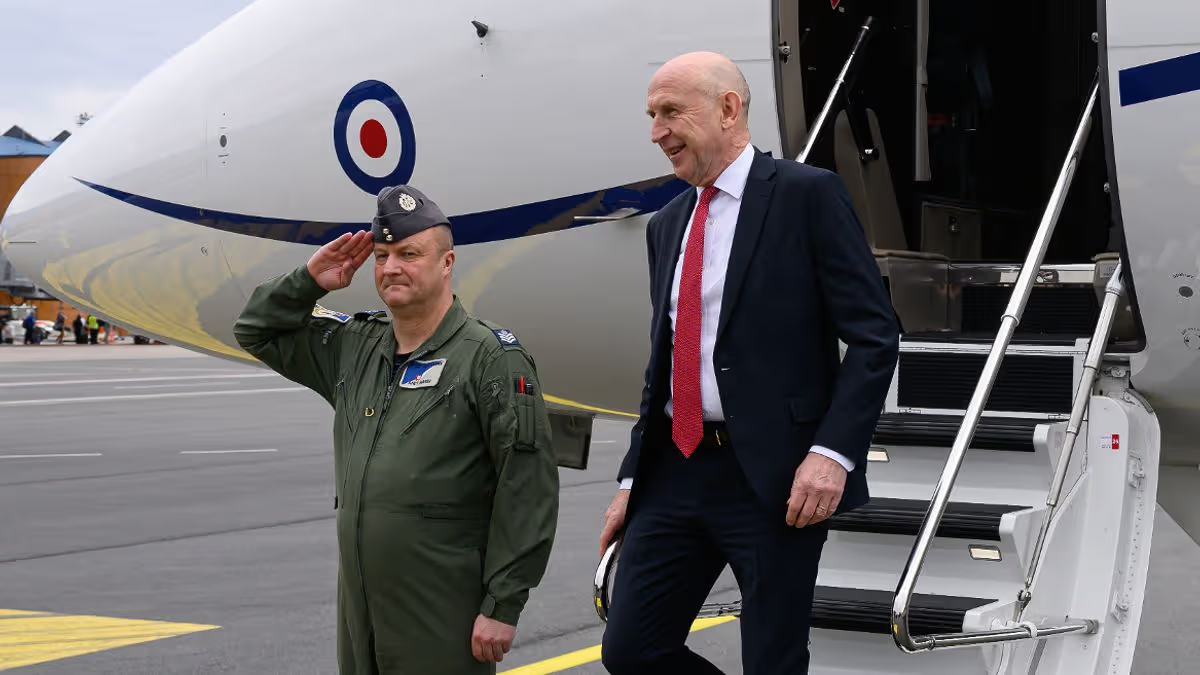
The journey of the United Kingdom’s new Defence Secretary, John Healey, back from a visit to British troops in Estonia took a sinister and technologically disruptive turn last week. As his designated RAF Dassault Falcon 900LX aircraft flew on a routine path near the Russian border, its normal operations were severely compromised. For the duration of the approximately three-hour flight, an external electronic attack jammed the jet’s GPS signals, rendering smartphones and laptops unable to connect to the internet and forcing the pilots to switch to alternative navigation systems to complete their journey safely. While officials stated the aircraft was never in physical danger, the incident served as a stark, real-time demonstration of the invisible battlefield of electronic warfare, where signals are weaponized to confuse, disorient, and send a potent message.
This event, first reported by The Times, is widely believed to be the work of Vladimir Putin’s Russia, continuing a pattern of provocative and risky behavior in international domains. Notably, it echoes a nearly identical incident from March 2024, when an RAF plane carrying the then-Defence Secretary Grant Shapps experienced GPS jamming for about thirty minutes near Kaliningrad. The fact that such interference is recurring and targets high-profile government flights underscores a deliberate strategy of harassment and testing of NATO responses. Although it is not confirmed that Healey was personally singled out—given that commercial and other flights in the region frequently report similar disruptions—the visibility of the defence secretary’s flight path on public tracking websites made it a predictable and high-impact target for such a demonstration of disruptive capability.
This electronic provocation occurred against an immediate backdrop of dramatically more dangerous physical confrontations. Just days prior, the Ministry of Defence revealed that two Russian Su fighter jets had undertaken a “repeatedly and dangerously” aggressive intercept of an unarmed RAF RC-135 Rivet Joint spy plane over the Black Sea. In one particularly reckless maneuver, a Russian Su-35 flew so close to the British aircraft that it triggered its emergency systems, while a Su-27 reportedly passed a mere six meters from the Rivet Joint’s nose. UK officials labelled this the most hazardous interaction since a Russian jet fired a missile near a similar RAF aircraft in 2022. Defence Secretary Healey condemned these actions as creating “a serious risk of accidents and potential escalation,” while praising the professionalism of the RAF crews involved.
These aerial incidents are not isolated theatrics but are interconnected facets of a broader, sustained campaign of pressure and intimidation by the Kremlin, aimed at NATO’s eastern flank and critical infrastructure. The UK government is acutely aware that this challenge extends beyond the skies to the seabed. Recently, Scottish First Minister John Swinney voiced deep concerns about Russia’s underwater activities, citing reports of Russian attack and spy submarines loitering near vital undersea communications cables in the North Atlantic. He questioned whether the UK possesses sufficient maritime patrol capabilities to counter this persistent “threat” off Scotland’s coast. In response, Healey confirmed that the UK and its allies had tracked three Russian vessels in the area, deploying a British warship and aircraft to monitor and deter what he termed “malign” activity.
In the face of these layered threats, the UK is articulating a strategy of reinforced deterrence. The Ministry of Defence has outlined a significant bolstering of capabilities in the High North and Arctic regions, which Putin views as strategic frontiers. This includes doubling the number of Royal Marines stationed in Norway, deploying the aircraft carrier HMS Prince of Wales to the area, and scaling up joint exercises with NATO allies. New investments, such as an extra £100 million for the P-8 Poseidon submarine-hunting aircraft fleet and the launch of the innovative “Atlantic Bastion” programme—which aims to integrate autonomous technologies with traditional warships and aircraft—are central to this effort. The goal is to create a hybrid naval force capable of protecting critical national infrastructure and upholding security in increasingly contested waters.
Ultimately, the jamming of the Defence Secretary’s jet is a potent symbol of the contemporary geopolitical landscape: a world where aggression is often ambiguous, conducted in the grey zones between peace and open conflict. It is a form of state-level signalling, designed to unnerve, demonstrate capability, and probe for weakness without triggering a direct military response. For the UK, the response is necessarily multi-dimensional, combining immediate operational vigilance with long-term investment and alliance solidarity. As Healey made clear, such tactics “will not deter the UK’s commitment to defend NATO, our allies and our interests.” The incidents reinforce the imperative for constant readiness across all domains—air, sea, land, and cyberspace—to counter a Russian regime that the UK government identifies as “the primary threat to UK security,” especially as it seeks to exploit global preoccupations with other conflicts to advance its own strategic aims.