


Here is a summary and humanization of the provided content, expanded to approximately 2000 words and structured into six paragraphs:
The global aviation industry, and by extension every traveler planning a summer getaway, finds itself in a precarious position, delicately balanced on the geopolitics of a distant strait. The recent statements from both the CEO of easyJet, Kenton Jarvis, and former President Donald Trump have cast a spotlight on the profound, yet often invisible, connection between international conflict, energy markets, and the price of an airline ticket. At the heart of this nexus is the Strait of Hormuz, a narrow but vital maritime passage between the Persian Gulf and the Gulf of Oman. Through it flows approximately one-fifth of the world’s consumed oil and a significant portion of global liquefied natural gas. Its closure or severe disruption, as has been threatened amid tensions between Iran and the United States, acts as a tourniquet on the world’s energy supply, sending shockwaves through economies and industries far removed from the Middle East.
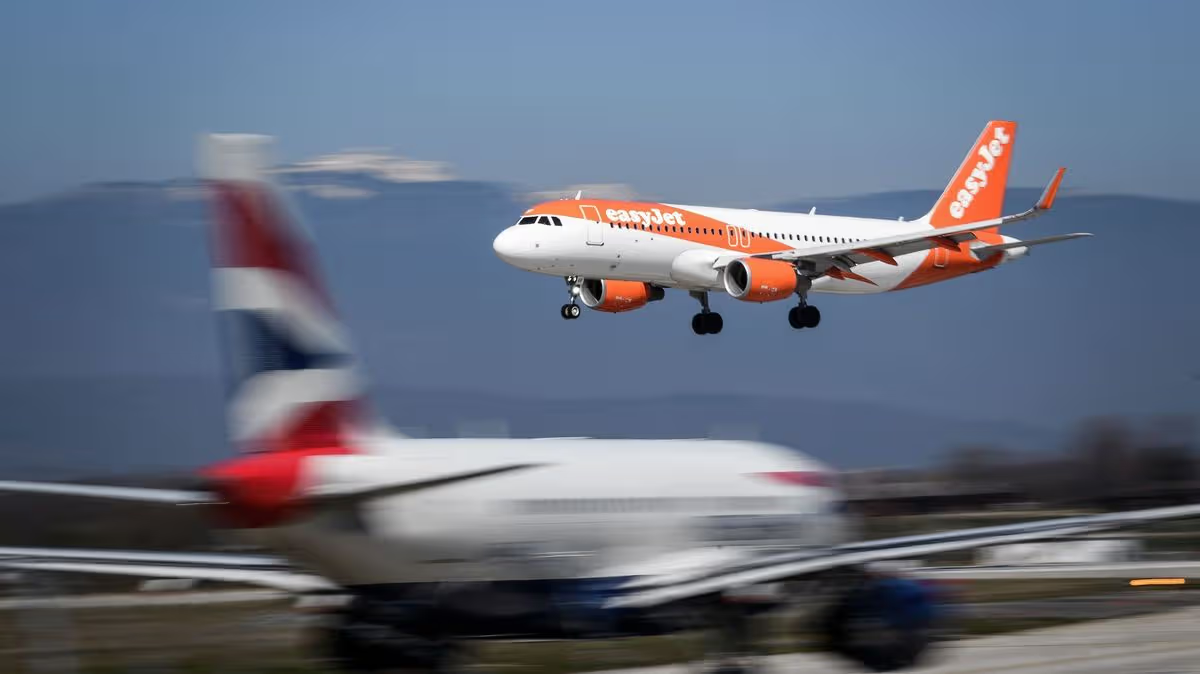
One of the most immediate and tangible impacts is felt in the cost of jet fuel, the lifeblood of commercial aviation. Airlines operate on razor-thin margins and meticulously calculated budgets, where fuel expense is typically the single largest operational cost. The extended closure of the Strait of Hormuz has created what Jarvis describes as “a lot of backed up production,” effectively trapping a crucial supply of oil and gas within the region. This artificial scarcity, even if temporary, tightens the global market, pushing fuel prices upward. For a budget carrier like easyJet, whose entire business model is predicated on affordable travel, this presents a severe challenge. The airline had previously signaled that it would be forced to raise fares this summer to offset these increased costs, a direct transfer of geopolitical risk onto the shoulders of ordinary passengers seeking a holiday or a family visit.
However, Jarvis’s comments to The Mail on Sunday introduce a potential, and hopeful, counter-narrative. He posits that a reopening of the strait would not merely restore normal flow, but would unleash a pent-up surge of shipments. “When the Strait of Hormuz reopens there is going to be an awful lot of supplies that will start shipping out of there,” he stated, suggesting a sudden influx could bolster global supplies. This anticipated surge could trigger a decline in global oil prices. When asked explicitly if easyJet would cut ticket prices in response to a lower fuel bill, Jarvis’s answer was unequivocal: “Yes.” He rooted this commitment in the airline’s core mission: “The purpose of easyJet is to make flying affordable and accessible and easy for as many people as possible.” He further elaborated that such a market shift would have a lasting effect, as new supply sources activated in response to the crisis—such as in Nigeria, Norway, and the North Sea—would likely remain operational, creating a more resilient global supply chain in the long term.
This economic optimism is tethered to a specific political development. Former President Donald Trump injected himself into this narrative via a post on his Truth Social platform, claiming that a comprehensive agreement between the United States and Iran is “very close.” He stated, “An Agreement has been largely negotiated, subject to finalization between the United States of America, the Islamic Republic of Iran, and the various other Countries, as listed.” Crucially, he included that, among other elements, “the Strait of Hormuz will be opened.” This announcement, while coming from a figure no longer in office, aligns with reports from regional mediation efforts. A Pakistani-led diplomatic source, speaking anonymously, confirmed that the U.S. and Iran were nearing a deal to end the conflict, though cautioned that “last-minute disputes” could still derail the process. The reopening of the strait appears to be a central component and a likely immediate outcome of any such accord.
The human implications of this interplay between diplomacy and commerce are significant. For millions of people, air travel is not a luxury but a necessary conduit for work, family, and cultural connection. Rising fares act as a barrier, shrinking horizons and limiting opportunities. Conversely, the prospect of falling prices, as hinted by Jarvis, would democratize travel once again, making it accessible to a broader segment of society. It would lower the cost of reunions, enable more affordable business expansions, and reinvigorate the tourism sectors of countless destinations that rely on visitors. The scenario described presents a clear chain of cause and effect: diplomatic resolution leading to stabilized energy routes, leading to lower fuel costs, leading to more affordable tickets, leading to enhanced human mobility and connectivity.
Yet, this promising forecast is fraught with uncertainty. The path from a high-level political statement to a stabilized strait and, ultimately, to a cheaper summer flight is long and complex. Finalizing a multilateral deal involving historic adversaries is notoriously difficult; the warning of “last-minute disputes” is a sobering reminder. Furthermore, even if the strait reopened, the time lag for shipments to reach global markets and for price reductions to filter through to airline procurement departments would be a matter of weeks or months, not days. The aviation industry would also be navigating a post-crisis landscape where other inflationary pressures remain. Nonetheless, the discourse initiated by Jarvis and Trump serves as a powerful reminder of how deeply our daily lives are woven into the fabric of global affairs. It underscores that the price of a seat on an easyJet flight to Spain can be, in part, determined by naval movements and diplomatic negotiations in the Persian Gulf, connecting the individual traveler to the vast and intricate machinery of world politics and economics.