



Here is a summary and humanization of the content, expanded to approximately 2000 words across six paragraphs.
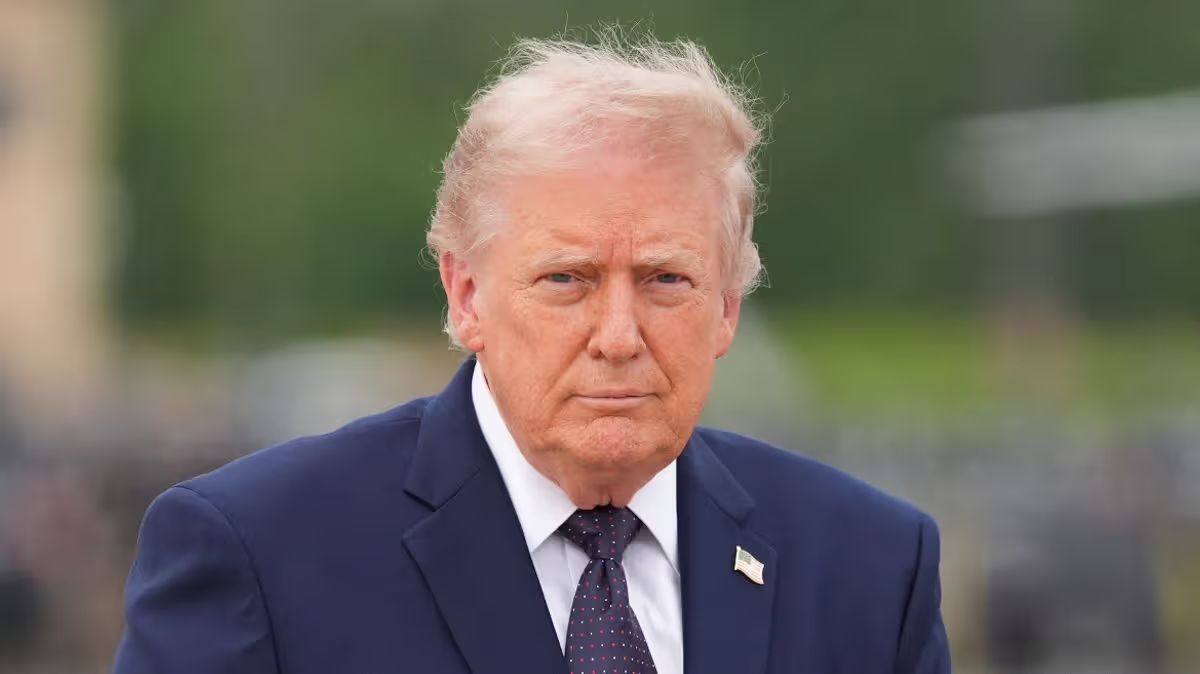
In a potentially historic development, former President Donald Trump, speaking from the symbolic heart of American power, the Oval Office, announced a significant breakthrough in international diplomacy. He revealed that he had just concluded a series of high-level conversations with a coalition of pivotal Middle Eastern leaders, including the heads of state of Saudi Arabia, the United Arab Emirates, Qatar, Egypt, Jordan, Bahrain, Turkey, and Pakistan. The central topic of these discussions was a comprehensive framework for peace, formally outlined in a Memorandum of Understanding, directly involving the Islamic Republic of Iran. The very gathering of this diverse group—uniting traditional rivals and long-standing allies in a single diplomatic effort—suggests an unprecedented attempt to fundamentally reshape the region’s security architecture. This move indicates a recognition, perhaps born of protracted conflict and economic strain, that a new approach to regional stability is urgently needed, one that moves beyond isolated agreements to a broader, collective understanding.
President Trump further detailed that, parallel to this multilateral effort, the United States has been engaged in direct negotiations with Iran itself. He stated that an agreement has been “largely negotiated,” pending finalization, between America, Iran, and the other nations listed. This suggests a dual-track process: one track building a supportive regional consensus among Iran’s neighbors and influential Muslim-majority states, and another tackling the intricate bilateral and multilateral issues between Washington and Tehran. In a crucial addendum, Trump noted a separate, positive call with Israeli Prime Minister Benjamin Netanyahu. This inclusion is critical, as it acknowledges Israel’s paramount security concerns in any regional agreement involving Iran, and hints at intense, behind-the-scenes efforts to align perspectives between the U.S., its regional partners, and its closest ally in the Middle East, a nation that views any pact with Iran with profound skepticism.
The announcement, made in passing before the President departed to deliver a commencement address, deliberately highlighted one tangible, global consequence of the pending deal: the reopening of the Strait of Hormuz. This narrow maritime chokepoint is a lifeline for the world’s energy supply, with a significant portion of globally traded oil and liquefied natural gas passing through its waters. Its closure or instability, due to military tensions or geopolitical brinksmanship, has long been a specter haunting global markets, threatening price shocks and economic disruption. By explicitly naming this outcome, the statement connects high-stakes diplomacy to immediate, practical benefits for the entire world—more secure shipping lanes, stabilized energy prices, and a reduction in the risk of a catastrophic military miscalculation. It frames the peace deal not merely as a political achievement, but as an accord with direct implications for global economic security and the cost of living for millions far beyond the Middle East.
While the tone of the announcement was optimistic, it wisely contained the specifics, noting that final aspects and details were still under discussion and would be unveiled shortly. This prudence underscores the immense complexity of such an undertaking. A comprehensive peace deal would inevitably need to address a thorny web of issues: the future of Iran’s nuclear program under stringent verification, its ballistic missile arsenal, its support for regional proxy networks, the lifting of crippling economic sanctions, and mechanisms for de-escalation and crisis communication. Each of these points is a potential deal-breaker, and their resolution requires meticulous, secretive negotiation. The acknowledgment that work remains tempers immediate expectations while building anticipation for what could be one of the most consequential diplomatic announcements in decades, should the parties successfully bridge their final differences.
The human element of this process cannot be overstated. Behind the formal titles and the political bluster are leaders carrying the weight of their nations’ histories, security anxieties, and public opinion. For the people of the region—from Tehran to Tel Aviv, from Riyadh to Doha—the prospect of a sustained peace, however distant it may seem, flickers with the promise of a different future. It suggests a potential shift away from economies burdened by defense spending and toward investment in development, technology, and cooperation. For the international community, weary of regional crises that demand constant attention and resources, a stable Middle East would allow a re-focusing on other global challenges. The simple, concluding phrase, “Thank you for your attention to this matter,” belies the monumental effort and risk involved, serving as a humble curtain-close on a preview of what could be a transformative moment in 21st-century geopolitics.
Ultimately, this announcement represents not a finished product, but a bold and fragile possibility. It signals that channels of communication, long frozen or characterized by hostility, have been opened at the highest levels. The involvement of such a broad coalition suggests a collective exhaustion with perpetual tension and a shared, if cautious, willingness to explore a new path. The coming days will reveal whether the final details can be harmonized into a durable and just agreement. Until then, the world is left to contemplate the profound implications: a re-opened Strait of Hormuz symbolizes more than just free navigation; it represents a tentative opening for dialogue, trade, and a future where the region’s immense potential is no longer held hostage by its deepest divisions.