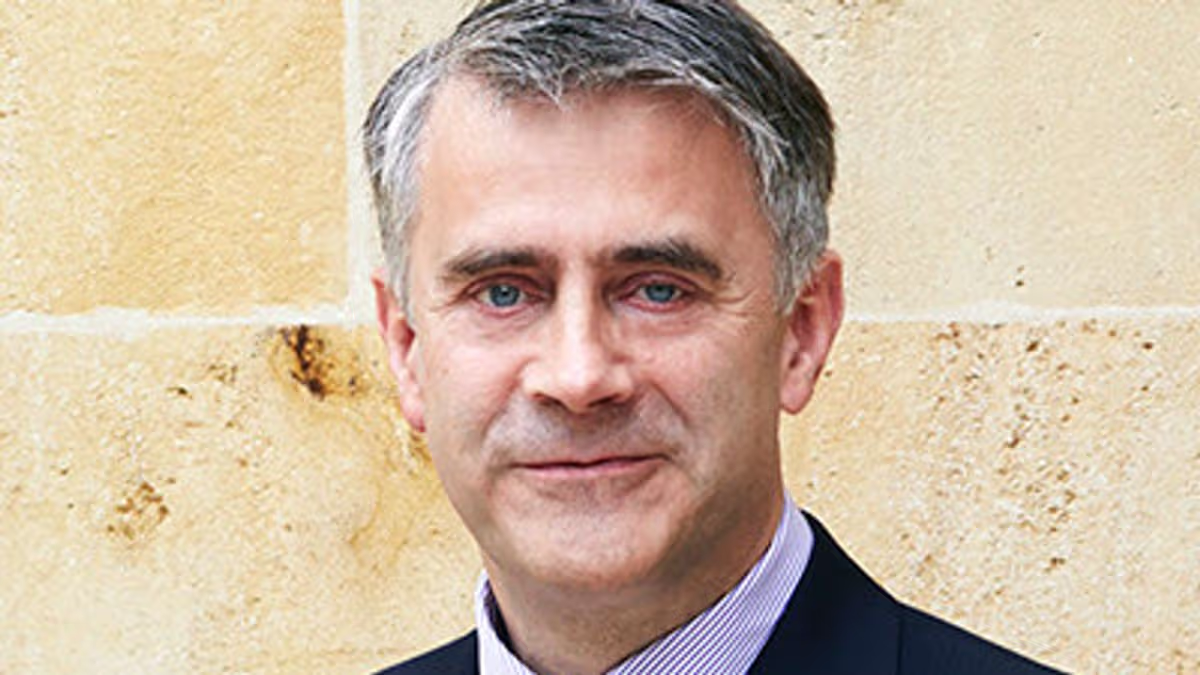


In the bustling heart of Bangkok, nestled nearly two dozen floors up an unremarkable commercial tower, a small paper sign bearing the name “AML Global Ltd” offers the only tangible clue to the whereabouts of one of the world’s most elusive billionaires. This is the registered address of Christopher Harborne, the enigmatic crypto and aviation fuel tycoon who has recently been propelled into the UK political spotlight as the financial backer of Reform UK leader Nigel Farage. The anonymity of the location is telling; when visited, no staff were present, with only occasional “messengers” arriving to collect mail. This tower, situated in an upmarket district near the US embassy, lists services starting from just £3.42 a day for an office, underscoring the stark contrast between the modest facade and the staggering £18.2 billion fortune attributed to Harborne on the Sunday Times Rich List. It is the address of a man who, by all appearances, does not wish to be found.
Harborne’s low profile has been shattered by a political controversy centering on an undeclared £5 million gift to Nigel Farage, intended for the Reform leader’s personal security. This donation has triggered an investigation by the Parliamentary standards commissioner, examining whether Commons rules were breached. While Reform UK maintains the gift was personal and unconditional, the incident has cast a piercing light on Harborne’s mysterious empire and his decades-long residence in Thailand. His presence is traced through scattered paperwork—from UK Companies House filings to Thai shareholder documents—that point to various addresses across Bangkok, yet he remains a ghost in the machinery of his own wealth, a figure more often represented by legal entities than by personal appearance.
The pursuit of the billionaire leads from the anonymous tower to a gated residential community in another part of Bangkok, an address used on official Thai filings. Here, a property lined with potted plants suggests a residence, but before inquiries can be made, a staff member intervenes, denying any recent sighting of Harborne. The tycoon, who also uses the name Chakrit Sakunkrit, links this address to ventures like Kamalaya, his luxury wellness retreat on the island of Koh Samui. This juxtaposition of secluded luxury and bureaucratic secrecy is a recurring theme. Elsewhere in the city, the trail leads to a weathered apartment block with peeling paint—a setting seemingly incongruous with immense wealth. Yet, three of his companies are registered to an apartment here, where a mother and son, said to work for Harborne, reside. These addresses paint a picture of a vast but fragmented empire, anchored not in palatial headquarters but in discrete, unassuming points on a map.
The scale of Harborne’s fortune, estimated at £18.2 billion, derives from a formidable and diverse portfolio. As detailed in the Rich List, his most valuable asset is a 12% stake in Tether, the cryptocurrency giant valued at approximately $200 billion. This alone accounts for nearly £18 billion of his wealth. His most transparent UK holding is a £357 million stake in QinetiQ, a defense technology firm spun out from the Ministry of Defence. These investments reveal a businessman operating at the highest echelons of both cutting-edge digital finance and established defense contracting. Yet, this financial footprint is managed from a distance, facilitated by the very “virtual office” services his Bangkok tower promotes—tools that allow for a “polished, professional image” without the need for a physical, centralized presence.
This deliberate obscurity raises profound questions about influence, transparency, and connection in the modern globalized economy. Harborne’s significant donations—totaling £12 million to Reform UK, according to reports—have undeniably influenced British politics, yet the man himself remains a specter. He operates through a network of holding companies and nominee addresses, leveraging the privacy afforded by international business structures. In an age where wealth is increasingly digital and fluid, Harborne exemplifies how immense economic power can be both exerted and concealed, how political landscapes can be shaped by figures who carefully curate their absence from the public eye.
Ultimately, the story of Christopher Harborne is less about a single individual and more about the architecture of modern wealth and influence. The small paper sign in a Bangkok tower is a fitting symbol: a minimal, almost trivial marker for a colossal reservoir of capital and impact. As investigations into the gift to Nigel Farage proceed, they probe not just a potential breach of parliamentary rules, but the very nature of political funding in a world where backers can be billionaires without a clear address. Harborne’s elusive presence underscores a broader narrative of how money moves silently across borders, shaping events from behind a veil of corporate filings and virtual offices, leaving the public to piece together the shadowy outlines of power.