


Even the strongest among us can find themselves at the mercy of the water. This is the profound and humbling lesson shared by Olympic legend Rebecca Adlington, who, despite being one of the most accomplished swimmers in history, once came perilously close to drowning. At the height of her career in 2010, a chilling incident at Australia’s Bondi Beach left an indelible mark on her. Fresh from her double-gold triumph in Beijing and training at an elite level, she was overwhelmed by a relentless series of waves. “Every time I came up, another one would hit,” she recalls. “I felt like I was choking.” Though her training allowed her to remain controlled and eventually swim to safety, the experience left her “absolutely terrified.” It was a stark reminder that water respects no reputation; panic and powerful currents can overwhelm anyone, even an athlete swimming 75,000 meters a week.
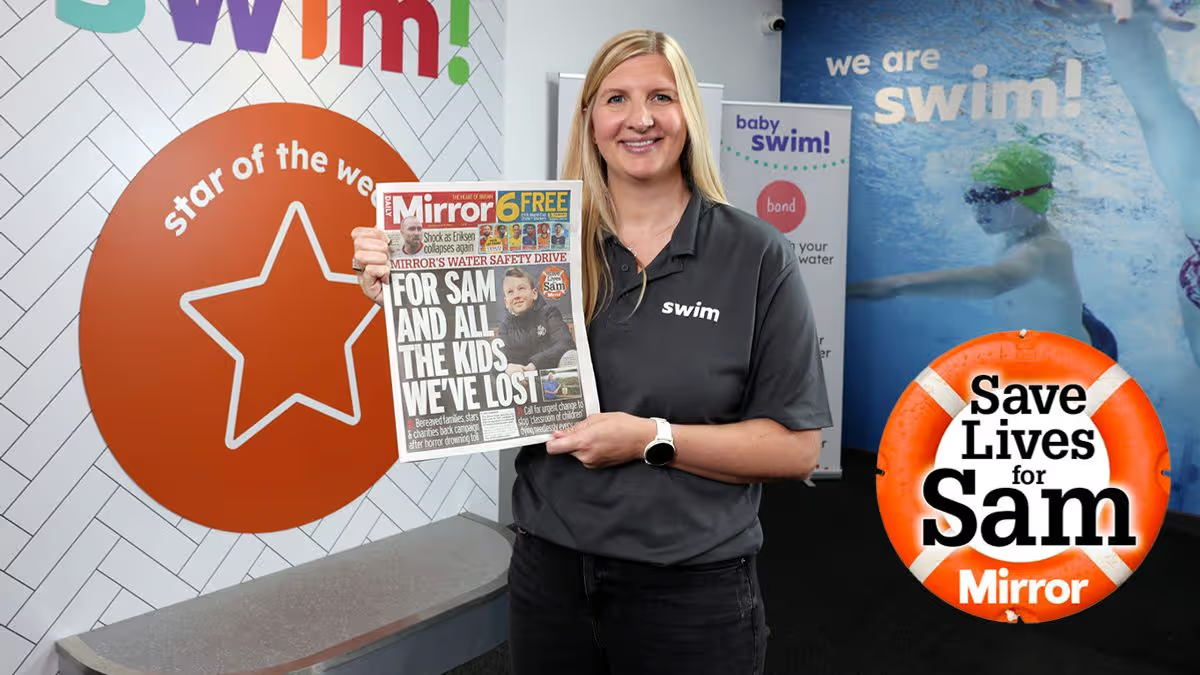
This firsthand understanding of vulnerability is what drives Adlington’s passion for water safety today. Now a mother of three and a co-founder of the swim school chain Swim!, she has shifted her focus from winning medals to saving lives. The mission is personal and urgent. With approximately 500 public pools having closed across the UK in just five years, access to formal swimming lessons has become a critical issue. Her company is actively working to fill this gap, opening new centers to provide vital lessons to thousands of children. She emphasizes that the ideal window for learning is between ages three and five, before deep-seated fears develop. Her own children were introduced to water as infants, and she advocates for simple safety measures, like avoiding blue swimwear in favor of brighter, more visible colors.
For Adlington, the reward of this work surpasses even the glory of standing on the Olympic podium. The true medals are the stories of children whose lives have been transformed—and potentially saved—by learning to swim. She recounts one parent whose child, after falling from a boat, was able to confidently swim back to safety because of their lessons. Another story tells of a boy so traumatized by water he refused to bathe, who found confidence and joy through patient instruction. “This is way more rewarding,” she admits. “I love my Olympic medals, don’t get me wrong, but this is way better. The fact that people are learning such a vital life skill.” She believes swimming is as fundamental as reading and writing, a necessary layer of protection in a country surrounded by water.
It is this conviction that led her to wholeheartedly endorse the Mirror’s ‘Save Lives for Sam’ water safety campaign. Adlington expresses frustration at the preventable nature of most drowning tragedies, which spike alarmingly during the summer months. She criticizes the inadequate safety measures at many open-water sites across the UK, pointing out that a small, faded “do not swim” sign is barely legible to an adult, let alone a child drawn to the water’s edge. “We’re not asking for millions and millions of pounds,” she states. Her calls to action are straightforward: install proper safety equipment and clear signage at open-water locations, and prioritize foundational water safety education in schools. These are not extravagant demands but basic, lifesaving interventions.
The campaign has united a powerful coalition of bereaved families, water safety charities like the Royal Life Saving Society UK (RLSS UK) and the RNLI, and fellow athletes. They all underscore a crucial message echoed by Adlington’s own experience: being a strong swimmer is not enough. Ashley Jones of RLSS UK emphasizes that water safety knowledge is essential, including the skill of floating to conserve energy if you get into trouble. Understanding the Water Safety Code—such as always swimming with others and knowing how to call for help without entering the water yourself—is a critical component of public education that can prevent tragedies.
Rebecca Adlington’s journey from Olympic champion to water safety advocate embodies a powerful narrative. It is a story that transforms personal fear into a public mission, leveraging her platform to advocate for change. Her terrifying minute at Bondi Beach became a catalyst, reminding everyone that drowning does not discriminate. By sharing her story and championing practical solutions, she hopes to foster a culture where respect for water is ingrained, essential skills are accessible to all, and the UK’s beautiful waterways are met with the caution and preparedness they demand. The goal is simple yet profound: to ensure that a day by the water ends with safety and joy, not tragedy.