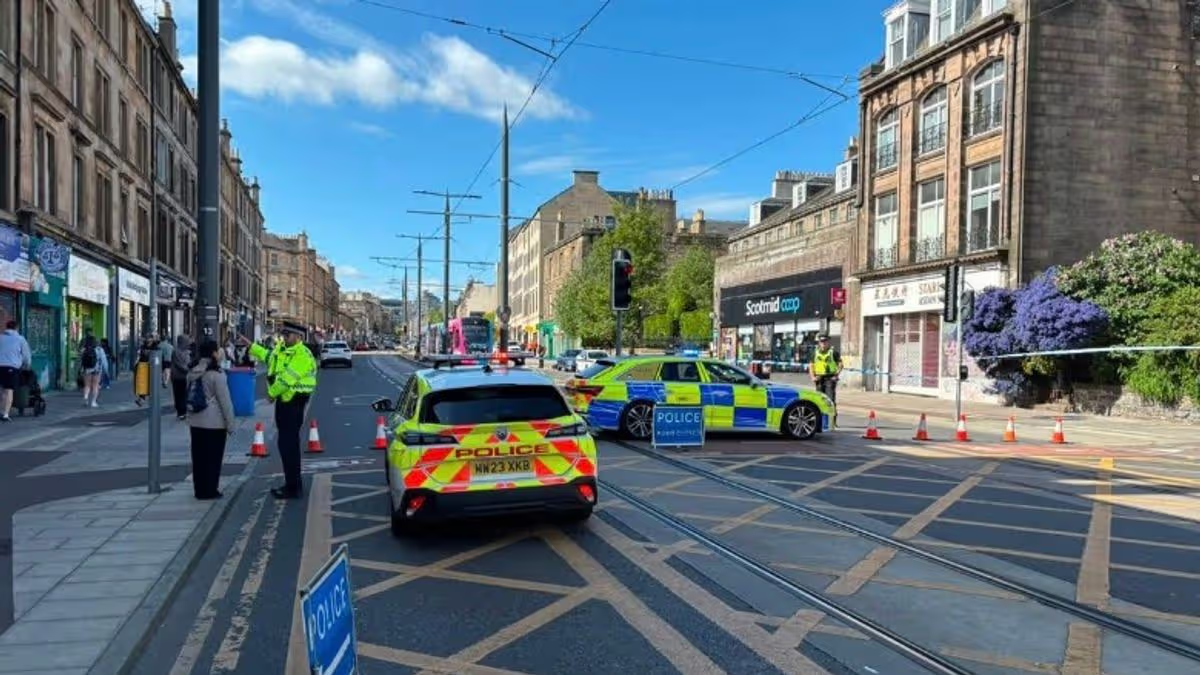




In the heart of Edinburgh, a vibrant artery of the city was abruptly silenced on a Sunday morning. Leith Walk, normally bustling with the familiar hum of trams and the flow of weekend life, became the scene of a distressing incident that has left a community shaken and authorities urgently seeking answers. On the morning of May 24, 2026, at approximately 8:50 AM, a 19-year-old woman was struck by a tram along this crucial thoroughfare. The precise location, between Albert Street and Pilrig Street near the Scotmid store, transformed from an ordinary city block into a place of emergency response. Police swiftly closed the road as crash investigation work began, cordoning off the area from Duke Street to Iona Street, a tangible manifestation of the sudden disruption to the city’s rhythm and a necessary step in piecing together the events of that morning.
The human impact of this collision is profound and deeply personal. The young woman sustained serious injuries in the incident and was transported by emergency services to the Royal Infirmary of Edinburgh for urgent medical care. Her condition underscores the vulnerability inherent in such moments and the grave consequences that can arise from a split-second event on shared urban infrastructure. The incident was witnessed by residents, one of whom, choosing to remain anonymous, stepped forward not only to provide a crucial account but also to offer immediate aid. This local resident described rushing out with a first aid kit upon hearing of the accident outside their flat, finding that a concerned crowd had already placed the injured woman in the recovery position. This snapshot of community response—of neighbors mobilizing to help—reveals the human solidarity that emerges in crisis, even as the official machinery of police and medical services deploys around them.
In response to the incident, authorities have made a formal appeal to the public, emphasizing the ongoing nature of their investigation. Sergeant Michael Thomson of Police Scotland articulated this call, stating, “Our inquiries are ongoing to establish the full circumstances and we are asking anyone who can help who has not already spoken to officers to get in touch.” This appeal extends beyond the immediate witnesses, seeking anyone with information, perhaps from a different angle or a dashcam, who might shed light on the precise sequence of events. The resident’s account mentioned the woman was seen carrying black bags to bins across the road prior to the collision, a detail that may form part of the broader context investigators are striving to understand. Every piece of information is vital in constructing an accurate picture of how this tragic accident occurred.
The practical repercussions of the collision and the ensuing investigation rippled across Edinburgh’s public transport network, affecting thousands of daily journeys. Edinburgh Trams swiftly implemented a partial route service, running trams only between Edinburgh Airport and St Andrew Square, while suspending operations through the affected Leith Walk corridor. To mitigate the disruption, ticket acceptance was arranged with Lothian Buses for the segment between St Andrew Square and Newhaven. Lothian Buses themselves confirmed significant diversions, with services unable to serve Duke Street and Leith Walk, rerouting instead via London Road and Easter Road in both directions. These coordinated adjustments, while essential, caused inevitable inconvenience for passengers, illustrating how a localized incident can cascade into systemic disruption for a city reliant on smooth transit links.
As the investigation continues on the closed section of Leith Walk, the incident prompts a broader reflection on the dynamics of shared urban spaces. Trams, representing efficient mass transit, and pedestrians, embodying individual mobility, must coexist safely within dense city environments. This collision, resulting in serious injury to a young person, highlights the critical importance of continuous vigilance, clear infrastructure design, and public awareness from all parties using such routes. It is a moment that naturally leads transport authorities, city planners, and the community to consider safety protocols, visibility, and the interplay between vehicle pathways and pedestrian activity, even as the immediate focus remains firmly on the welfare of the injured woman and the meticulous police inquiry.
The closure of Leith Walk serves as a sobering reminder of the fragility of normalcy. A routine Sunday morning was irrevocably altered by an event that has left a young woman fighting serious injuries, a community grappling with the shock of what happened outside their homes, and a city adapting its rhythms around an ongoing police investigation. While the trams will eventually resume their full journey and the buses return to their regular routes, the human impact of this day will endure far longer. The hope of the authorities and the community now rests on two parallel paths: the first is the recovery of the injured woman at the Royal Infirmary; the second is the gathering of clear information from the public to help investigators understand this tragedy, with the ultimate aim of preventing such incidents in the future and ensuring the safe coexistence of all who share Edinburgh’s streets.