



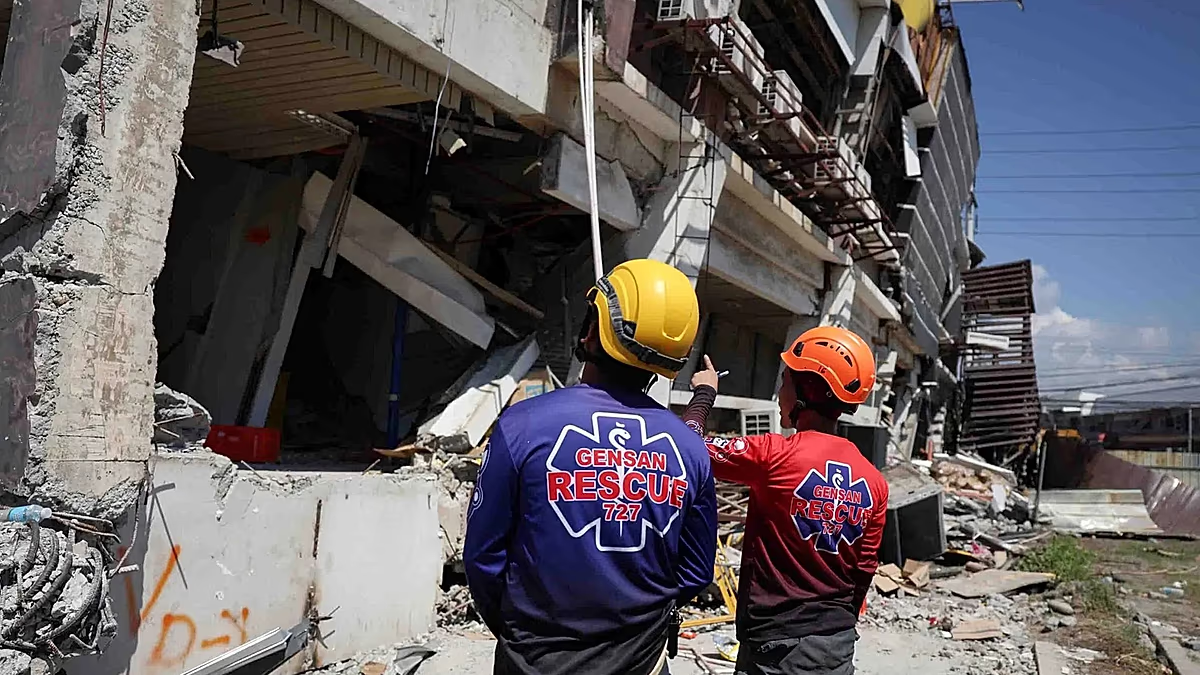
A nation still shaking from the force of the earth awoke to a grim reality on Tuesday in the southern Philippines. Rescue teams, their faces etched with determination and fatigue, picked through the rubble of collapsed buildings, driven by the fragile hope of finding survivors. Just one day earlier, a devastating 7.8 magnitude earthquake—the strongest to strike the country in nearly half a century—had ripped through the region, leaving at least 37 people dead, injuring nearly 500, and displacing more than 20,000 from their homes. While official records listed only four individuals as missing, the sheer scale of the destruction, with numerous structures reduced to piles of concrete and twisted metal, meant that the true toll was still unknown. The Office of Civil Defence acknowledged the urgent, painstaking task ahead: every unstable building, every slab of fallen debris, had to be inspected, a silent race against time for those who might still be trapped.
The earthquake’s path of destruction was etched across the landscape and communities of Mindanao, the country’s second-largest island. In the bustling coastal city of General Santos, home to over 700,000 people, at least 13 lives were lost to falling buildings and debris. The tragedy reached into the mountains as well; in the town of Glan in Sarangani province, a landslide cascaded down a hillside, burying houses and claiming at least 18 lives. The other fatalities were scattered across the southern provinces, a testament to the quake’s wide and violent reach. Beyond the heartbreaking loss of life, the temblor shattered the foundations of daily existence: an initial assessment reported damage to about 2,000 homes and 117 government buildings, displacing thousands into emergency shelters. Many had fled their homes not just from the quake itself, but from the terrifying specter of a tsunami, which did send waves over a metre high onto Philippine shores, luckily causing only minor damage.
The disruption extended deeply into the fabric of civic life, touching some of society’s most vulnerable. The earthquake struck on a symbolically poignant day: the first day of the national school year after the summer break. As a result, many of the injured were young students gathered for morning assemblies. With approximately 6,000 public school buildings in the affected provinces now potentially compromised, authorities faced the difficult decision of keeping classrooms closed indefinitely. “We cannot force the immediate reopening of schools because we have to ensure the integrity of the buildings,” stated Rafaelito Alejandro of the Office of Civil Defence. The danger persisted not only in the silent cracks within walls but in the continued shudder of the earth itself, as powerful aftershocks threatened to finish what the main quake had started. Meanwhile, General Santos International Airport remained shuttered, cancelling dozens of flights and severing a critical lifeline for the region.
The seismic shock reverberated not just physically, but historically. Scientists confirmed the quake was triggered by movement in the Cotabato Trench, the same undersea fault that unleashed an even more catastrophic event on August 17, 1976. That 8.1 magnitude earthquake and the subsequent tsunami waves, some as high as a three-story building, killed about 8,000 people. The memory of that disaster, which the Philippine Institute of Volcanology and Seismology was poised to commemorate this very August, hung heavily over the current crisis, a stark reminder of the region’s volatile geology. The nation also recalls a 1990 quake of the same magnitude that devastated northern provinces, claiming over a thousand lives. This history made the current response a matter of urgent national priority, with President Ferdinand Marcos Jr. deploying top officials to oversee search and rescue and to coordinate the distribution of aid to thousands of suddenly-homeless families.
In the face of this calamity, both national resolve and international solidarity swiftly mobilized. The Philippine government’s disaster response machinery swung into action, focusing on immediate humanitarian needs—thousands of food packs and construction materials—and the longer-term assessment of crucial infrastructure like roads and bridges. The global community, recognizing the Philippines’ plight, offered support. The United States, a long-standing treaty ally, along with nations like France, Japan, and New Zealand, expressed their readiness to assist. This outreach underscores the country’s unfortunate familiarity with natural disasters, situated as it is on the Pacific “Ring of Fire,” an arc of intense seismic and volcanic activity. Compounding this geological vulnerability is the annual battering from about twenty typhoons and tropical storms, collectively rendering the Philippine archipelago one of the most disaster-prone nations on Earth.
As the initial frantic phase of the response transitions into the arduous work of recovery and rebuilding, the people of southern Philippines are left to grapple with profound loss and dislocation. The earthquake, a brutal force of nature, disrupted the rhythm of everyday life—school, work, travel—and shattered the very sense of shelter and security. The search through the ruins continues, a solemn mission for rescuers committed to leaving no one behind. For the survivors, the path forward is fraught with challenges: rebuilding homes, healing injuries, mourning loved ones, and confronting the psychological aftershocks of the trauma. Yet, within this landscape of devastation, the efforts of local communities, national agencies, and international partners weave a narrative of resilience, a determination to rise from the rubble once more, hardened by history but unwavering in hope.