

Paragraph 1: A Presidential Appearance Sparks Immediate Reaction
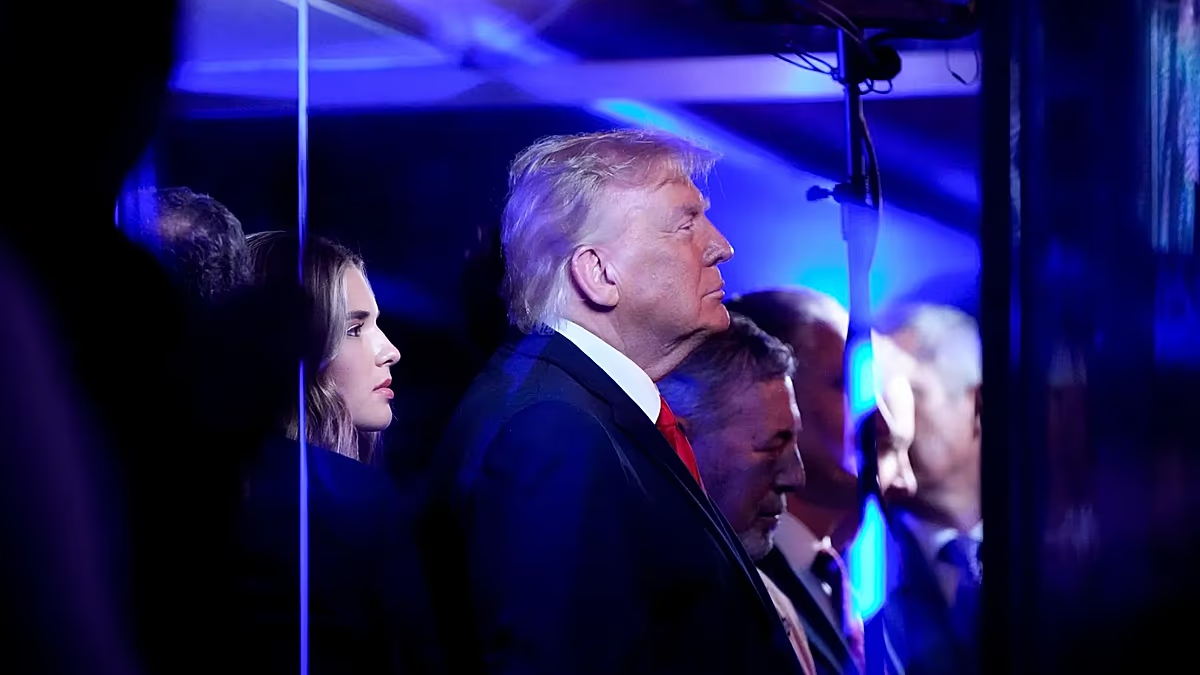
During a pivotal NBA Finals game at New York City’s Madison Square Garden, the appearance of former President Donald Trump became an event nearly as charged as the on-court battle between the Knicks and the Spurs. As the national anthem played, cameras inside the arena panned to Trump watching from an executive suite, prompting a wave of audible boos and jeers from a significant portion of the crowd. This visceral, immediate reaction underscored the deep political divisions that continue to permeate American life, even within spaces dedicated to sports and entertainment. The moment transformed a celebratory sporting event into a flashpoint, reminding everyone present that the figure in the suite remained one of the most polarizing in the nation.
Paragraph 2: A Fortress in the Heart of the City
The presidential visit necessitated a security operation that dramatically altered the atmosphere and accessibility of one of New York’s most iconic venues. Authorities erected a three-meter security fence around sections of the arena, while a heavy presence of Secret Service agents—some visibly heavily armed—worked alongside hundreds of NYPD officers. The familiar pre-game festivities for fans were curtailed; watch parties outside the Garden were banned, and anyone without a ticket was urged to avoid several blocks surrounding the area. Ticket holders themselves faced airport-style screenings and were advised to arrive hours early, a stark contrast to the usual buzz of a playoff game. NYPD Commissioner Jessica Tisch explicitly advised, “celebrate the Knicks, but avoid the MSG area tonight if you do not have tickets,” framing the evening as one where security concerns fundamentally overrode communal celebration.
Paragraph 3: Inconvenience and Ire from the Public and Politicians
This immense disruption did not go unnoticed or uncriticized. Many New Yorkers and Democratic lawmakers expressed frustration that what they viewed as a unifying moment of civic pride—a home team competing for a championship—had been commandeered and complicated by Trump’s presence. Senate Minority Leader Chuck Schumer captured this sentiment on social media, writing, “During one of the best moments NYC has enjoyed in decades, (Trump) makes it all about himself. Trump should LEAVE US ALONE! He’s not wanted here.” As Trump’s motorcade navigated the city streets, scattered protesters held signs declaring “Trump must go,” with a few individuals offering crude gestures, channeling a broader sense of annoyance from a segment of the populace.
Paragraph 4: Mixed Feelings Amidst the Disruption
However, the reaction was not monolithic. Some attendees, while acknowledging the inconvenience, expressed a degree of appreciation for the former president’s attendance. Knicks fan Anthony Pulley, 43, typified this mixed view, stating, “I think it sucks. I think it really put a damper on all the watch parties. But it’s pretty cool he wants to show up and be a part of it.” This sentiment highlights how, for some, Trump’s status as a famed New Yorker and a self-proclaimed longtime Knicks fan lent a certain legitimacy to his presence, cutting through the political noise. Inside the packed arena, where ticket prices had soared out of reach for most, the focus for many remained on the game itself, with celebrity fans and even New York Mayor Zohran Mamdani joining the crowd, having paid a small fortune for the experience.
Paragraph 5: An Unprecedented Security Calculus
The extraordinary security measures extended far beyond visible patrols and barriers. The Secret Service confirmed the deployment of counter-drone technology, a detail that hinted at the sophisticated and layered protection required for a figure who has faced multiple alleged assassination attempts in recent years. Special Agent Matt McCool framed the mission clearly: to ensure the safety of all attendees while fulfilling the paramount duty of protecting the president. This operation occurred against a tense backdrop, following a stabbing at the adjacent Penn Station just a day earlier, though police were quick to downplay any terror connection to that isolated incident. The overall scene presented a jarring juxtaposition: the vibrant, electric hope of a championship game unfolding within a hardened, high-alert security bubble.
Paragraph 6: The Game Goes On, But the Moment Lingers
Ultimately, the basketball game proceeded, with the San Antonio Spurs securing a narrow victory to tighten the series. Yet, the narrative of the evening was split. For sports purists, it was a classic Finals battle; for the city and the nation observing, it was a potent reminder of Trump’s enduring and disruptive presence in the public sphere. His visit to the Garden, following a post-election UFC event months prior, reinforced his pattern of inserting himself into the cultural mainstream. As fans dispersed—some debating the game’s pivotal plays, others the night’s political theater—the event stood as a microcosm of contemporary America: a place where sports, security, spectacle, and sharp political sentiment are now inextricably intertwined, ensuring that even a night at the arena is no longer just a game.