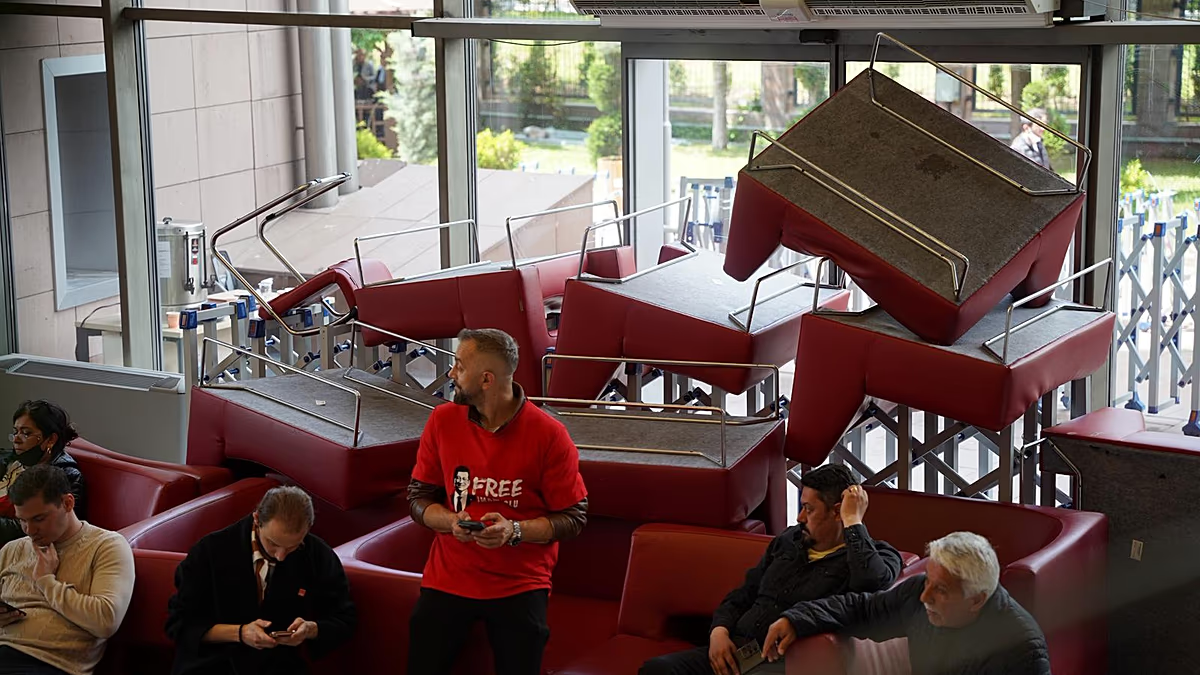


In a startling escalation of political tensions within Turkey’s main opposition party, police forces in Ankara stormed the headquarters of the Republican People’s Party (CHP) on Sunday morning. The operation aimed to forcibly reinstate the former leader, Kemal Kılıçdaroğlu, following a controversial court ruling. More than one hundred officers arrived, cutting through the main gate to gain entry and employing tear gas against party members who had barricaded the reception area with furniture in a desperate attempt to block the intrusion. The scene was one of chaos and confrontation, emblematic of a deep and bitter fracture within the party that serves as the primary parliamentary opposition to President Recep Tayyip Erdoğan’s government.
The legal basis for this dramatic police action stems from a lawsuit challenging the legitimacy of the CHP’s leadership transition in 2023. The suit sought to annul the party’s congresses that resulted in Özgür Özel replacing Kılıçdaroğlu as chairman, alleging that delegates were paid to vote for Özel. In a ruling that bypassed the authority normally held by the Supreme Electoral Council, the 36th Civil Chamber of the Ankara Regional Court of Justice declared those congresses “absolutely null.” This judicial intervention created a volatile legitimacy crisis, pitting the court’s verdict against the internal democratic processes of the party and setting the stage for the physical clash that unfolded.
The raid was preceded by a tense phone conversation between the former and current leaders on Friday. According to accounts from Kılıçdaroğlu’s camp, he conveyed his intention to “take the party to a congress at the most appropriate time.” By Sunday morning, this intention transformed into direct action, as a group of his supporters, including several MPs, marched on the headquarters. The response from party officials loyal to Özel was immediate and fierce. CHP MP Mahmut Tanal addressed Kılıçdaroğlu directly on social media, telling him to “pull back your third-rate mafia thugs,” language that underscores the raw hostility now defining the internal conflict.
Other party voices framed the struggle not merely as an internal power dispute, but as a battle for Turkey’s democratic future. CHP MP Nurhayat Altaca Kayışoğlu accused Kılıçdaroğlu of sacrificing the hope of millions for personal parliamentary gain, warning that he was trying “to hand over this country’s future once again to the same mentality” and that Turkey was being “dragged back into darkness.” This rhetoric highlights how the schism is viewed by many within the CHP: a betrayal of the party’s role as a beacon of opposition and a potential setback for the entire nation’s political health.
Meanwhile, Kılıçdaroğlu himself issued a statement calling for the CHP leadership to “comply with the court ruling and not act against party discipline,” and his lawyer formally requested police assistance to hand over the party building. This legalistic posture contrasted sharply with the scene on the ground. As the standoff continued, CHP MP Ali Mahir Başarır voiced despair, asking, “What more harm can be done to Turkey’s number one party?” Another senior figure, Murat Emir, challenged Kılıçdaroğlu to confront the party’s will directly: “If you refuse to recognise the congresses we’ve held, then bring out the ballot box and let’s hold a congress with whichever delegates you wish.”
This event transcends a simple leadership tussle; it represents a profound institutional crisis. The use of state police to enforce a contentious court order against a major opposition party’s headquarters is a stark image that raises serious questions about judicial independence, political interference, and the stability of democratic norms in Turkey. The CHP, already grappling with the challenge of uniting against a dominant ruling party, is now engulfed in a self-inflicted and publicly violent struggle. The scars from this raid will not heal quickly, and the path forward—whether through a coerced handover, a new congress, or prolonged legal battles—remains deeply uncertain, casting a shadow over the broader political landscape.