
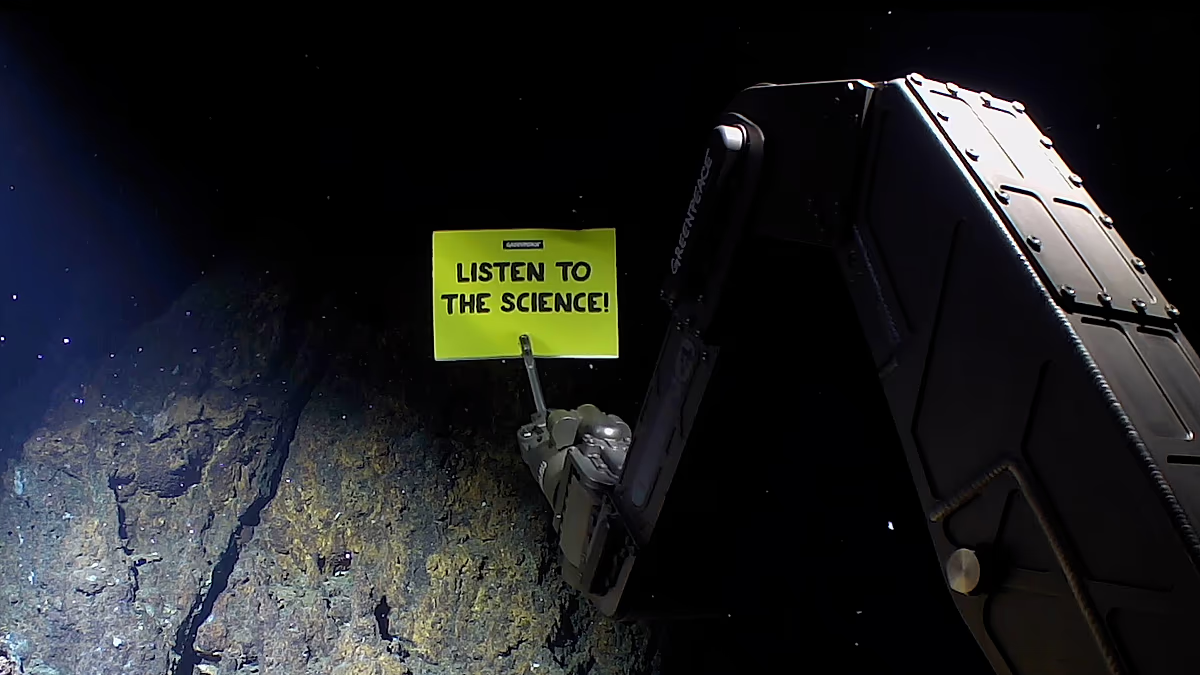


In a profound and symbolic act of advocacy, environmental activists from Greenpeace International, in collaboration with Greenpeace Germany and Greenpeace Nordic, have taken their protest to the planet’s final frontier: the dark, silent depths of the ocean. As part of their sustained campaign to halt commercial deep-sea mining, they orchestrated what they describe as the deepest banner protest in history. Using specialized underwater robotics, they unfurled a powerful message on the seabed itself, at a staggering depth of approximately 2,315 meters (over 7,500 feet). This location is not arbitrary; it lies within a region of intense interest to mining corporations aiming to extract precious nodules rich in cobalt, nickel, and other metals deemed critical for manufacturing batteries, smartphones, and renewable energy technologies. By placing their plea directly on the proposed mining site, Greenpeace transformed the seafloor from a remote industrial prospect into a global stage, forcing the world to visually confront the reality of this emerging industry.
This dramatic protest was meticulously timed to resonate within the halls of international diplomacy. Its primary audience is the assembly of governments and delegates currently engaged in crucial negotiations at the International Seabed Authority (ISA), the UN-affiliated body tasked with regulating all mineral-related activities in international waters. The ISA is presently wrestling with the monumental challenge of establishing a legal framework for deep-sea mining, balancing economic interests against a profound lack of scientific understanding. Greenpeace’s action serves as a direct visual pressure tactic, aiming to sway these critical discussions by reminding decision-makers that their abstract policy debates have tangible, irreversible consequences for a hidden world. The banner on the abyssal plain is a stark, physical manifestation of the global public concern that the ISA must account for as it considers whether to open the last great wilderness on Earth to industrial exploitation.
The core of Greenpeace’s argument, echoed by a growing chorus of marine scientists, centers on the profound and irreversible ecological damage that seabed mining would inflict. The proposed mining method involves enormous, heavy machinery scouring or vacuuming the ocean floor, which would immediately annihilate the unique and fragile ecosystems that exist there. These deep-sea environments, home to exotic life forms like ancient coral gardens, sponges, and species found nowhere else on Earth, are characterized by extreme conditions and incredibly slow growth rates. Scientists warn that recovery from such disturbance could take millennia, if it occurs at all. Furthermore, the process would create massive sediment plumes, potentially toxic clouds of fine particles that could travel on deep ocean currents for hundreds of miles, smothering life far beyond the immediate mining zone and disrupting vital oceanic processes. Greenpeace and the scientific community argue that plunging into this destructive venture in an ecosystem we have scarcely begun to understand is an act of profound arrogance and reckless risk-taking.
In response to these overwhelming ecological threats, Greenpeace and a coalition of nations, environmental organizations, and corporate leaders are advocating for a decisive global moratorium or precautionary pause on deep-sea mining. They contend that the purported economic benefits—primarily securing metals for a transition to green technology—are both overstated and fraught with contradiction. The argument is that we cannot save the planet’s climate by simultaneously destroying its last intact ecosystems. Instead, the focus must urgently shift towards a truly circular economy based on reducing demand, improving battery technology to use less or different materials, and radically enhancing recycling rates for existing metals. A moratorium would allow essential time for comprehensive, independent scientific research to fully grasp the biodiversity and ecological functions of the deep sea, enabling informed rather than speculative governance. This stance champions the principle of precaution, asserting that the permanent loss of irreplaceable natural heritage is too high a price for mineral convenience.
The technological execution of this protest itself holds significant meaning. By employing a remotely operated robot to deploy their banner, Greenpeace powerfully highlighted the dual-edged nature of such technology. The same realm of robotics and engineering that makes deep-sea mining technically possible is also the very tool used to expose and challenge its destructive potential. This action underscores how technology can serve either extraction or exploration, exploitation or protection. The image of a machine—a symbol of industrial intrusion—being used to deliver a message of preservation creates a potent metaphor. It demonstrates that human ingenuity, currently poised to disrupt the deep sea, can and must be redirected toward non-invasive study, monitoring, and ultimately, the stewardship of these vulnerable ecosystems. The protest thus becomes a statement about choice and responsibility, urging us to channel our technological prowess toward understanding and preserving wonders, not obliterating them for short-term gain.
Ultimately, this silent protest from the abyss is a profound call for a global ethical and ecological reckoning. It asks humanity to reconsider its relationship with nature in an era of climate crisis and resource scarcity. The deep ocean is not a lifeless desert or a mere repository for raw materials; it is a vital, interconnected part of our planetary life-support system, regulating climate and harboring immense, fragile biodiversity. Greenpeace’s action translates complex, out-of-sight policy debates into a single, arresting image: a human message resting on the fragile seabed, a plea etched in the very arena of the proposed conflict. It challenges us to look beyond immediate economic calculations and embrace a longer, wider vision of sustainability—one that protects the intricate web of life in all its forms, from the sunlit surface to the eternal dark of the deep sea, for generations to come.