


Here is a summary and humanization of the provided content, expanded to six paragraphs.
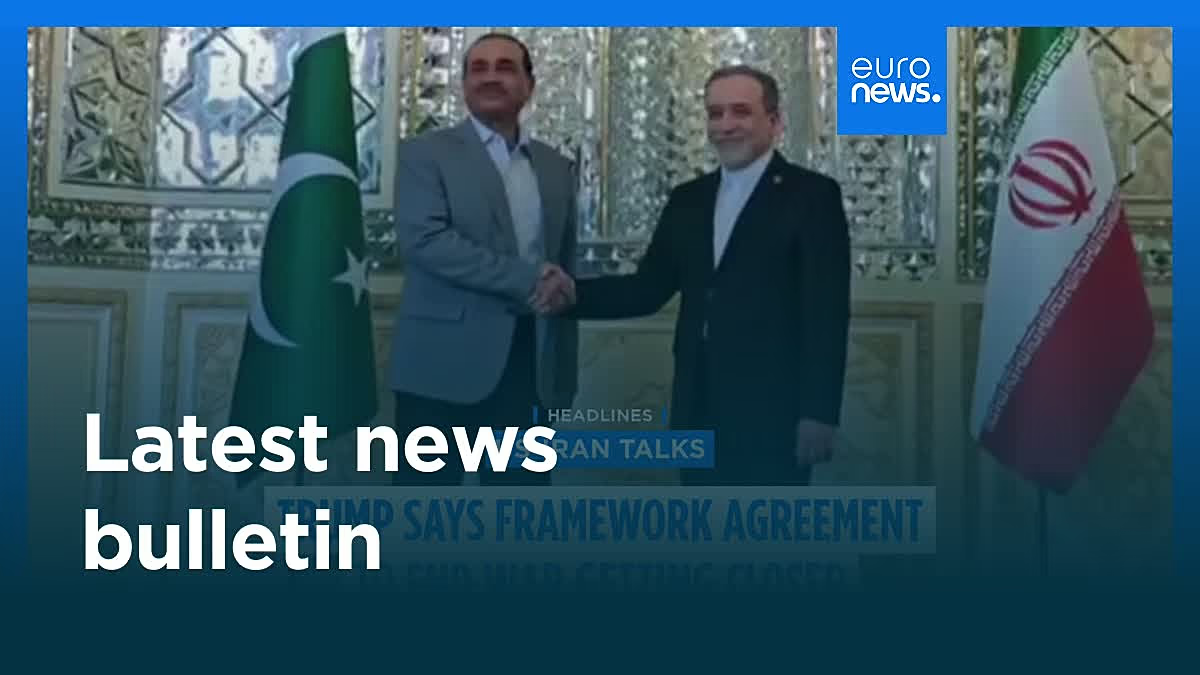
The digital news cycle is a relentless, ever-flowing river of information. It’s easy to feel adrift in its currents, pulled from one headline to the next without a moment to breathe. The content you’ve provided serves as a kind of anchor point—a timestamp and a promise. Dated May 24th, 2026, at noon in Central European Time, it declares itself a curated checkpoint. Its mission is to help us catch our breath and catch up, offering a consolidated view of the most significant narratives unfolding not just across the diverse continent of Europe, but echoing from every corner of our interconnected world. It’s a reminder that amidst the chaos, there are still attempts to distill, prioritize, and present a coherent picture of our shared moment in history.
This isn’t merely a list of events; it’s a reflection of what a global newsroom, at that precise hour, deemed essential for an informed citizen. The categories outlined—World, Business, Entertainment, Politics, Culture, Travel—form a mosaic of the human experience. The “World” section likely grapples with the weighty issues: perhaps diplomatic breakthroughs or alarming conflicts, climate summits or humanitarian crises. “Business” translates the pulse of global markets, innovation, and economic forces that shape our daily livelihoods, from stock exchanges to startup hubs. Together, these categories form the backbone of hard news, the stories that define the structure of our societies and the urgent challenges we face collectively.
But a human life is not lived solely on the front pages of finance and geopolitics. This is where the other dimensions of the digest come into play, adding color and depth to the day’s portrait. “Entertainment” and “Culture” speak to our souls and our shared identity—the new film sparking conversation, the album dominating streams, the groundbreaking art exhibition challenging perspectives, or the literary prize celebrating a powerful new voice. These stories tell us what we’re dreaming about, laughing at, and being moved by. They are the conversations around dinner tables and water coolers, the shared cultural touchstones that connect us across borders.
Meanwhile, “Politics” zooms in on the machinery of governance and power, from the halls of the European Parliament to domestic elections and policy debates that will trickle down to affect public services and civic life. “Travel” offers a different kind of narrative—one of movement, discovery, and connection. It might highlight new sustainable travel routes, recovery in tourism-dependent regions, or simply inspire with a feature on a hidden European village. This category reminds us of the world’s beauty and accessibility, a counterbalance to stories of division and strife.
The simple, powerful phrase “… More” at the end of the prompt is perhaps the most human element of all. It’s an acknowledgment of the inherent limitation of any summary. It confesses that for every story highlighted, a dozen others remain just beneath the surface, each with its own complexity and consequence. It’s an invitation, a doorway. It tells the reader, “We have given you the map of the major landmarks, but the territory is vast and yours to explore.” This nod to the infinite depth of the news cycle is a gesture of humility and respect for the audience’s own curiosity.
Ultimately, this content framework, though minimalist, captures a very modern human need: to make sense of a vast and noisy world without being overwhelmed by it. On a spring day in 2026, it aims to be a trusted guide. It promises a filter for the signal in the noise, delivering not just data, but context—a starting point for understanding the forces shaping our lives, the art inspiring our hearts, and the stories connecting our global community. It’s a brief pause in the stream, offering a chance to get one’s bearings before diving back into the profound, bewildering, and fascinating current of events that we call the news.