



A Lavish Welcome and a Strategic Embrace: Xi’s Summit with Kim Amidst Regional Shifts
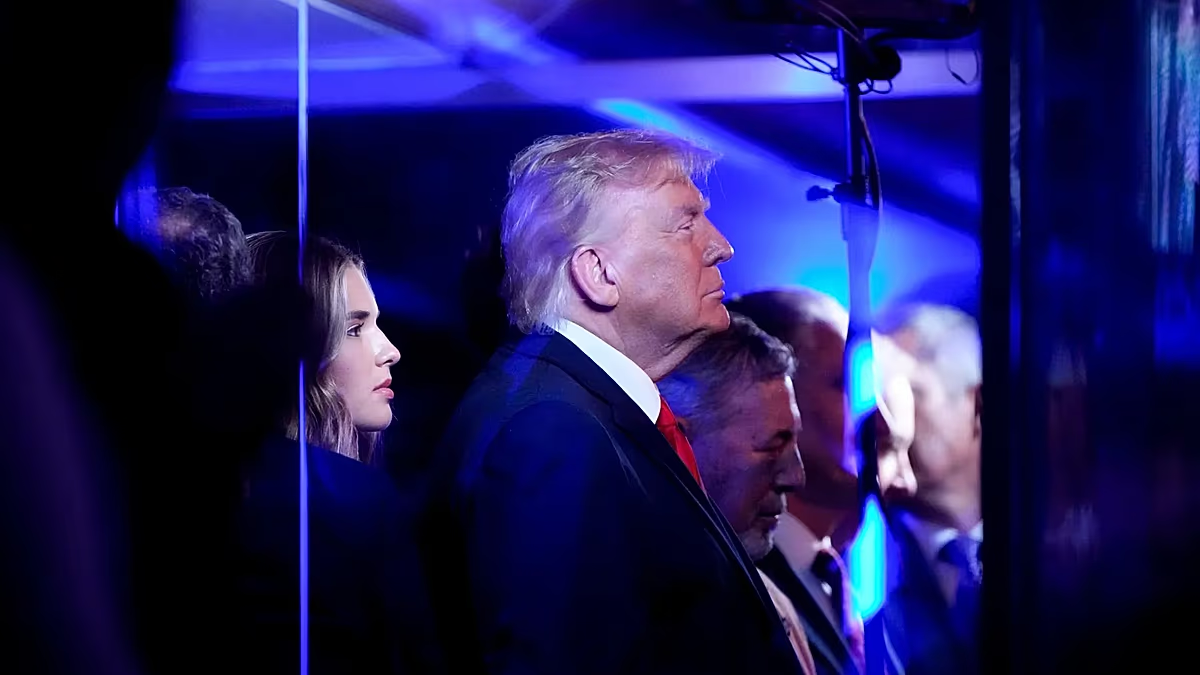
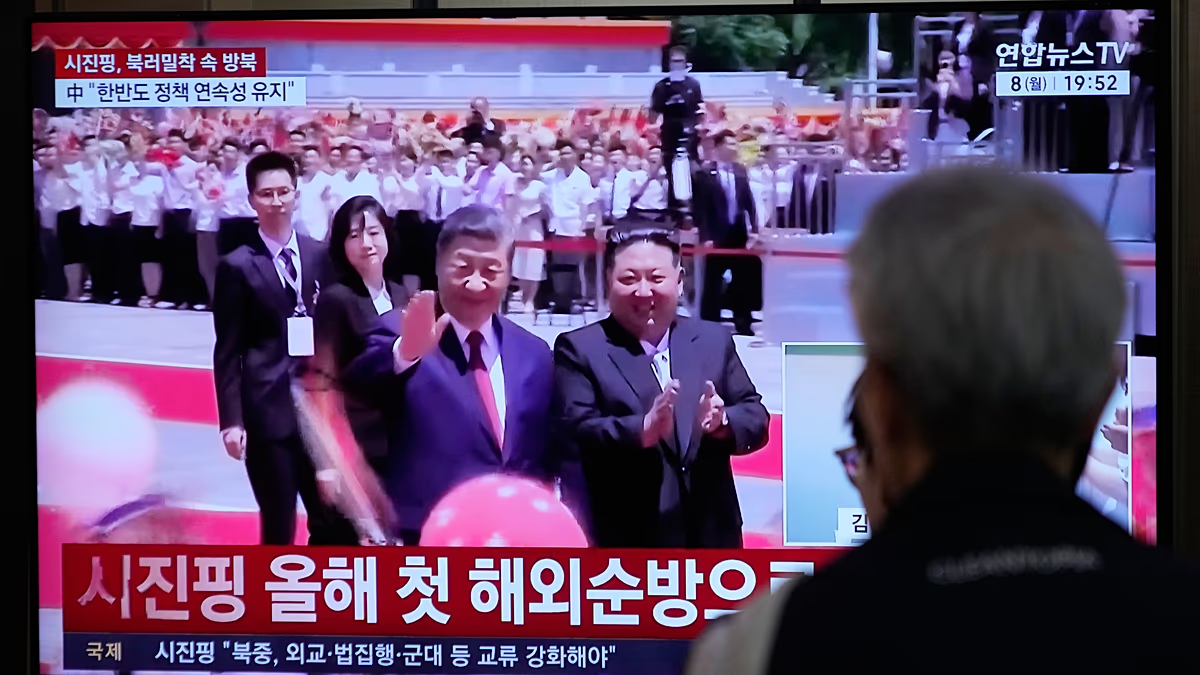
The streets of Beijing were awash with a display of orchestrated solidarity as Chinese President Xi Jinping welcomed North Korean leader Kim Jong Un with a lavish state reception. The visit, marked by military honours, ceremonial fanfare, and large crowds dutifully waving the flags of both nations, was a public spectacle designed to project an image of unshakeable fraternity. This summit, however, was far more than a ritualistic display of communist brotherhood. It occurred at a moment of intense diplomatic choreography for Beijing, which had recently played host to both U.S. President Donald Trump and Russian President Vladimir Putin. Placing Kim Jong Un within this sequence of world leaders was a deliberate signal, underscoring North Korea’s continued centrality in China’s strategic calculus and elevating Kim’s stature on a global stage that often seeks to isolate him.
Beneath the surface of the ceremonial pomp, the talks between Xi and Kim were a pragmatic response to a region simmering with uncertainty. Northeast Asia is a chessboard of competing interests, where the ambitions of China, the United States, Russia, Japan, and South Korea increasingly intersect and clash. Within this volatile landscape, North Korea remains a pivotal, if unpredictable, piece. For China, Pyongyang is not merely a neighbor but a strategic buffer and a historical ally. Despite its enforcement of international sanctions, China remains North Korea’s economic lifeline and most crucial diplomatic shield. The summit served as a powerful reminder of this enduring reality, with Xi explicitly calling for deepened cooperation across sensitive domains like diplomacy, law enforcement, and even military exchanges—a suggestion sure to resonate in Washington and Seoul.
A fundamental tension, however, lies at the heart of this relationship: the irreconcilable gap between China’s stated objectives and North Korea’s declared reality. President Xi reiterated China’s long-standing support for the denuclearization of the Korean Peninsula, a consistent position that aligns, at least rhetorically, with international demands. Yet, Kim Jong Un’s regime has repeatedly and unequivocally described its nuclear arsenal as a permanent, irreversible national achievement—the ultimate guarantor of its security and sovereignty. This visit did not—and could not—bridge that chasm. Instead, it reflected China’s immediate priority: managing the status quo. For Beijing, a unstable or collapsing North Korea is a far greater threat than a nuclear-armed one that remains within its sphere of influence.
Analysts interpret this high-profile embrace primarily as a stabilizing maneuver by China. The primary goal was to reaffirm Beijing’s paramount influence over Pyongyang at a time when diplomatic avenues with the United States have stalled and inter-Korean dialogue has faltered. By extending such a warm welcome, Xi Jinping sought to ensure that North Korea does not drift away from China’s orbit or embark on provocations that could trigger a crisis on China’s doorstep. The summit was a masterclass in preventive diplomacy, aiming to curb Kim’s more impulsive tendencies by offering the tangible benefits of political support and continued economic sustenance, however constrained by sanctions.
Furthermore, the meeting was a clear play for regional leadership. As great-power rivalry intensifies, China is determined to assert its role as the indispensable arbiter of Northeast Asian security. Hosting Kim so soon after meetings with Trump and Putin positioned China as the common thread connecting all key players in the North Korean drama. It communicated to Washington that any lasting solution must pass through Beijing, and to Seoul and Tokyo that China’s leverage over Pyongyang remains unmatched. This reinforced role is vital for a China that views the U.S. alliance network in Asia as a constraint on its own ascendancy.
In conclusion, the grandeur of Kim Jong Un’s reception was a visual metaphor for the complex, calculating relationship it represented. While the flags and cheers spoke of historic bonds, the substance of the talks was firmly anchored in present-day realpolitik. China, under Xi Jinping, is not seeking to force a dramatic breakthrough on the nuclear issue but to consolidate its control over the geopolitical tempo surrounding it. The summit was less about changing North Korea’s strategic direction and more about ensuring that, whatever path it takes, it remains aligned with China’s core interest: maintaining a stable peninsula where Beijing holds the dominant hand. In a region of shifting alliances and rising tensions, the message was unequivocal—the bond between Beijing and Pyongyang, for all its contradictions, remains a cornerstone of China’s vision for its neighborhood and its own global standing.