



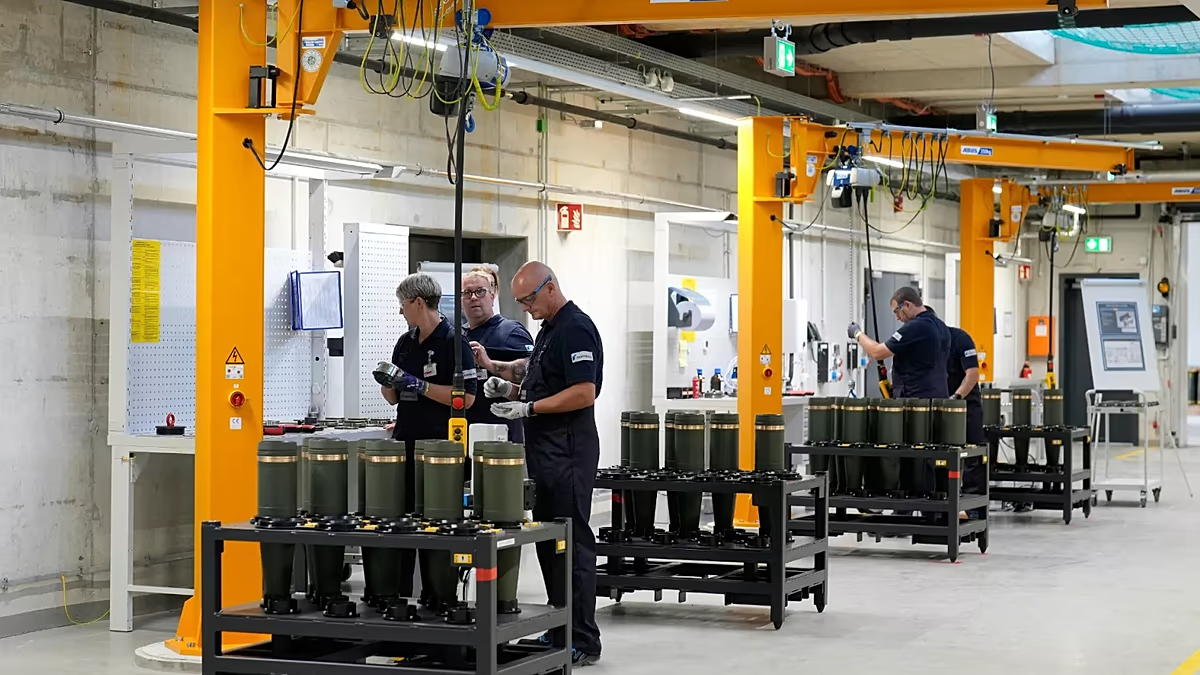
In a significant move to modernize its military capabilities, the German Bundestag’s Budget Committee has given the green light for a major framework contract with defence giant Rheinmetall to produce advanced combat drones for the Bundeswehr. Approved on Wednesday, this deal forms a cornerstone of Germany’s enhanced commitment to NATO’s collective defence, particularly on its eastern flank. The decision underscores a strategic shift in Berlin, reflecting heightened security concerns following Russia’s full-scale invasion of Ukraine. With a potential total value reaching up to €2.4 billion, the project has received an initial authorization of approximately €298 million, marking one of the larger and more technologically focused procurement efforts in recent German military history.
The primary intended deployment for these new unmanned systems is within the German-led NATO brigade stationed in Lithuania. This unit, consisting of around 5,000 soldiers, is a pivotal element of the alliance’s deterrence posture, tasked with guaranteeing the defence and security of NATO’s eastern frontier until at least the end of 2027. The drones are specifically designed as loitering munitions, often colloquially termed “kamikaze drones.” Unlike reconnaissance drones that return to base, these systems are built to circle a designated area for extended periods until a human operator identifies a target and commands the drone to engage, at which point it detonates upon impact. This capability provides a persistent, precise, and responsive strike option, directly supporting the German Defence Ministry’s goal of equipping the Lithuania Brigade with a comprehensive “reconnaissance and strike network” by 2027.
A critical feature of these Rheinmetall drones is their integration of sophisticated sensors and artificial intelligence. The AI algorithms analyse real-time data to autonomously identify and classify potential targets on the ground, presenting them to the drone pilot for a final decision. This human-in-the-loop protocol is emphasized by the Defence Ministry as a fundamental ethical and legal safeguard; the final command to attack must always come from a soldier. This fusion of AI-driven reconnaissance with human oversight is seen as a force multiplier that enhances situational awareness while creating a physical distance between soldiers and the frontline, thereby minimizing direct risk to troops’ lives during engagements.
Notably, Rheinmetall is not the sole beneficiary of this push for drone capabilities. The government has adopted a multi-vendor strategy, having already approved contracts in February with two German tech start-ups, Helsing and Stark Defence. This tripartite approach, as explained by the ministry, is designed to “save time and quickly introduce the new, important capability to the troops.” By fostering parallel development and production streams across three companies, the Bundeswehr aims to accelerate deployment, encourage technological innovation, and build in logistical redundancy to prevent bottlenecks or supply chain failures. All three manufacturers will operate under similar framework agreements, starting with fixed initial orders followed by rigorous qualification tests; successful performance will trigger options for larger follow-on orders under the overarching contract structure.
The drone procurement was one of five substantial defence projects approved by the Budget Committee in its recent session, illustrating a broad effort to bolster Germany’s military readiness. Another key initiative is the further expansion of the “Infantryman of the Future” system, a holistic modernization program for soldiers’ gear encompassing advanced protective clothing, smart weapon optics, and networked command and control equipment. Furthermore, the committee authorized funding for the LARUS sea rescue drone, an unmanned aerial system that supports search and rescue operations in the North and Baltic Seas while also performing reconnaissance missions. Additionally, two projects were approved to upgrade the F124 Sachsen-class air defence frigates with modifications and new onboard systems, strengthening naval capabilities.
Collectively, these approvals represent a tangible and accelerated implementation of Germany’s Zeitenwende, or historic turning point, in security policy. The substantial investment in cutting-edge, AI-enhanced drone technology, coupled with parallel investments in infantry equipment and naval assets, signals a clear intent to transform the Bundeswehr into a more agile, technologically advanced, and robust force. Driven by the enduring threats emanating from the conflict in Ukraine, these measures are fundamentally focused on fulfilling Germany’s NATO obligations with greater resolve and capability, ensuring that its contributions to collective defence, particularly on the vulnerable eastern flank, are both credible and effective for the challenges of modern warfare.