



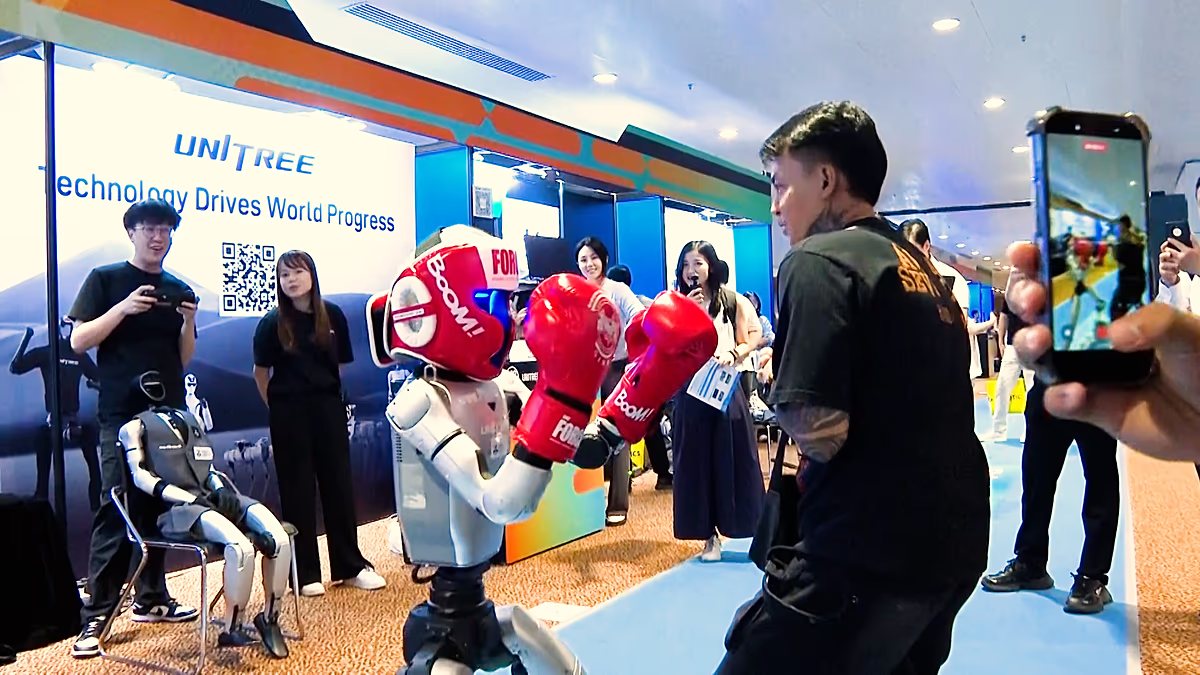
The landscape of advanced robotics is undergoing a profound transformation, and its vibrant epicenter is currently on display in Hong Kong. At the InnoEx technology fair, part of the city’s Business of Innovation and Technology Week, Chinese companies are presenting a staggering assembly of more than one hundred humanoid robots. This is not a niche exhibition of prototypes, but a powerful demonstration of an industry reaching maturity. The event features four of the world’s top five best-selling humanoid robot manufacturers from 2025, including AgiBot, EngineAI, UBTech, and Unitree. Here, machines are not confined to static displays; they are actively boxing with visitors, dancing with fluidity, and engaging in conversations, their expressions rendered through sophisticated synthetic skin and powered by complex artificial intelligence. This gathering signals a decisive shift from science fiction to tangible, interactive reality, showcasing a sector that is ready for integration into daily life.
The interactions at the fair highlight a deliberate move beyond mere mechanical function toward creating relatable, even empathetic, machines. At the Unitree stand, crowds gathered to watch their G1 robot spar with willing participants, a spectacle blending sport and technology. Meanwhile, the synthetic skin developed by firms like Shenzhen DX Intech Technology invited a surprisingly human impulse—touch. Visitors reached out to feel the robots’ faces, a testament to the engineers’ success in bridging the uncanny valley and creating a semblance of life. These robots are already at work in the real world, with some models currently serving as guides in museums and government venues across mainland China. Other companies, like Novautek, are exploring different paths to integration, using screen-based faces to display information and personality. Their vision extends to programming robots with distinct characters capable of providing emotional support and educational instruction, suggesting a future where machines could become companions and tutors.
A central pillar of this robotic evolution is advanced artificial intelligence, which grants these machines not just movement, but cognition and the ability to learn. In one telling exchange, when a robot was asked about the source of its knowledge, it replied, “My knowledge comes from a big omniscient brain inside me, like a comprehensive encyclopaedia. I also keep learning and evolving through large model technology to answer various questions.” This statement encapsulates the dual foundation of modern robotics: vast, pre-loaded datasets combined with adaptive learning algorithms. The most dynamic displays of this synergy came from companies like Shenzhen-based EngineAI, whose PM01 robot elicited cheers from the audience as it performed acrobatic flips, rolls, and dances on stage. This combination of physical agility and cognitive ability is what makes the technology so compelling and potentially disruptive, pointing toward a future of versatile machines capable of complex tasks.
The ambition driving this industry is monumental, rooted in a national strategy that views technological supremacy as paramount. Accelerating the development of humanoid robotics is an explicit priority within China’s latest five-year plan, which aims to “target the frontiers of science and technology.” The results of this focus are clear in the numbers: by 2025, China was home to over 140 humanoid robot manufacturers and more than 330 distinct models. This explosive growth is fueled by what industry insiders describe as key systemic advantages. Robert Chan from EngineAI’s global strategy office pointed to strengths such as low-cost engineering and, crucially, a culture of open knowledge exchange between companies and research institutions. This collaborative ecosystem, he contrasted, differs from tendencies in Europe and the U.S. to guard proprietary technology more closely, allowing for rapid iteration and scaling.
This rapid advancement is inextricably linked to the broader technological rivalry between China and the United States, a competition with growing economic and national security dimensions. Robotics sits at the intersection of AI, advanced manufacturing, and data analytics, making it a field of strategic importance. The commitment to mass production underscores the commercial seriousness of this endeavor; EngineAI itself announced plans to open two new factories in China this year to scale up output. The end goal, as articulated by its representatives, is not just to create machines, but to create preferred partners. Chan suggested a future where people might choose to interact with a robot over a human, for instance, in a sales capacity, precisely because a robot could be perceived as unbiased, informative, and free from hidden agendas designed to serve a human counterpart’s interest.
The exhibition in Hong Kong, therefore, is more than a trade show; it is a window into a deliberate and accelerating future. It presents a world where humanoid robots, cultivated through national strategy, industrial collaboration, and breakthroughs in AI, are poised to step out of exhibition halls and into roles as guides, assistants, workers, and perhaps even companions. The questions it raises are as significant as the technologies on display, touching on the future of work, the nature of human-machine relationships, and the global balance of technological power. As these machines learn, evolve, and become more capable, they challenge us to reimagine the boundaries between human and artificial intelligence, and to consider what kind of future we are building, one synthetic interaction at a time.