



In the vast and calculated realm of space operations, a longstanding barrier has persisted just a few hundred kilometers above our heads. For decades, orbiting a satellite below 500 kilometers was considered a practical impossibility, a dead-end zone shunned by the global aerospace industry. The reason is the tenuous but present atmosphere at these altitudes, which exerts a constant, drag-inducing force. This drag relentlessly slows any object, pulling it back to Earth within a matter of days unless counteracted by immense and unsustainable amounts of fuel. Consequently, the industry settled into higher, more stable orbits, leaving the region known as Very Low Earth Orbit (VLEO)—the band between 150 and 400 kilometers—effectively unexplored and written off as unviable. This uncharted frontier, however, is precisely where a young Spanish startup named Kreios Space has boldly set its sights, developing a revolutionary solution that turns the core problem of drag into its very source of power.
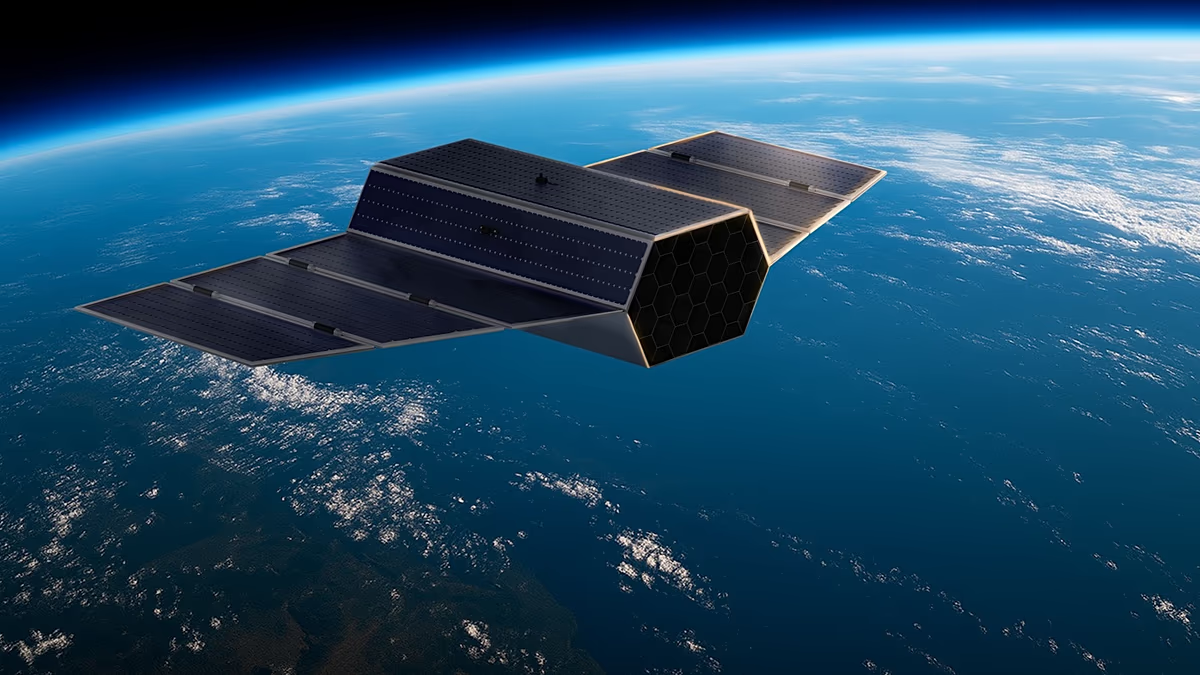
Founded in 2021 by six recent graduates of the Polytechnic School of Catalonia, Kreios Space emerged from a classroom vision into a serious technological contender. The founders, all under 25 at the company’s inception, identified the untapped potential of VLEO and set out to conquer its fundamental challenge. Their breakthrough is the Air-Breathing Electric Propulsion (ABEP) engine, a system of elegant ingenuity. Instead of carrying finite, heavy fuel reserves, this engine captures the sparse atmospheric molecules present at these extreme altitudes. It then converts this captured air into plasma and uses it as propellant, all powered by solar energy. This creates a sustainable cycle where the very drag that doomed previous satellites becomes the feedstock for continuous propulsion. The result is a satellite that can maintain its position for years, not days, leaving no fuel residue and promising no future space debris—a self-sustaining sentinel in a once-forbidden zone.
The profound strategic implications of this technology have not gone unnoticed. In a significant vote of confidence, the NATO Innovation Fund, a €1 billion venture fund backed by 24 allied nations, led an €8 million investment round in Kreios Space in late 2025, marking the first Spanish startup to receive such strategic backing. This move underscores a clear recognition of VLEO’s advantages for security and resilience. Operating dramatically closer to Earth offers transformative benefits: imaging satellites can achieve up to three times the resolution of those in higher orbits, and communications latency can drop to a mere 2-8 milliseconds, enabling direct broadband connectivity to standard mobile devices. Furthermore, VLEO is a pristine environment, free from the crowded and dangerous debris fields that plague Low Earth Orbit, mitigating the risk of catastrophic chain collisions known as Kessler Syndrome. For NATO, enabling persistent, high-fidelity observation and resilient, low-latency communication represents a major strategic asset.
Of course, operating in VLEO presents unique logistical hurdles. Achieving continuous global coverage requires more satellites than in higher orbits, and the constant need for propulsion to counteract drag demands robust and reliable systems like the ABEP engine. Launch logistics are also more complex, as current rockets typically deploy payloads at higher altitudes, requiring a controlled descent into the VLEO zone. Yet, the Kreios team, now grown to 17 people and having relocated its headquarters to Vigo in Galicia, has built the infrastructure to meet these challenges. Their new facilities in Nigrán include a clean room for precision assembly and a vacuum chamber to simulate the harsh conditions of space, allowing them to manage nearly the entire manufacturing and validation process within the region. This local development hub stands as a testament to Galicia’s growing role in Europe’s new space economy.
The immediate path forward is crystallized around a crucial milestone: an in-orbit demonstration. The recent funding is earmarked for launching the first two test satellites, which will put the ABEP engine through its ultimate trial in the actual space environment. Success here will pave the way for commercial constellations aimed at two major markets: ultra-high-resolution Earth observation and direct-to-device communications. The applications are vast, ranging from precision agriculture and natural resource management to critical defense monitoring. Kreios is already collaborating on projects like Ícaro, an early wildfire detection system. In communications, the potential for maintaining functional networks during terrestrial infrastructure failures—such as during major blackouts or natural disasters—promises a new layer of societal resilience.
Kreios Space’s journey, from a university idea to a NATO-backed pioneer in less than five years, is a compelling narrative of youthful ambition meeting profound innovation. None of its founders has yet reached the age of thirty, yet they have developed proprietary breakthrough technology, secured the confidence of a major international alliance, built state-of-the-art facilities, and stand on the precipice of a historic launch. Their story redefines what is possible in orbital mechanics and serves as a powerful measure of what a determined, talented team can achieve when they dare to reimagine a fundamental constraint not as a wall, but as a doorway. In harnessing the atmosphere itself for propulsion, they are not just reaching a new orbit; they are opening an entirely new domain for human ingenuity and exploration.