

Kaylie Kelliher, a 36-year-old mother living in Greenwich, London, is confronting a reality she never imagined possible at her age: the rapid and relentless loss of her sight. Her story dismantles the common assumption that cataracts are an ailment reserved for the elderly, revealing a frightening and isolating journey that began with seemingly minor symptoms. Last August, Kaylie woke to a world that had turned hazy and milky. A visit to a pharmacist led to a diagnosis of conjunctivitis and a prescription for eye drops, but the treatment offered no relief. Instead, her vision continued to decline. She began to perceive car lights not as distinct beams but as blinding, overwhelming halos, making night driving perilous. During a family camping trip at the end of that month, the truth of her deteriorating condition became unavoidable; she was struggling to see the world around her, a world that included her seven-year-old daughter, Boe.
The turning point came in September when a visit to her optician delivered a shocking diagnosis: rapid-onset cataracts. Kaylie was, as she describes, “absolutely dumbfounded.” She protested, telling the optician she was too young for such a condition, and he agreed it was an unusual and alarming case for a 36-year-old. This diagnosis transformed her life from one of normal maternal and domestic activity to one of increasing confinement and helplessness. The clouding of her lenses has progressed so severely that she cannot see her own face in the mirror, cannot watch television, and cannot perform simple personal tasks like painting her toenails or plucking her eyebrows. “I’m not living a life at the minute, I’m housebound,” Kaylie explains, her words painting a picture of a vibrant life suddenly shrinking into darkness. The emotional weight is profound; facing the possibility of blindness fills her with sadness, a sentiment compounded by the speed at which this crisis has unfolded.
The technical measurements of her eyesight reveal the severity of her condition. Her right eye has deteriorated to -12 and her left to -11. In terms of short-sightedness, these are exceptionally high numbers; Specsavers classifies -6 as a large prescription, meaning Kaylie’s vision is impaired far beyond typical levels. Without surgical intervention, this path leads to total blindness. The surgery she needs involves replacing the clouded natural lenses in her eyes with clear artificial ones, a procedure that is typically straightforward and highly successful but is now her only hope to reclaim her sight and her life. Yet, access to this vital treatment has become a formidable financial obstacle, casting a shadow not only over her future but over her present role as a mother.
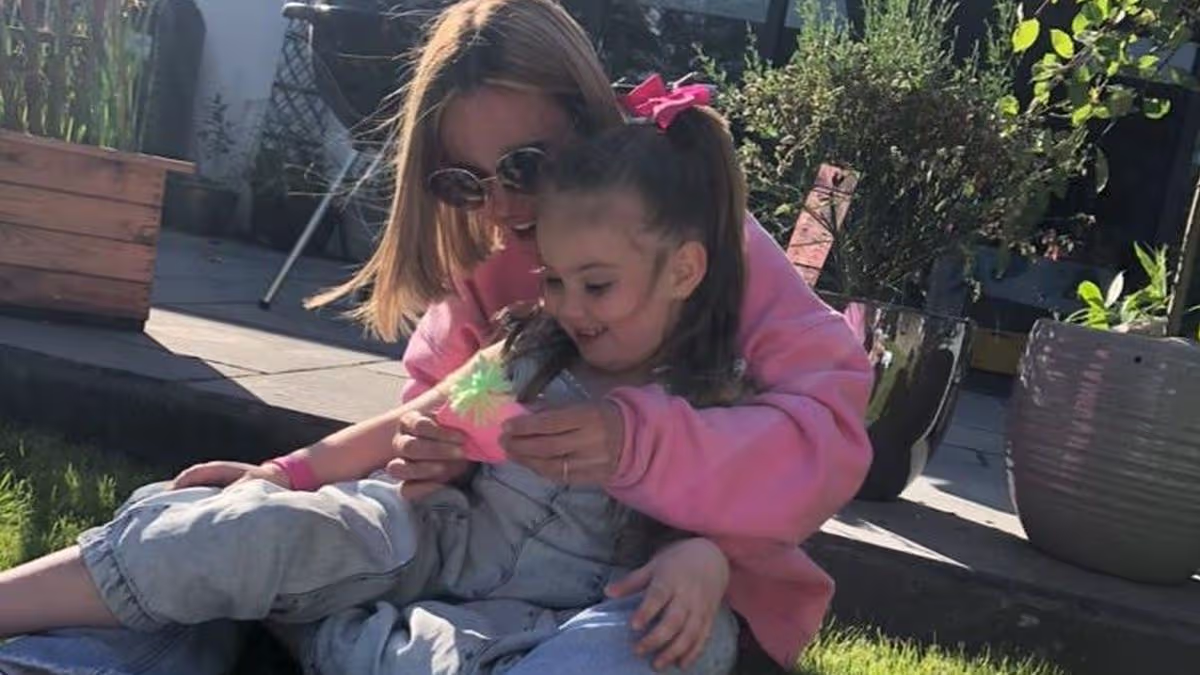
Kaylie’s greatest heartache stems from the impact on her relationship with her daughter. She struggles to see Boe clearly, and the young girl, aware of her mother’s plight, will gently rub her eyes in a simple gesture of care and concern. Kaylie grieves for the experiences she cannot provide: she cannot safely take Boe out on adventures during school holidays, cannot board a bus alone with her, and cannot participate in the shared visual joys of childhood. “I can’t do anything,” she says, highlighting the cruel way this condition steals not just individual sight but shared moments and maternal independence. The danger of navigating the outside world alone with her child has become too great, further imprisoning them both within the limits of her vision.
Recognizing the urgent need, Kaylie’s sister has established a GoFundMe page to raise the estimated £15,000 required for private cataract surgery. Kaylie and her husband, Joe, exist in a financial reality where this sum is an impossible mountain. “There is no way we could ever even contemplate having that sort of money for private surgery. It’s just something we haven’t got,” she admits. This fundraising effort is therefore not a mere convenience but a critical lifeline. The public healthcare system, while offering cataract surgery, often faces significant waiting lists based on clinical priority. For Kaylie, whose sight is vanishing at a terrifying pace, waiting could mean the irreversible loss of her vision before she reaches the operating table. Private treatment offers the only chance for timely intervention to save her sight.
Kaylie’s story is a powerful reminder that health crises do not always adhere to expected timelines. Cataracts, while statistically more common in those over 60, can, through rare and aggressive forms, strike anyone. Her experience underscores the importance of seeking specialist care when symptoms persist and the devastating personal cost when essential medical treatment becomes entangled with financial barriers. As she fights to restore the simple ability to see her daughter’s face clearly and navigate her own life independently, Kaylie’s campaign represents a plea for help not just for a medical procedure, but for the restoration of a mother’s world, a world currently fading into a debilitating and heartbreaking blur. The hope is that through collective support, she can secure the surgery that will pull her back from the brink of blindness and return light, clarity, and life to her eyes.