



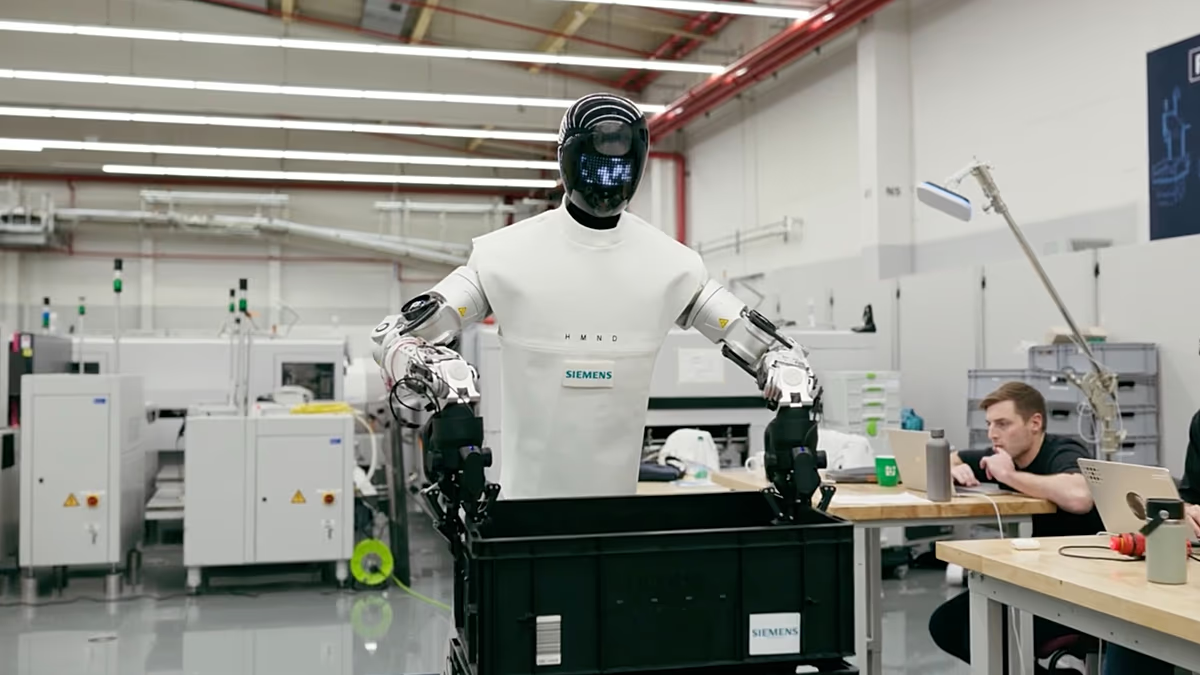
In a significant step toward the long-envisioned future of intelligent manufacturing, a powerful alliance of technology giants has successfully tested a humanoid robot on a live, active factory floor. The trial, conducted at a Siemens electronics plant in Erlangen, Germany, brought together the industrial automation prowess of Siemens, the cutting-edge artificial intelligence platforms of Nvidia, and the specialized robotics hardware from UK-based firm, aptly named Humanoid. This collaboration represents more than just another automation project; it is a concerted push to create a new generation of “adaptive” factories where machines do not merely repeat pre-programmed motions, but perceive, reason, and work autonomously alongside their human colleagues. The deployment of Humanoid’s HMND 01 robot, powered entirely by Nvidia’s AI technology, moves the concept of physical AI—where intelligence escapes the confines of computer screens and interacts directly with the physical world—from laboratory demonstrations into a real-world industrial setting.
During the trial, the humanoid robot was tasked with routine but essential logistics work, specifically picking up, moving, and placing containers used by human workers on the production line. For over eight hours of autonomous operation, the HMND 01 successfully completed more than 90% of its assigned tasks, handling approximately 60 containers per hour. This performance is noteworthy because it involves navigating the unpredictable and dynamic environment of a functioning factory, a stark contrast to the controlled conditions of a research lab. As Deepu Talla, Nvidia’s vice president of robotics and edge AI, explained, the future demands robots that can adapt. This test provided a crucial proof-of-concept, demonstrating that with Siemens’s industrial integration and Humanoid’s robotics platform utilizing Nvidia’s full “physical AI stack,” humanoid robots can begin to meet tangible production targets in a genuine industrial context.
A cornerstone of this accelerated development is the revolutionary use of simulation. The companies revealed that by leveraging Nvidia’s advanced simulation and AI training tools, the vast majority of the robot’s development and training was conducted in hyper-realistic virtual environments. This “simulation-first” approach dramatically reduces the reliance on slow, expensive, and risky physical prototyping. Where such a robotic system might have traditionally required up to two years of design and testing, the virtual pathway slashed that timeline to roughly seven months. This method not only speeds up innovation but also allows engineers to safely train robots for millions of scenarios—from avoiding unexpected obstacles to handling objects of different weights and sizes—before they ever take a physical step. It represents a fundamental shift in how intelligent machines are built and prepared for the complexities of the real world.
The drive toward such advanced automation is fueled by pressing economic and social challenges, most notably acute labour shortages in manufacturing and logistics sectors worldwide. Traditional, rigid industrial robots excel at repetitive tasks in fixed locations but struggle with the variability and dexterity required for many manual jobs. This gap has left a multitude of complex, yet routine, tasks—like the container handling in this test—firmly in the realm of human workers. The adaptive, AI-driven humanoid robot is envisioned as a solution to this impasse. By being mobile, dexterous, and capable of learning, these robots could step into roles that have so far resisted automation, assisting human teams rather than replacing entire assembly lines. This partnership explicitly aims to create machines that can collaborate with people, taking over strenuous or monotonous logistical duties to free up human workers for more skilled, cognitive, and creative functions.
Despite the excitement surrounding this milestone, the path to widespread adoption remains carefully measured. The companies involved have been clear to frame this trial as a successful but early step on a longer journey. They have not provided a specific timeline for the commercial rollout of such systems, acknowledging the significant work still required in reliability, safety certification, and cost reduction. The goal is not to suddenly populate factories with human-like machines, but to methodically prove the technology’s value, robustness, and return on investment. This cautious optimism reflects the understanding that integrating such advanced, autonomous systems into complex human-centric workplaces requires more than just technical success; it demands unwavering proof of safety, seamless interoperability with existing industrial processes, and ultimately, clear economic benefits for manufacturers.
Ultimately, the Siemens, Nvidia, and Humanoid collaboration is a vivid signal of where industrial automation is headed. It moves beyond the paradigm of isolated machines bolted to the floor, toward a future of mobile, intelligent assistants that share our workspace. By combining world-class industrial engineering, groundbreaking AI, and agile robotics development through simulation, this partnership is constructing a blueprint for the adaptive factory. While humanoid robots working alongside people may not become commonplace tomorrow, this test in Erlangen proves that the foundational technology is no longer science fiction. It is a working prototype, moving containers in a German factory today, and in doing so, it is quietly laying the groundwork for a more flexible, resilient, and collaborative industrial world.