



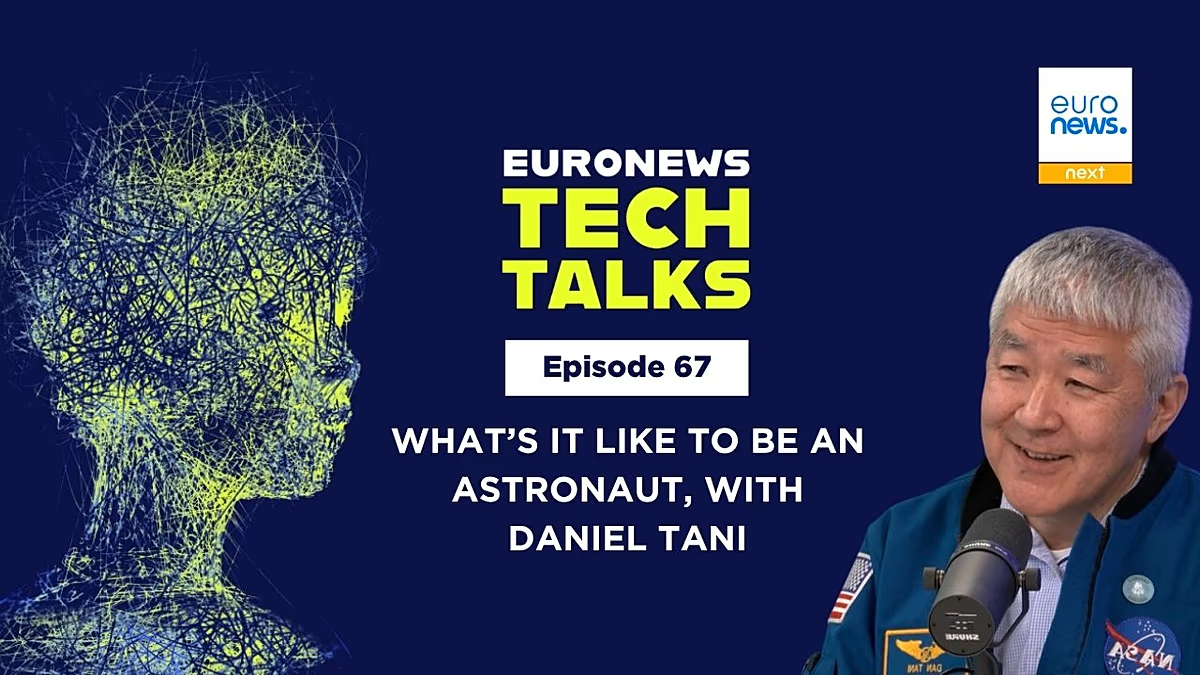
While many children of the Apollo era dreamed of becoming astronauts, Daniel Tani’s childhood passions were far more grounded in the tangible world of making and building. Fascinated by constructing objects like clock radios and toothbrushes, he followed a logical path into engineering. Yet, through his work in the aerospace sector, the stars—quite literally—aligned for him. After several applications to NASA, he received a famously cryptic phone call in 1996. The caller never uttered the word “astronaut,” instead simply asking if he wanted to “come down and work for us.” Tani enthusiastically agreed, hanging up the phone with a mixture of excitement and wonder about what he had just accepted. This moment launched a career that would see him spend over 130 days in space, primarily aboard the International Space Station (ISS), and embark on six extraordinary spacewalks.
Despite the profound privilege of walking in space, Tani is quick to dispel any romantic notions about the physical experience itself. He describes the spacesuit as bulky, heavy, and deeply uncomfortable, requiring astronauts to endure it for up to twelve hours for a single six-to-seven-hour excursion. However, he asserts that every moment of discomfort is instantly forgotten the second the hatch opens. The overwhelming sensory experience of floating into the void, holding onto a station moving at 17,500 miles per hour, is life-changing. Against the infinite darkness of space, the brilliant structure of the ISS, and the breathtaking panorama of Earth 250 miles below—where he could pick out Baja California and recognize the shape of Italy—any physical hardship melted away. His most salient memory from that first walk, however, was the intense, focused pressure to perform flawlessly in such an unforgiving environment.
Reflecting on his time in orbit, Tani’s perspective is deeply shaped by his long-term residence on the International Space Station, which he views as a pinnacle of peaceful global cooperation. Born from the U.S. “Space Station Freedom” project, the ISS evolved after the Cold War into an unprecedented partnership between the United States, Russia, Japan, Canada, and Europe. For Tani, the station stands as a powerful testament to how shared scientific and exploratory goals can transcend political tensions. Even as geopolitical relationships have faced strains on Earth, the commitment to maintaining the orbiting laboratory has persisted. Tani expresses a palpable sadness about the station’s planned decommissioning around 2030–2031, not just for the loss of the engineering marvel itself, but for the potential end of the regular, mission-critical dialogue it demands from international leaders.
The retirement of the ISS coincides with a dramatic transformation in the landscape of space exploration, ushering in an era defined by commercial innovation and new global players. Private companies like SpaceX are now dominant actors, driving down costs and increasing access to orbit, while a growing number of nations are developing their own space capabilities. Tani views this shift with a balanced eye. He acknowledges that competition can be a healthy catalyst for innovation, efficiency, and affordability, accelerating progress in ways that monolithic government programs sometimes cannot. However, he also cautions that this new dynamic risks fostering division and hard feelings in a domain that has historically benefited from collaboration. The central challenge, as he sees it, will be finding a sustainable equilibrium between the driving forces of competition and the imperative for cooperative stewardship of space.
Looking ahead, the future of human activity in orbit will likely be shaped by this public-private, multi-national ecosystem, with commercial stations poised to replace the ISS. This new chapter raises profound questions about the utilization of space resources, the establishment of norms for behavior, and the management of an increasingly crowded orbital environment. Tani’s experience provides a unique lens through which to view this transition. His career bridges the era of government-led, symbolic international projects and the emerging age of commercial expansion. He embodies the shift from an astronaut who was a government employee operating a national vehicle to one who soared on the wings of multinational cooperation.
Ultimately, Daniel Tani’s journey—from a boy who loved building things with his hands to an engineer holding onto a space station while looking down at a fragile, borderless Earth—offers more than just a tale of personal achievement. It is a human-scale story within a grand technological saga. His recollections ground the awe-inspiring spectacle of spaceflight in the very real sensations of pressure, discomfort, and focus, while his insights underscore a crucial human truth. Whether in the collaborative spirit of the ISS or the competitive stir of the new space age, our endeavors beyond Earth remain a reflection of ourselves: our ingenuity, our ambitions, and our enduring need to both explore and connect. The legacy of his view from outside will continue to inform how we navigate the promising yet complex frontier that lies ahead.