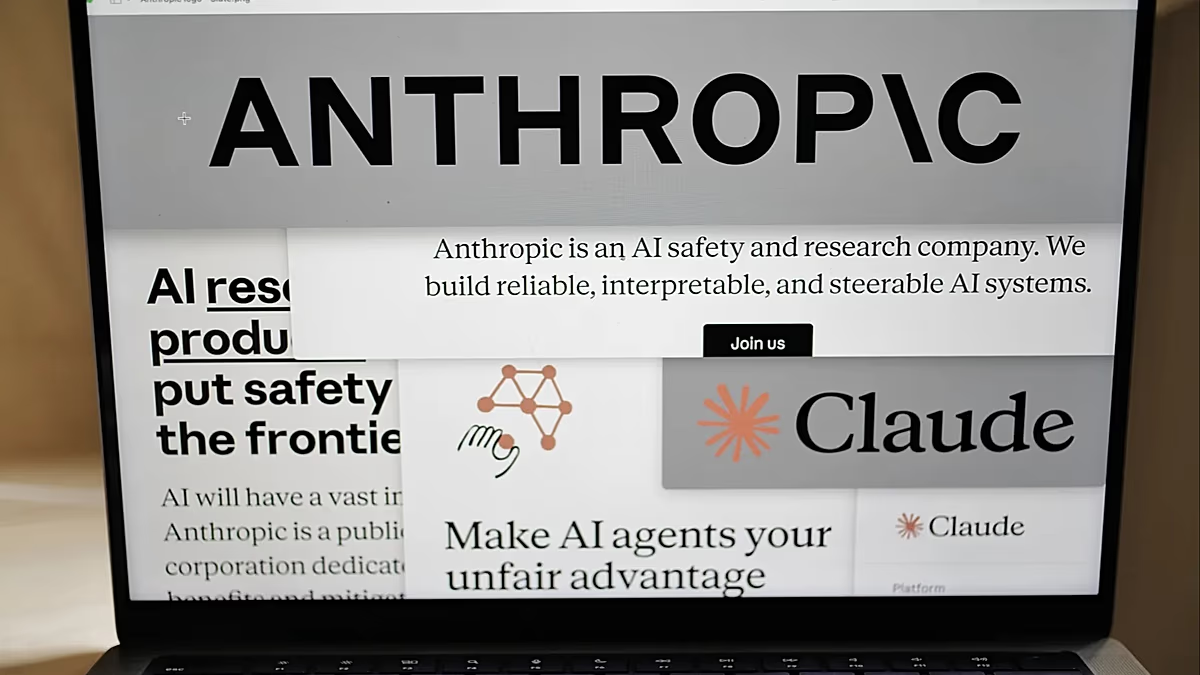


In a world increasingly defined by digital infrastructure, the guardians of our cyberspace are engaged in a relentless, silent war. The battleground is the code that powers everything from our national power grids and water treatment facilities to our personal web browsers and hospital databases. For years, the defense has relied on human experts and traditional software tools, a strategy often overwhelmed by the scale and sophistication of modern threats. Now, a new kind of ally is entering the fray, not with a shield, but with an intelligence capable of parsing millions of lines of code at superhuman speed. Anthropic, a leading artificial intelligence research company, is significantly expanding the frontline deployment of its specialized cybersecurity model, named Mythos, by inviting approximately 150 new partner organizations into its testing program. This move signals a pivotal moment in the practical application of AI for proactive defense, moving from theoretical research into the hands of those who operate the systems upon which modern society depends.
The initiative, known as “Project Glasswing,” began with a tightly controlled group of 50 initial partners. The results from this preview phase have been nothing short of staggering. According to Anthropic, Mythos has already identified thousands of high-severity vulnerabilities, uncovering critical flaws in every major operating system and web browser. These initial partners used the model to find more than 10,000 security issues classified as high or critical risk. The expansion now brings in organizations from over 15 countries, spanning a diverse and critical array of industries: power generation and distribution, public water utilities, healthcare networks, global communications systems, and hardware manufacturers. Anthropic explicitly states a grim but unifying criteria for its new partners: a successful cyberattack on any of their codebases could lead to catastrophic real-world consequences. The company estimates that for most of these new organizations, a major breach would directly impact the lives and safety of over 100 million people.
This sense of urgency driving the expansion is rooted in a sobering forecast about the near future of AI itself. Anthropic is operating under the conviction that within the next year, several other AI companies will develop models with capabilities rivaling or exceeding those of Mythos. The concern is not the advancement of technology itself, but the potential for its reckless deployment. The company warns that these powerful tools “could be released without safeguards that prevent misuse.” In such a scenario, the digital landscape would transform into a far more dangerous place. Malicious actors, equipped with equally powerful AI assistants, could launch cyberattacks with unprecedented frequency, speed, and creativity, exploiting vulnerabilities in “much more unpredictable forms.” By proactively placing Mythos—developed with a strong emphasis on safety and alignment—into the hands of critical infrastructure defenders now, Anthropic aims to build a robust defensive bulwark before the offensive capabilities become widely and uncontrollably available.
The strategic importance of Project Glasswing is underscored by the caliber of organizations expressing interest. One notable potential customer is the European Commission, the executive branch of the European Union, which confirmed to US media that Anthropic had approached it regarding the use of Mythos. While details of any formal agreement are still under independent verification, the mere fact that a major governmental body is considering the tool highlights its perceived value at the highest levels of policy and security. Integrating an AI model like Mythos into the cybersecurity protocols of a transnational institution like the EU would represent a landmark adoption, potentially setting a new global standard for how public institutions leverage advanced AI for collective security and resilience.
This ambitious expansion coincides with a period of remarkable momentum for Anthropic as a company. The announcement comes just one day after the firm confidentially filed paperwork for an initial public offering (IPO), a major step that would transition it from a privately-held entity to a publicly-traded company. This move is often pursued to raise substantial capital for growth, reward early investors, and increase public profile. It follows a recent and colossal funding round of $65 billion (approximately €59 billion), which has propelled the company’s estimated valuation to nearly $1 trillion (€878 billion). These financial milestones reflect not only immense investor confidence in Anthropic’s technology and vision but also the vast economic stakes perceived in the future of safe and beneficial artificial intelligence. The resources garnered will undoubtedly fuel further development of models like Mythos and their integration into global systems.
In conclusion, the scaling of Project Glasswing is more than a simple product rollout; it is a strategic maneuver in the high-stakes arena of global cybersecurity. By deploying Mythos to a vast network of critical infrastructure partners, Anthropic is attempting to fortify the digital foundations of society ahead of a predicted wave of AI-powered threats. The collaboration with entities from the power, water, healthcare, and governmental sectors demonstrates a practical, application-focused path for AI that moves beyond chatbots and content creation into the domain of essential public safeguarding. As Anthropic itself navigates a transformative period with its IPO and astronomical valuation, the success of Mythos will be measured not in stock prices, but in its tangible contribution to stability and security—its ability to find the hidden flaws in our complex digital world before they can be exploited, protecting the millions who rely on these systems every single day.