



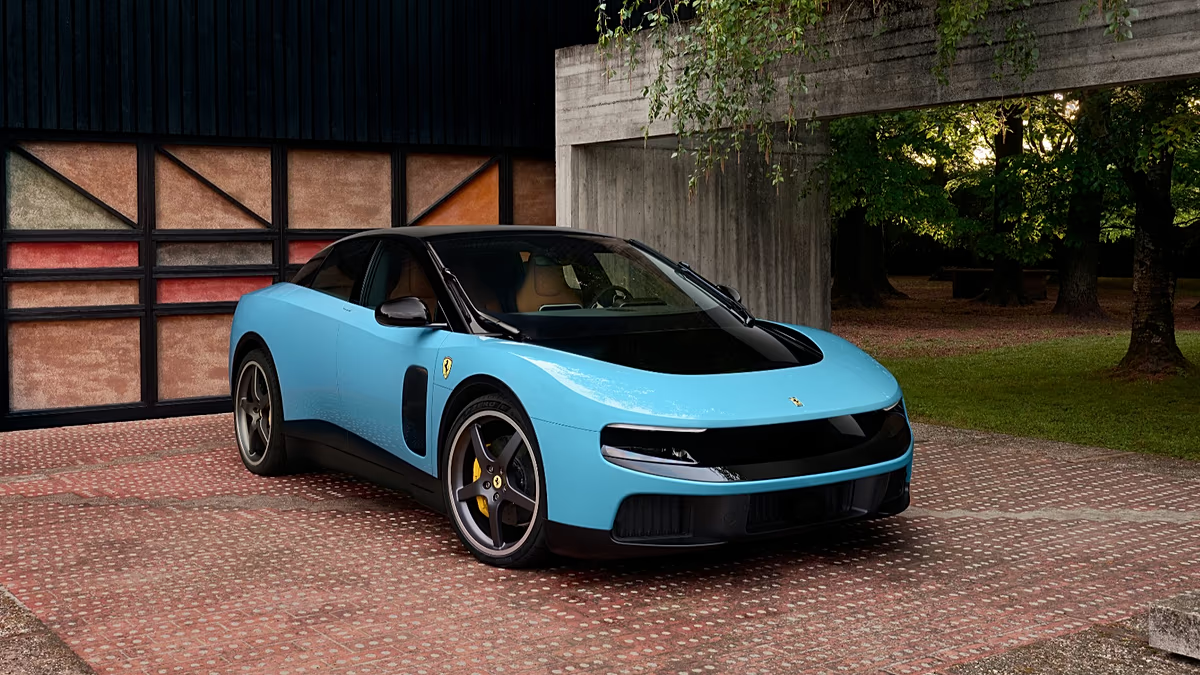
Ferrari, a name synonymous with roaring engines, sculpted curves, and a legacy of Italian passion, has embarked on its most audacious journey yet. On Monday, the marque unveiled the Ferrari Luce, its first fully electric vehicle. With a price tag of €550,000, it immediately positioned itself as one of the world’s most exclusive and expensive EVs. The significance of the moment was underscored by Ferrari Chairman John Elkann, who presented the car to Italian President Sergio Mattarella at the Quirinale Palace. Yet, far from universal celebration, this historic pivot sparked an immediate and fierce controversy, revealing deep tensions about innovation, heritage, and national identity.
The backlash was swift and merciless, primarily flooding in from social media. The Luce—whose name means “light” in Italian and was designed in collaboration with former Apple design chief Jony Ive—found itself mocked for its aesthetics. Its smooth, glassy, and minimalist exterior, a stark departure from Ferrari’s traditionally muscular and aggressive silhouette, was compared online to mundane mass-market cars like the Nissan Leaf or a budget Toyota. One widely shared post quipped that it looked “less like a supercar and more like a budget Nissan.” The market reacted in tandem; Ferrari shares fell as much as 7.8% in Milan trading following the reveal, suggesting investor unease about this radical new direction.
Criticism was not confined to anonymous commentators. It took on a weighty, political dimension when Carlo Calenda, a former Italian industry minister with a past at Ferrari, levied a scathing judgment. He called the Luce “an aesthetic and technological insult to anyone who loves Ferrari” and used the occasion to deliver a sweeping indictment of John Elkann’s leadership. Calenda argued that Elkann, who chairs both Ferrari and the Agnelli family’s holding company Exor, has presided over the “steady dismantling of Italy’s industrial heritage.” He pointed to the sale of auto parts maker Magneti Marelli (now in bankruptcy), the divestment of robotics unit Comau, and the demerger of truck maker Iveco. The poignant disappearance of Fiat as an autonomous Italian brand within the Stellantis merger was noted, alongside talks to sell prominent newspapers like La Repubblica and La Stampa. Even Ferrari’s Formula One record—without a championship since 2008—was cited as evidence of a broader decline under Elkann’s stewardship.
Yet, beneath the polemics, the Luce is undeniably a feat of engineering. It is emphatically not your grandfather’s Ferrari, but it is built to perform. Its four electric motors—one for each wheel—generate over 1,000 horsepower, propelling the car to 100 km/h in a blistering 2.5 seconds and achieving a top speed exceeding 310 km/h. Practical for a grand tourer, it seats five and boasts a 600-litre boot. Ferrari also addressed a core emotional concern for enthusiasts: the sound. The company spent five years developing an acoustic system that captures and amplifies the natural hum of the electric motors, eschewing a synthetic imitation of a traditional engine roar. This represents a philosophical choice to authentically express the new technology, rather than mimic the past.
The design itself is the most visible declaration of this new philosophy. Crafted with Jony Ive’s LoveFrom collective, the Luce’s clean, uninterrupted surfaces and glass-like finish mark a conscious break from history. It is a car conceived not from nostalgia, but from a vision of a future where luxury and performance are expressed through purity and light. Ferrari’s leadership appears resolute in this vision. Elkann, addressing journalists at the Rome launch, stated, “Ferrari Luce is not a response to change. It’s a decision, a deliberate decision, to lead what comes next with clarity, with courage.” The company is proceeding with commercial confidence, opening orders and expecting deliveries before the year’s end.
The unveiling of the Ferrari Luce is, therefore, far more than a simple product launch. It is a cultural event, a high-stakes gamble that lays bare a conflict between preservation and progression. On one side lies a profound attachment to a legacy of mechanical theater, national industrial pride, and iconic design. On the other is a bold claim to define the next era of automotive emotion through silence, minimalism, and electrified power. Whether the Luce will be remembered as a misstep or a masterstroke will ultimately be decided not just by critics or shareholders, but by time and by those who choose to drive it into the future.