



The Future Takes Flight: SpaceX’s Starship Delay and Historic IPO
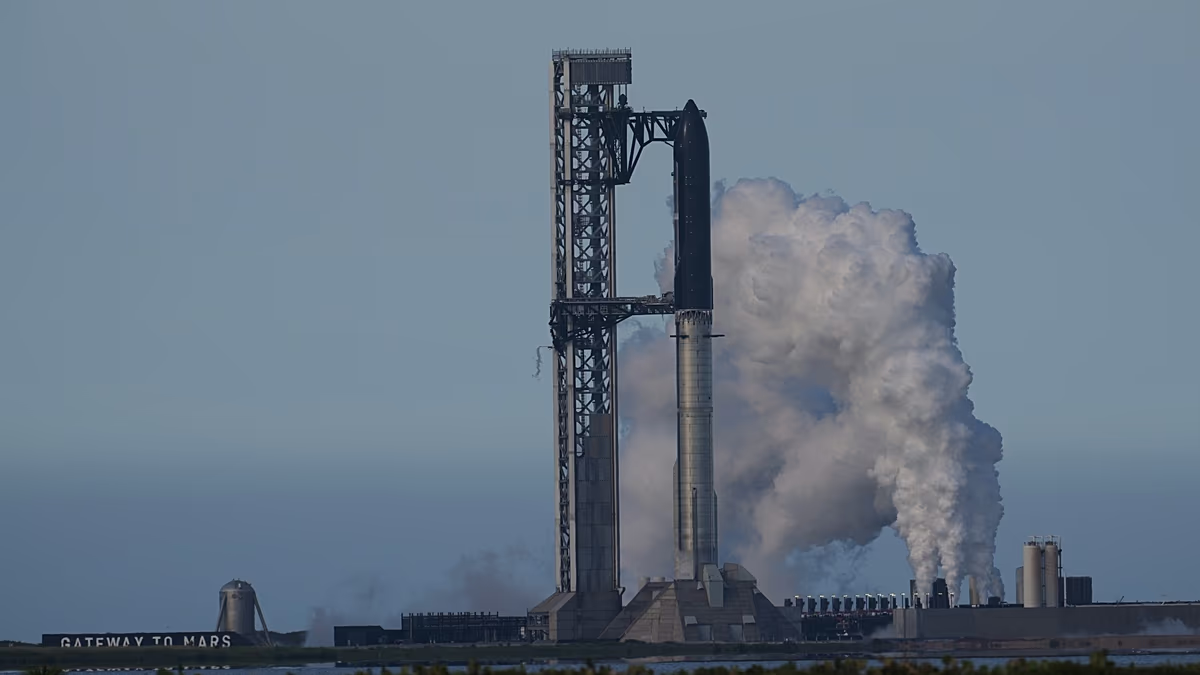
In the world of modern exploration, few events capture global attention like a SpaceX launch. This week, that anticipation was tempered by a last-minute delay, as the 12th test flight of the monumental Starship rocket was postponed just seconds before ignition. Scheduled for a Thursday launch from Texas, the mission was halted due to a technical issue with a hydraulic pin holding the launch tower’s arm. In the characteristic style of its founder, Elon Musk, the company swiftly pivoted, announcing a new attempt for Friday. This minor setback, however, occurs against a backdrop of a far more seismic corporate event: SpaceX’s impending stock market debut, which promises to be the largest Initial Public Offering (IPO) in history.
The timing of this launch delay is particularly poignant because the success of the Starship program is now intertwined with the company’s financial future. Just a day prior to the scrubbed launch, SpaceX confirmed its path towards an IPO, targeting a staggering valuation of $1.75 trillion. The performance of the Starship V3—the latest and most powerful iteration of the rocket—is seen as a critical factor that could significantly influence investor enthusiasm and share sales once the company goes public. This uncrewed vehicle, already refined through dozens of upgrades for rapid NASA moon missions and massive Starlink satellite deployments, embodies the company’s ambitious engineering ethos. Its journey to the pad has been long, facing months of delays due to exhaustive testing and redesign, making each launch attempt a high-stakes milestone.
The specific hiccup—a mechanical pin that failed to retract—is a classic example of the intricate challenges of rocket science. Yet, Musk promptly communicated the issue and the plan to resolve it, reflecting a transparent and fast-paced operational culture. He also sought to reassure stakeholders, noting that a failure would not be catastrophic, likely delaying future tests by only a month, as multiple backup V3 vehicles and boosters exist. This attitude underscores SpaceX’s foundational strategy of “extreme flight-testing,” where real-world launches actively probe for failure points, leading to iterative and rapid enhancements. This approach, while risky, has propelled them forward at a pace unmatched in the aerospace industry.
The investment behind this bold strategy is monumental. SpaceX has already poured over $15 billion into developing the fully reusable Starship system. The company’s vision for this rocket is not merely lunar landings; it is a fundamental rethinking of space economics and capability. In its IPO filing, SpaceX hailed Starship V3 as “the most powerful launch system ever developed,” expecting it to carry 100 metric tons to orbit, with future generations aiming to double that payload. The goal is to dramatically slash launch costs, thereby making projects like orbital data centers and deep-space exploration financially feasible. Starship is the vehicle intended to transform SpaceX from a launch provider into an architect of humanity’s future in space.
This transformation is now culminating in a financial event that will reshape the market and history. SpaceX plans to list on the Nasdaq in June under the ticker SPCX. The IPO is structured to cement Musk’s control, with a dual-class share system granting him over 85% of voting power. The offering’s scale could also catapult Musk into unprecedented financial territory, potentially making him the world’s first trillionaire, following his record as the first person to reach a net worth exceeding $500 billion last year. Given the anticipated colossal demand, details on how retail investors can access shares are still pending, but the offering will undoubtedly be a landmark moment for the tech and investment worlds.
Thus, what began as a story about a delayed rocket launch unfolds into a narrative about the convergence of technological ambition and financial destiny. The Friday launch attempt is more than another test; it is a live demonstration of the capability underpinning a historic corporate transition. As SpaceX stands at the threshold of both a new era in spaceflight and a record-breaking entry into the public market, each ignition of the Starship’s engines carries the weight of that dual promise. The world watches, not just for a rocket’s ascent, but for the lift-off of an entire new chapter in how we reach for the stars and how we value those who dare to build the path.