


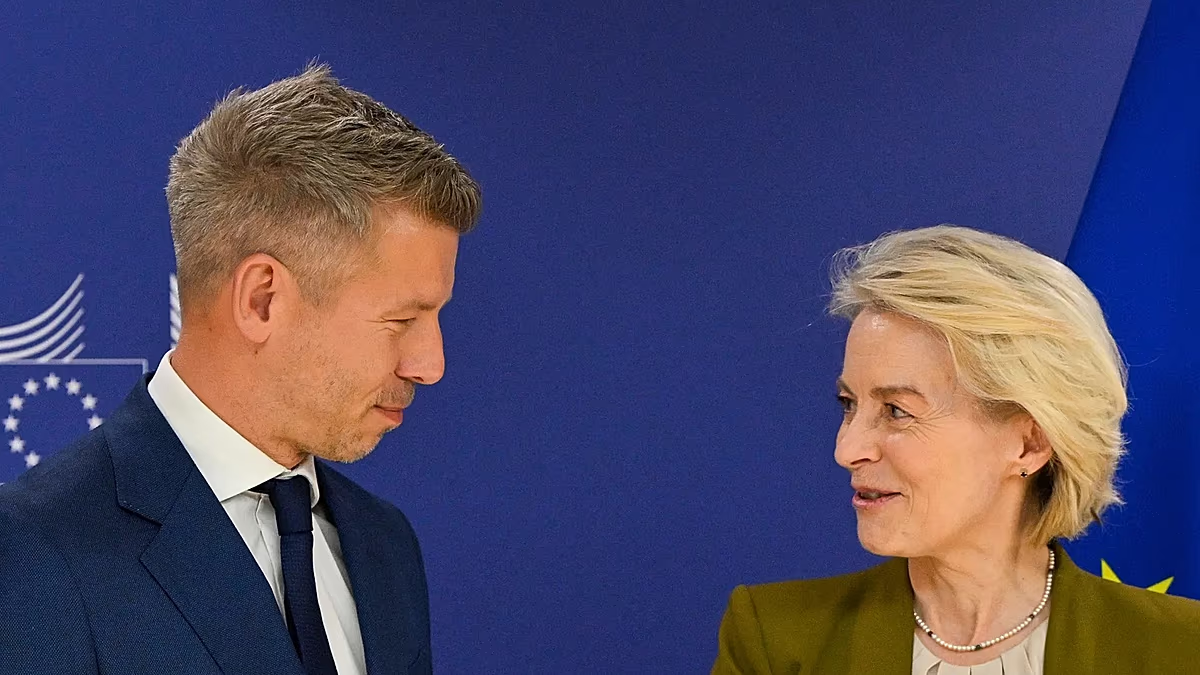
A critical and time-sensitive negotiation is underway between the European Union and Hungary, centered on unlocking €17 billion in frozen EU funds. The core of the dispute, as revealed in technical talks, lies in Budapest’s resistance to implementing specific reforms to its pension system and tax code. These measures were conditions attached to the funds, initially blocked over rule-of-law and corruption concerns during the previous administration of Viktor Orbán. Hungary’s new Prime Minister, Péter Magyar, faces a severe dilemma: the August 31st deadline to access €10.4 billion in post-COVID recovery funds is fast approaching, and his government argues that complex, sweeping reforms cannot be responsibly enacted in such a short timeframe, especially given the country’s strained budget.
The political stakes for Prime Minister Magyar are exceptionally high. Pension reform was a central promise of his electoral campaign, with his Tisza party pledging to raise minimum and below-average pensions—a popular measure that seems at odds with the EU’s demand for a broader, more structurally sustainable pension overhaul. Similarly, Magyar has publicly rejected phasing out special windfall taxes on sectors like energy and finance, which Brussels sees as market-distorting. He argues that in the current fiscal climate, the state cannot afford to relinquish this revenue. This creates a tight political bind: acceding to Brussels too quickly could be seen as abandoning campaign vows, while inflexibility risks losing billions essential for the Hungarian economy.
Recognizing the logistical impossibility of fully meeting all original conditions by the deadline, the negotiation has entered a pragmatic phase. A large delegation of over twenty EU experts descended on Budapest to assess what is realistically achievable. In a significant shift in strategy, Brussels has advised Hungary to focus solely on securing the €6.5 billion non-repayable grant portion of the recovery funds and to forgo the additional €3.9 billion in loans. This advice is rooted in concern that more borrowing would exacerbate Hungary’s debt, illustrating a nuanced approach where the Commission is balancing its reform demands with the economic stability of the member state.
The anticipated outcome of this technical wrangling is a high-level “political agreement” expected to be signed by Prime Minister Magyar and Commission President Ursula von der Leyen in Brussels next week. This agreement would be largely symbolic, marking a declared fresh start in EU-Hungary relations and setting a new timeline for compliance. It would also reaffirm Hungary’s commitment to long-standing EU integration goals, notably joining the European Public Prosecutor’s Office and the eurozone. However, officials are clear that the funds themselves will only flow once Hungary demonstrably meets its obligations, which include fulfilling 27 “super milestones” and hundreds of individual targets.
Beyond the recovery fund deadlock, progress appears possible on other fronts that have long poisoned the relationship. One bright spot is the potential resolution of the Erasmus+ dispute, which suspended 21 Hungarian universities from EU exchange programs over governance concerns. This issue has been particularly galling for Brussels, as it penalizes precisely the pro-European youth who are key to Hungary’s democratic future. A resolution would not require the abolition of the controversial university foundations but would demand credible governance changes. Meanwhile, a far heavier financial burden continues: a €1 million daily fine imposed by the European Court of Justice for Hungary’s non-compliance with asylum rules, another costly legacy that Magyar has signaled he must address.
The current standoff represents more than a technical budget discussion; it is a defining test for Hungary’s new political direction and the EU’s ability to enforce its principles while supporting a member state in transition. Prime Minister Magyar is navigating between the hard constraints of the calendar and the budget, the high expectations of his electorate, and the non-negotiable requirements of Brussels. The coming days will reveal whether a face-saving political declaration can pave a credible path forward, or if Hungary will forfeit a historic sum of money, with profound consequences for its economy and its standing within the European family. The outcome will hinge on finding a fragile balance between principle and pragmatism.