


Paragraph 1: An Offer Amidst Escalating Tensions
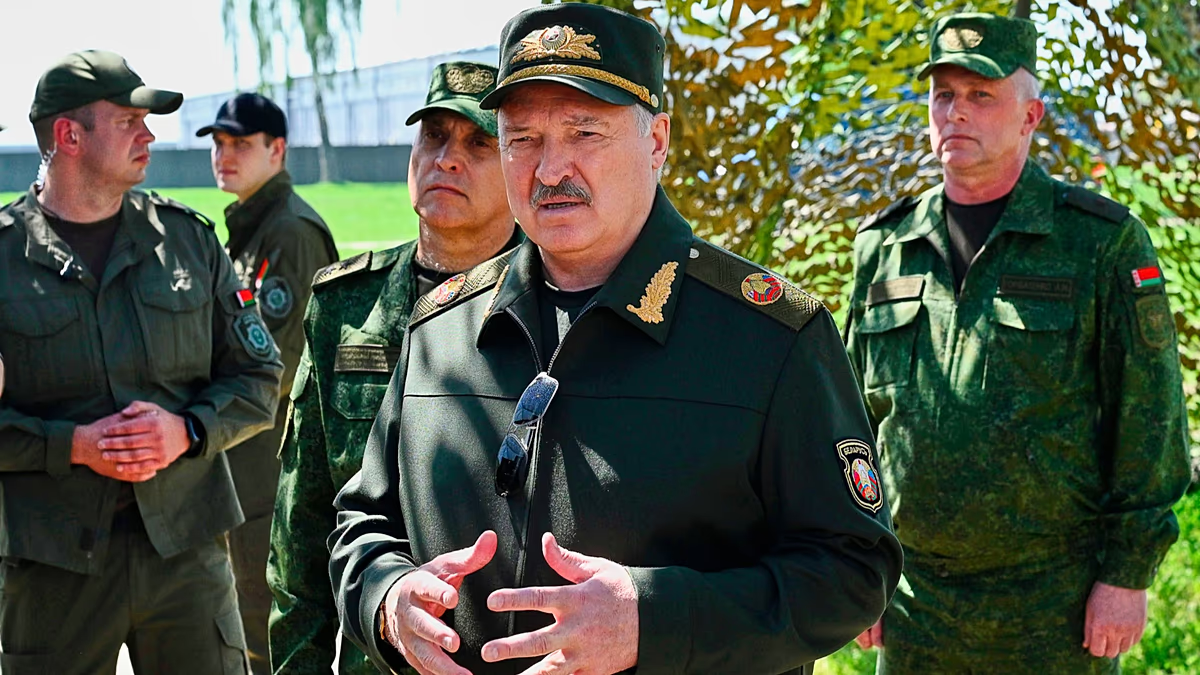
In a complex dance of diplomacy and military posturing, Belarusian President Alexander Lukashenko recently extended an offer to meet with Ukrainian President Volodymyr Zelenskyy “anywhere—in Ukraine, in Belarus.” He framed this as an opportunity to discuss the “problems of Belarusian-Ukrainian relations.” However, this gesture of openness arrives against a backdrop of severe distrust and escalating threat. Kyiv is currently warning that Russia is preparing a new offensive through Belarusian territory, targeting Ukraine’s capital and the northern Chernihiv region. Zelenskyy has responded by ordering the reinforcement of Ukrainian forces and fortifications along the northern border and has instructed his foreign ministry to prepare additional diplomatic measures against Belarus. The Ukrainian leadership views Lukashenko’s words with profound skepticism, dismissing the proposal as hollow, given that Belarusian territory was used as a launchpad for the initial Russian invasion in 2022.
Paragraph 2: The Shadow of History and the Language of “Aggression”
The core of Ukraine’s dismissal lies in a painful historical precedent. In 2022, Belarus also denied any intention to join Russia’s war, yet it provided its territory and military facilities for the assault on Kyiv. Lukashenko now repeats a familiar conditional clause: Belarus will not get drawn into the war unless “aggression is committed against its territory.” This mirrors his justification in 2022, where he claimed an attack was being prepared on Belarus, thus legitimizing his support for Moscow’s invasion. For Ukraine, this rhetoric is not a guarantee of neutrality but a potential pretext for future involvement. Zelenskyy has explicitly warned the Belarusian leadership to “stay on its toes” and understand that aggressive actions will have consequences. The situation is further charged by Ukrainian military reports indicating Belarus is building roads toward the border and setting up artillery positions, actions that Kyiv interprets as preparatory steps for renewed conflict.
Paragraph 3: Expanding the Sphere of Threat: NATO’s Eastern Flank
The tensions radiating from Belarus extend beyond the Ukrainian border, casting a shadow over NATO’s eastern members. In April, Lukashenko made unsubstantiated claims about alleged aggression from Poland and the Baltic states—Lithuania, Latvia, and Estonia—and outlined how Minsk and Moscow would respond “using all available means,” a thinly veiled reference to nuclear weapons. This rhetoric was followed by joint Russian-Belarus nuclear exercises, which included the deployment of Russian nuclear munitions to storage facilities in Belarus. Simultaneously, Russia’s Foreign Intelligence Service (SVR) alleged that Ukraine was preparing drone attacks from Baltic territory, specifically Latvia, and threatened “just retribution,” ominously noting that NATO membership would not protect “those who aid terrorists.” This creates a deliberate atmosphere of menace, attempting to frame NATO nations as co-aggressors and justifying potential escalation.
Paragraph 4: Denials and a Unified European Response
The Baltic states and Ukraine have firmly rejected these accusations, labeling them as a coordinated disinformation campaign. Nonetheless, the threats have tangible effects, with Baltic nations experiencing numerous air raid alerts due to drone incursions originating from the region. European Commission President Ursula von der Leyen condemned these actions as unacceptable, stating unequivocally that “Russia and Belarus bear direct responsibility” for endangering security on Europe’s eastern flank. She pledged that “Europe will respond with unity and strength,” signaling a collective NATO and EU stance against this hybrid tactic of combining military drills with psychological and disinformation warfare. The aim is clearly to test and strain the resolve of NATO’s frontline states.
Paragraph 5: The Impossible Dialogue: Actions Versus Words
This context makes Lukashenko’s offer for dialogue appear almost surreal. For Ukraine, engaging in talks under the looming threat of a Belarus-facilitated offensive, while Belarus simultaneously conducts nuclear drills with Russia and issues threats against NATO allies, is untenable. Zelenskyy’s advisor, Dmytro Lytvyn, summarized Kyiv’s position: since 2022, Lukashenko’s words mean nothing; only his actions matter. The proposed meeting is seen not as a path to peace, but as a potential tool for Russia and Belarus to create diplomatic cover, sow confusion, or extract concessions while military preparations advance. Ukraine’s focus is therefore on “preventive” and defensive measures—fortifying its border, strengthening its northern forces, and preparing diplomatic countermeasures.
Paragraph 6: A Perilous Standoff with Broad Implications
The situation presents a perilous standoff with wide-ranging implications. On one front, Ukraine is bracing for a potential renewed military assault from its north, a nightmare scenario replaying the early days of the war. On another, NATO’s Baltic members face a campaign of nuclear saber-rattling and fabricated accusations designed to intimidate and destabilize. Lukashenko, positioned as both a potential mediator and a complicit ally of Moscow, speaks in contradictory tones of peace and threat. This duality paralyzes any genuine diplomatic opening. The overarching narrative is one of prepared aggression, justified by a recycled rhetoric of victimhood and defensive necessity from Moscow and Minsk. In response, Ukraine and Europe are unifying around a principle of observing actions, not words, and preparing to meet any escalation with determined resistance and collective strength. The promise of a meeting is drowned out by the drumbeat of military preparation and geopolitical threat.