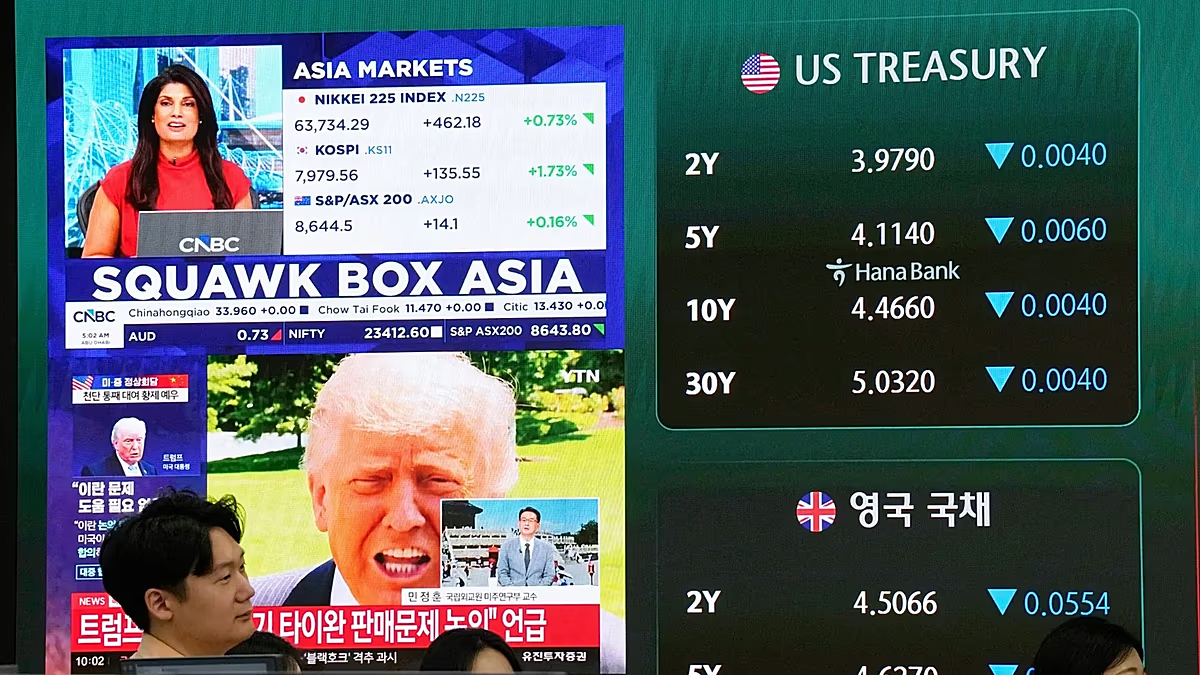




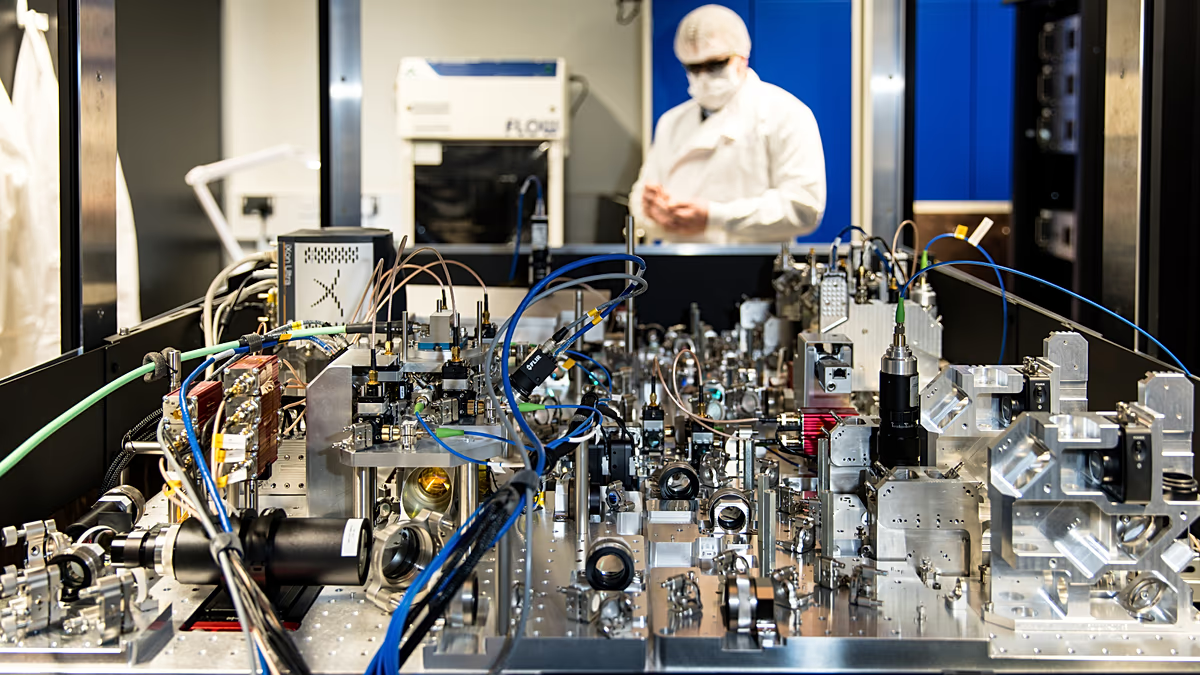
The technology sector witnessed a significant surge on Thursday, driven by a landmark announcement from the U.S. government. In a move to secure American leadership in a critical future technology, the Trump administration unveiled a federal investment program exceeding $2 billion, specifically targeting the quantum computing industry. This substantial commitment triggered an immediate and powerful market rally, with shares of companies across the sector climbing sharply. The clear signal of long-term, strategic government backing provided a massive vote of confidence for this still-emerging field, prompting investors to reposition their portfolios around what is increasingly seen as a strategic national priority.
Central to this initiative, known as the CHIPS Act initiative, is a direct award of $1 billion to IBM. This funding is designated for the construction of a dedicated foundry to produce quantum computing chips at scale. In a notable parallel to some previous administration investments, the government will receive equity stakes in the recipient companies in return for this capital. The remaining $1 billion of the package was distributed among eight other quantum firms, including established names like GlobalFoundries and pure-play quantum companies such as Rigetti Computing, D-Wave Quantum, and PsiQuantum. The market reaction was profound: IBM’s stock soared over 12%, adding a staggering $27 billion to its market value in a single day—a sum comparable to the entire worth of a global giant like Adidas. Other publicly traded beneficiaries like Rigetti and D-Wave saw even more dramatic jumps, with shares skyrocketing more than 30% as traders rushed to capitalize on the news.
This investment is far more than a simple subsidy; it is a calculated step in the global technological race. As part of its agreement with the U.S. Department of Commerce, IBM is establishing a standalone company named Anderon, heralded as “America’s first pure-play quantum foundry.” Headquartered in Albany, New York, this entity will focus solely on manufacturing the advanced and delicate wafers that form the heart of quantum processors. IBM framed the initiative as one of the most significant U.S. government commitments to quantum research and development to date, explicitly aimed at positioning the nation to manufacture the majority of the world’s quantum wafers. Demonstrating its own conviction, IBM also pledged to match the federal grant with an additional $1 billion of its own capital invested into the project.
The immense economic and strategic potential of quantum computing justifies this level of investment. Unlike classical computers, quantum machines leverage the peculiar principles of quantum mechanics to perform specific types of calculations at speeds deemed impossible today. Analysts from Boston Consulting Group estimate the quantum industry could generate up to $850 billion in global economic value by 2040. Proponents envision revolutions in drug discovery, financial modeling, logistics, and the development of new materials. As stated by a U.S. Department of Commerce official, the technology holds significant implications for national defense and critical infrastructure. However, this power carries a dual-edged risk: the same capability that could solve complex problems might one day crack the cryptographic codes that currently protect the world’s financial systems, communications, and state secrets, making leadership in the field a paramount security concern.
This substantial U.S. move casts a spotlight on the global competitive landscape, particularly for allies like Europe. The continent has cultivated several prominent quantum technology companies, such as Finland’s IQM, France’s Pasqal, and the UK’s Oxford Quantum Circuits, each of which has secured significant funding in the €100-200 million range. The European Union has also been a major funder of foundational research through initiatives like the Quantum Flagship. However, analysts consistently note that Europe’s approach remains more fragmented, relying on a patchwork of national programs and private capital, in contrast to the centralized, large-scale industrial strategy now being demonstrated by the United States. The sheer scale of this latest U.S. package is likely to intensify pressure on European governments to consolidate support and increase funding for their domestic quantum ecosystems to avoid being left behind.
In summary, the U.S. government’s multi-billion-dollar investment has acted as a powerful catalyst, validating the quantum computing sector for the public markets and setting a new benchmark for state-backed industrial policy in advanced technology. By directly funding a specialized manufacturing base and taking equity in a portfolio of leading companies, the strategy aims to build an entire domestic supply chain for this transformative technology. While the immediate effect was a dramatic stock market rally, the long-term goal is to secure a decisive advantage in a field poised to redefine computation, with profound implications for economic prosperity and national security. This move undoubtedly raises the stakes in the global quantum race, challenging other world powers to respond in kind.