

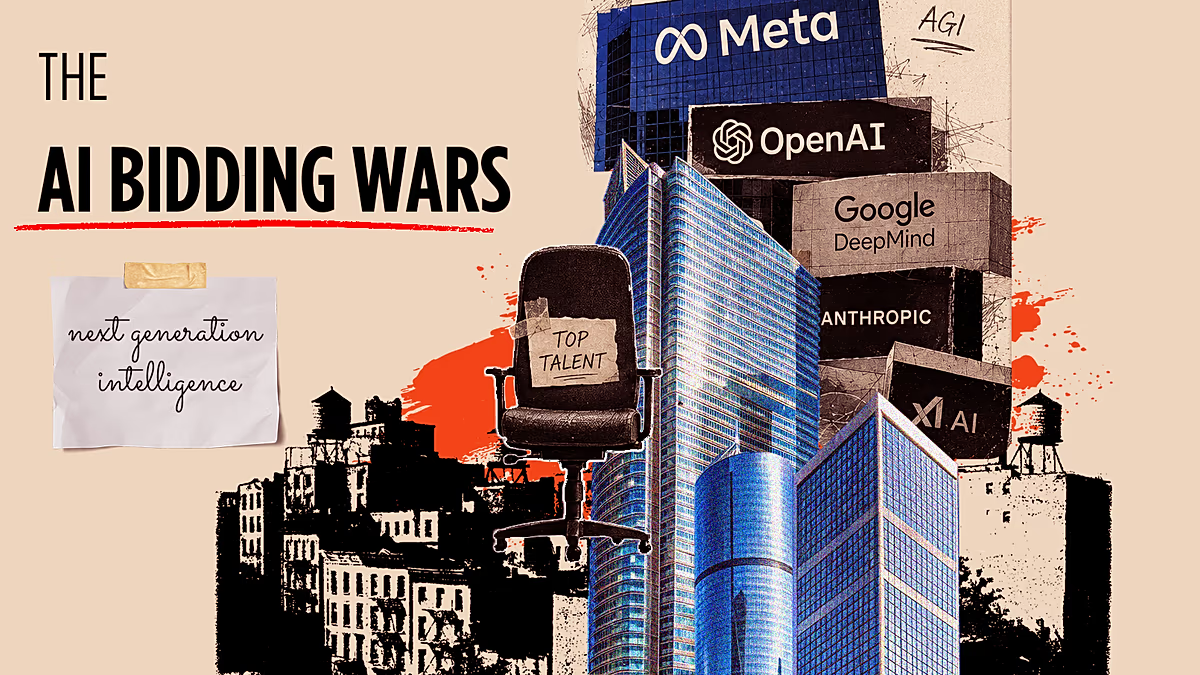
The world is witnessing an unprecedented technological gold rush, centered not on physical resources, but on human intellect. The explosive emergence of the artificial intelligence industry has created a labor market frenzy that Silicon Valley has not seen since the dot-com boom of the late 1990s. However, this modern scramble possesses a critical, defining difference: the pool of individuals with the proven, elite expertise to build and guide the most advanced “frontier” AI systems is astonishingly small, numbering perhaps only a few hundred people globally. Giants like OpenAI, Meta, Google DeepMind, and Anthropic, alongside a proliferating field of well-funded startups such as xAI and Safe Superintelligence, are all competing ruthlessly for this tiny cadre of talent. This scarcity has triggered a hyper-competitive environment where compensation packages have entered a stratospheric realm previously reserved for star athletes and hedge fund managers, with reports of nine-figure offers, colossal equity grants, and personal recruitment pitches from CEOs like Mark Zuckerberg and Sam Altman becoming part of industry lore.
The stories of a handful of top AI pioneers illustrate the intense and varied bidding wars defining this new era. Ilya Sutskever, the Israeli-Canadian co-founder and former chief scientist of OpenAI, stands as a paramount figure. Revered as a key intellectual architect of the generative AI boom through his work on the GPT models, Sutskever’s credibility is unmatched. Following OpenAI’s internal governance crisis in 2023, he departed and co-founded Safe Superintelligence (SSI) in 2024. Demonstrating the sheer value placed on proven leadership, SSI was privately valued at around $32 billion in 2025 without yet releasing a commercial product. Sutskever’s recently revealed $7 billion stake in OpenAI further underscores his monumental worth. Investors see in him a rare fusion of deep scientific insight, hands-on experience with frontier models, and the leadership stature needed to steer an organization toward artificial general intelligence (AGI), making him a perpetual target for recruitment.
Similarly, Mira Murati, the Albanian-American former Chief Technology Officer of OpenAI, leveraged her central role in launching ChatGPT, DALL-E, and GPT-4 to become a major talent magnet in her own right. After leaving OpenAI in 2024, she founded Thinking Machines Lab, which rapidly attracted elite researchers and achieved a valuation exceeding $5 billion. Her firm’s focus on human-AI collaboration differentiates its mission, but her true strategic value lies in her demonstrated ability to attract top-tier researchers at scale. In an industry where talent is concentrating around a few charismatic leaders, Murati’s “recruiting gravity” itself has become a powerful competitive advantage, prompting aggressive courtship from rivals like Meta who seek to tap into her network and influence.
The talent wars are not confined to those who strike out on their own; they also involve strategic acquisitions of entire companies and their visionary founders. Alexandr Wang, the Chinese-American founder of Scale AI, represents this path. His company, founded in 2016, built critical data-labeling and evaluation infrastructure that became the backbone for many machine learning projects. In 2025, Meta acquired a significant stake in Scale AI for $14.3 billion, bringing Wang into a leadership role within Meta’s AI division. Alleged leaks suggest his compensation package is among the largest in Silicon Valley history, featuring a $1 million salary and equity worth up to $150 million. Wang’s immense value stems not from pure academic research, but from an all-encompassing, operational mastery of how to build, scale, and manage the complex infrastructure behind giant AI systems—a skillset becoming ever more crucial as models grow larger and more expensive.
For some pioneers, value is accrued through a long history of groundbreaking scientific achievement that defines an entire field. Demis Hassabis, the British co-founder of DeepMind, epitomizes this. After building DeepMind into a world-renowned research lab—famous for AlphaGo and the protein-folding breakthrough AlphaFold, which earned him a Nobel Prize in Chemistry—he now leads Google DeepMind. While his exact compensation is private, it is undoubtedly in the millions, supplemented by significant performance bonuses. Hassabis combines the visionary stature of a founder with elite scientific credentials and proven organizational leadership. In the post-ChatGPT world, retaining a figure like Hassabis and his core team became a strategic imperative for Google, as his presence is a powerful signal of scientific seriousness and a key tool in the fierce competition for both talent and public trust.
Finally, influence within the AI ecosystem extends beyond corporate titles and valuations, residing powerfully in cultural and educational spheres. Andrej Karpathy, the Slovak-Canadian co-founder of OpenAI and former head of AI at Tesla, exemplifies this. While not publicly associated with the very largest compensation rumors, Karpathy’s strategic value is immense. His work on Tesla’s autonomous driving systems and his deep involvement from OpenAI’s early days grant him immense credibility. More importantly, through his clear, pedagogical communication style and educational initiatives like his startup Eureka Labs, he shapes developer communities and engineering culture itself. His ability to attract talent stems from this respected, influencer status, proving that in the AI talent war, intellectual leadership and the power to inspire the next generation of engineers are currencies just as potent as billion-dollar equity grants. Together, these stories reveal an industry where a handful of individuals hold the keys to the future, making their minds the most coveted—and expensive—resource on the planet.