



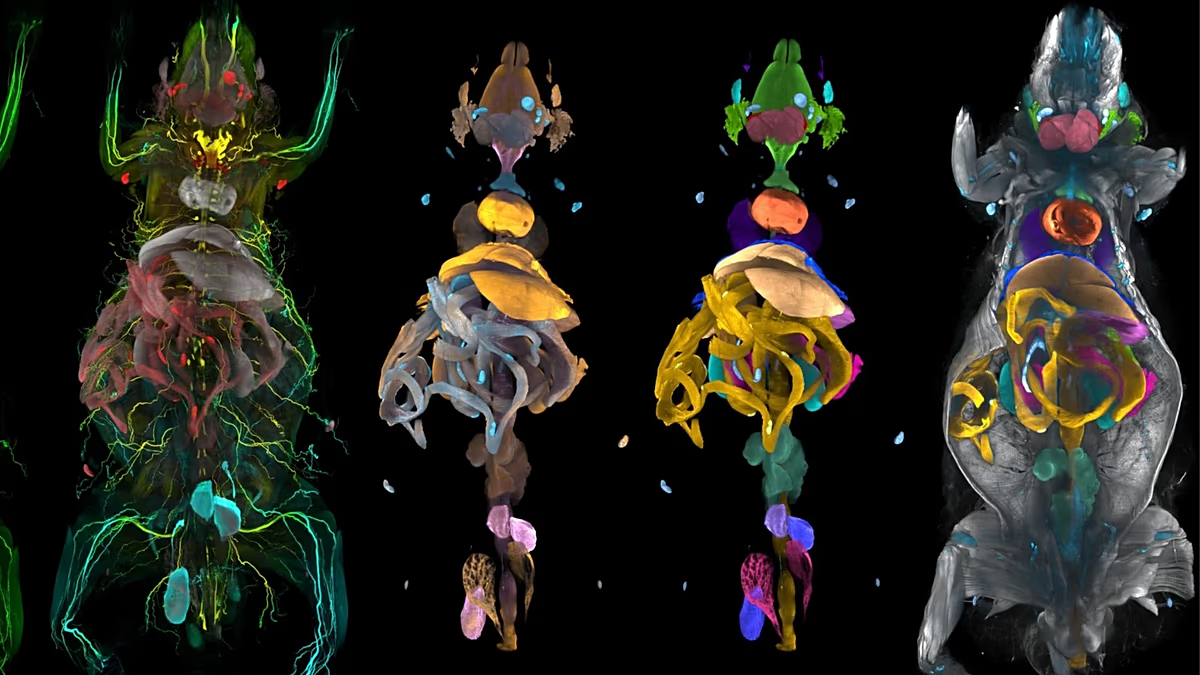
A groundbreaking study has unveiled the widespread, systemic damage obesity inflicts throughout the entire body, reaching far beyond the accumulation of fat tissue. Published in the prestigious journal Nature and led by researchers from Helmholtz Munich and Ludwig Maximilian University, this research introduces a novel artificial intelligence tool named MouseMapper. For the first time, scientists have been able to map the effects of a complex disease like obesity simultaneously across all organs and tissues, creating a comprehensive 3D “atlas” of the body. This represents a monumental shift from traditional methods, which could only examine changes in one organ at a time, often missing the interconnected nature of disease. The AI framework automatically identifies and analyzes tens of millions of cellular structures—from organs to nerves to immune cells—in a single, holistic view, revealing obesity not as a localized condition but as a whole-body crisis.
The technological marvel behind this discovery involves a sophisticated process that makes the invisible visible. To build their foundational atlas, researchers started with laboratory mice, using fluorescent markers to tag specific cells like nerves and immune systems. They then employed advanced tissue-clearing techniques, which render the animals’ bodies optically transparent while perfectly preserving the glowing fluorescent signals. Next, high-resolution 3D scans of the entire transparent bodies were captured using light-sheet microscopy. The MouseMapper AI was then tasked with analyzing these vast image sets, automatically identifying and mapping 31 distinct organs and tissue types. This pipeline allowed the team to observe, with unprecedented clarity, exactly where inflammation and structural damage were occurring across the entire organism in unison, painting a complete picture of physiological disruption.
When applied to mice fed a high-fat diet to induce obesity and metabolic dysfunction akin to human conditions, the AI atlas revealed devastating and widespread harm. As expected, the system confirmed significant inflammation and tissue remodeling in classic metabolic organs like the liver, fat deposits, and muscles. However, the most surprising and alarming discoveries were found far from these sites, within the nervous system itself. The research showed profound structural damage to the trigeminal nerve, a major cranial nerve responsible for facial sensation. In obese mice, this nerve exhibited fewer branches and nerve endings, suggesting a substantial degradation of its normal sensory function. Follow-up behavioral tests confirmed this physical damage had real-world consequences, as the mice showed noticeably reduced responses to touch and facial stimulation.
Crucially, this nerve damage is not confined to animal models. To bridge the gap to human health, the scientific team analyzed tissue samples from human patients with obesity. Their examination revealed similar molecular signatures of dysfunction and stress within the human trigeminal ganglion, the nerve cell cluster that serves as the control centre for facial sensation. This critical finding strongly suggests that the obesity-related neural degeneration observed in mice is mirrored in people, indicating that the disease’s reach may include impairing fundamental sensory systems. It highlights that the consequences of obesity are even more pervasive than previously understood, potentially contributing to a broader decline in neurological health and quality of life.
The implications of this research extend far beyond a single disease. Researchers envision that platforms like MouseMapper could fundamentally transform our approach to studying complex conditions like diabetes, cancer, or autoimmune disorders. By enabling a whole-body, systemic analysis, science can move away from a fragmented, organ-by-organ view and begin to understand the body as an integrated network where disease in one area reverberates throughout the entire system. Furthermore, this work lays the foundational groundwork for a future of “digital twins” in biology. These would be highly detailed virtual replicas of an organism, built from such comprehensive data, that could simulate the progression of a disease or the potential effects of a new drug entirely in silico.
This prospective future promises to accelerate the pace of medical discovery while adhering to ethical principles. By testing treatments first on a precise digital simulation, researchers could identify the most promising therapies more rapidly and with greater confidence before proceeding to physical experiments. This not only has the potential to dramatically speed up drug development but could also significantly reduce the reliance on animal testing. In essence, this study does more than map the damage of obesity; it charts a new course for medical research itself, pointing toward a future where we can comprehend and combat disease with a holistic, humane, and highly sophisticated clarity previously unimaginable.