

Of course. Here is a summary and humanization of the provided text, expanded and structured into six paragraphs as requested.
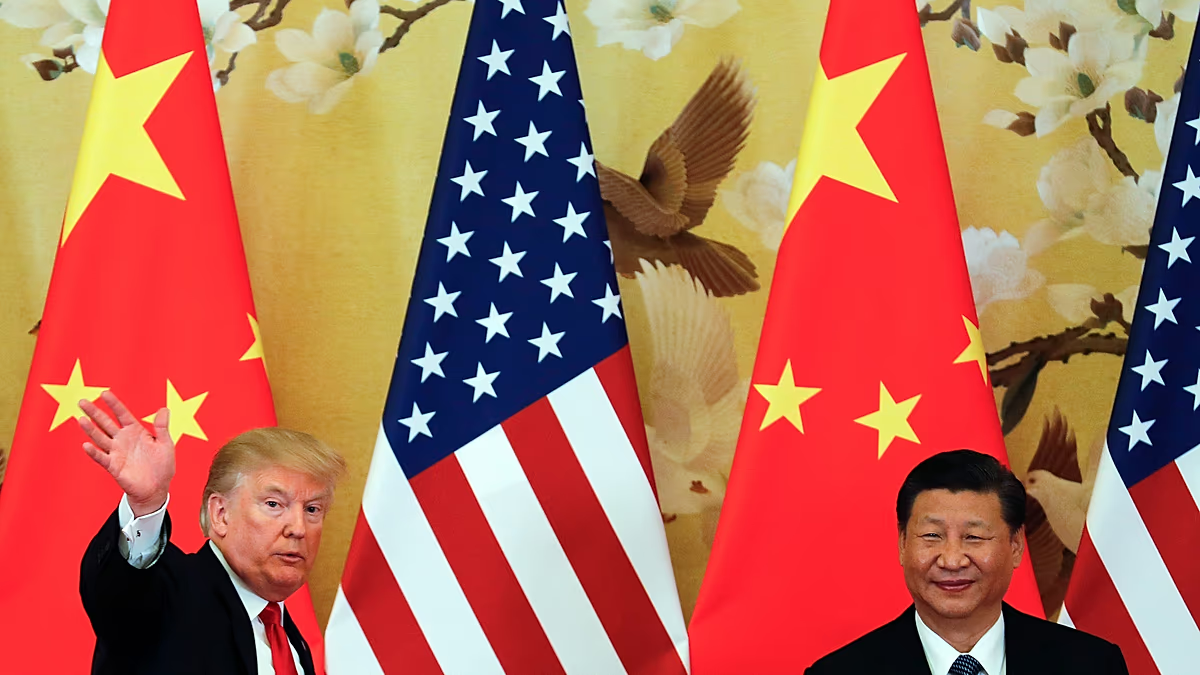
The arrival of US President Donald Trump in Beijing marks a moment of profound symbolic weight. This state visit, his first to China since 2017, occurs against a backdrop of global instability far more tense than during his previous trip. A conflict in the Middle East has shaken energy markets and trade routes, while the United States has aggressively reasserted its influence in Latin America through a renewed “Monroe Doctrine,” aiming to secure supply chains and counter China’s growing presence in the region. In contrast, China has sought to present itself as a pillar of economic continuity and diplomatic stability, expanding its commercial ties across Southeast Asia, Africa, and the Gulf. This summit, therefore, is not merely a diplomatic routine; it is a high-stakes meeting between two powers navigating a world where their strategic and economic paths are increasingly divergent and competitive.
The core of this competition is an economic rivalry of staggering scale. The United States continues to possess the world’s largest nominal economy, but China’s growth rate consistently outpaces that of its American rival. While the U.S. maintains a vast advantage in per-capita wealth, reflecting higher living standards, China has become the larger economy on a purchasing-power basis, underscoring its central role in global manufacturing and demand. China’s remarkable recovery from the COVID-19 pandemic further cemented its economic resilience. However, this strength coexists with significant internal challenges, including weak domestic consumption, a troubled property sector, and demographic pressures from an aging population. The narrative is thus one of a broadening aggregate might tempered by persistent developmental hurdles.
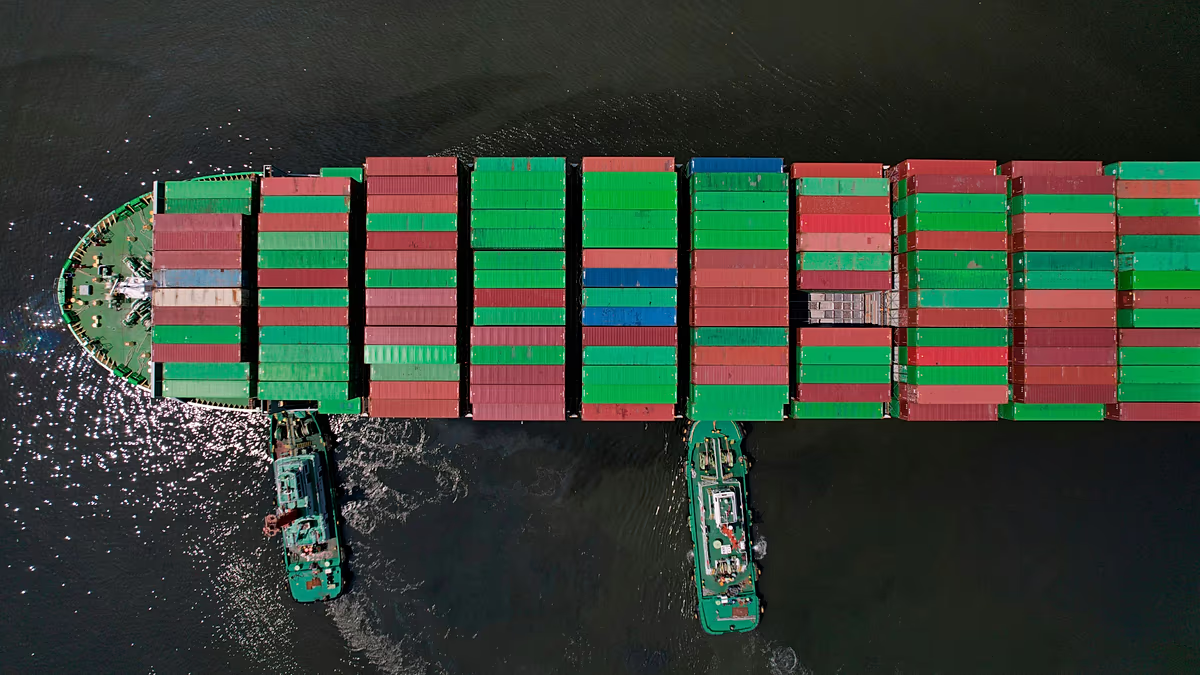
Beyond macroeconomic figures, the rivalry manifests in daily confrontations over trade, technology, and supply chains. Recent tensions have flared around port management in Panama and accusations of market “bullying.” The delegation accompanying President Trump—including tech giants like Tim Cook and Jensen Huang—spotlights the ongoing battles over semiconductors, electric vehicles, and artificial intelligence. The U.S. accuses China of distorting markets with state subsidies, while China argues that American export controls are designed to stifle its technological ascent. This friction extends to financial realms, where China holds the world’s largest foreign exchange reserves, providing it a powerful tool for economic management, while the U.S. benefits from the unparalleled global dominance of the dollar. Both nations are also accumulating gold, a traditional hedge, signaling a move toward diversifying away from purely dollar-dependent systems.
The economic and technological contest is inextricably linked to a parallel military buildup. The United States and China are the world’s top two military spenders, investing heavily to modernize their forces and secure strategic advantages. The U.S. focuses on maintaining its dominance in the Western Hemisphere and deterring China in the Indo-Pacific, backed by a vast network of alliances. China has rapidly expanded its naval, missile, and cyber capabilities. The most volatile flashpoint in this security dilemma is Taiwan. Beijing views the island as inseparable from its territory, while Washington sees stability in the Taiwan Strait as critical to global trade and security, especially given Taiwan’s vital role in advanced chip production. This issue remains a constant source of potential crisis.
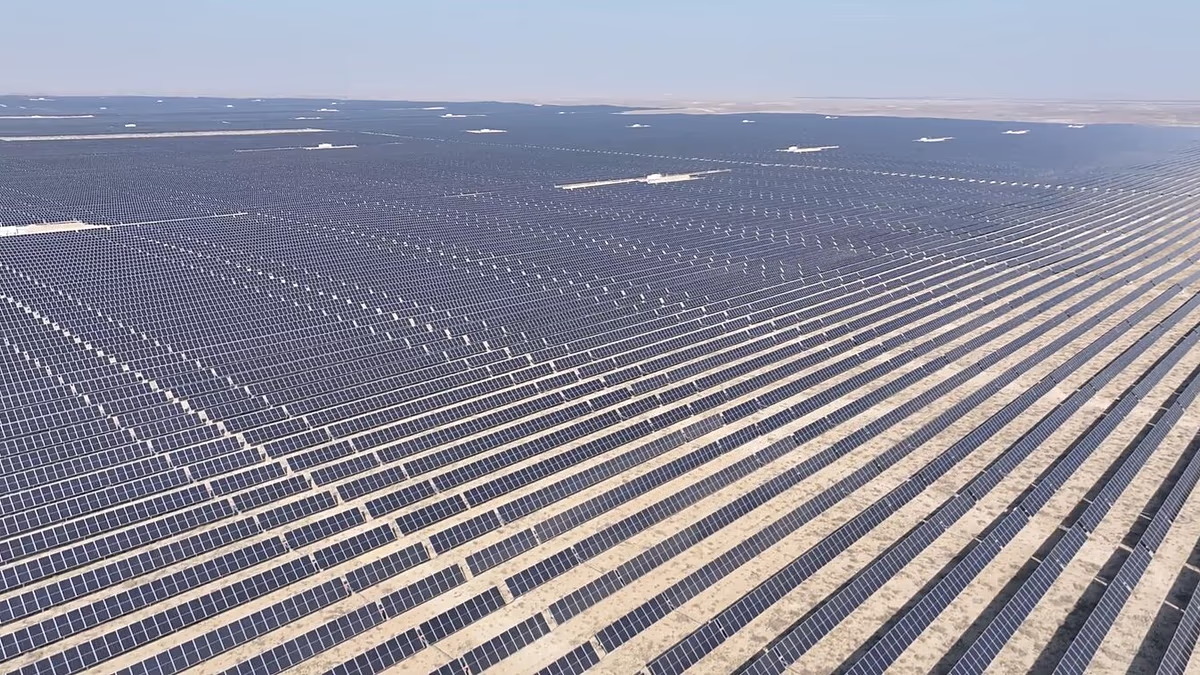
In the arena of future-facing technology, a bifurcation of strengths is evident. The United States retains leadership in advanced semiconductor design, aerospace, and foundational software research. China, however, has built commanding positions in the practical industrial applications of new technology, dominating global production of solar panels, electric vehicle batteries, and telecommunications equipment. Artificial Intelligence has become the defining battleground, with the U.S. restricting exports of advanced AI chips to China over security concerns. This separation of capabilities—U.S. innovation in core technologies versus Chinese mastery in scale manufacturing and deployment—frames a new kind of cold war, fought not with bombs but with batteries, algorithms, and supply chain control.
Ultimately, this summit will likely be judged not by specific, signed agreements but by its effect on the temperature of the relationship itself. The United States remains the preeminent global military and financial power, its influence anchored by the dollar and its alliance networks. China has evolved into a formidable systemic challenger, with the industrial scale, export power, and state-directed capital to reshape global infrastructure and geopolitical alignments. For Beijing, the meeting is an opportunity to project confidence and stability. For Washington, it is a test of whether it can still steer the rules of an increasingly multipolar world. The visit encapsulates a pivotal moment: two giants, one established and one ascendant, determining whether their rivalry will be managed within a framework of tense coexistence or will spiral into unconstrained conflict.