



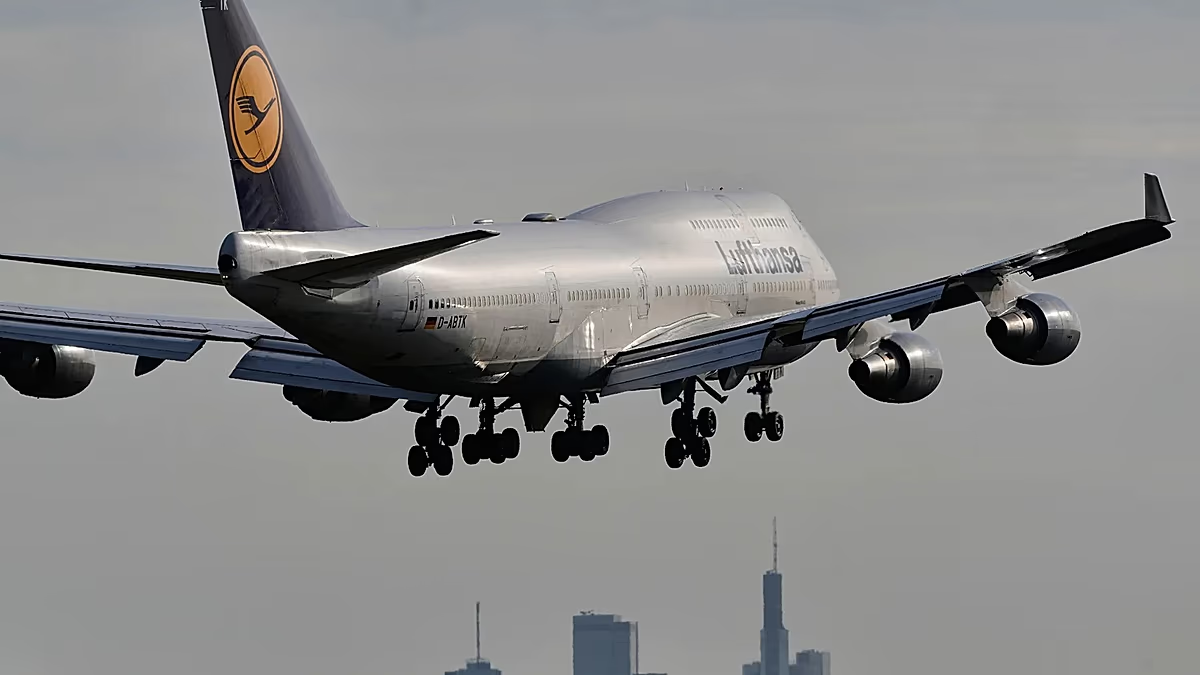
In a significant move that underscores the ongoing consolidation within the European aviation industry, the Lufthansa Group announced its firm intention to assume a commanding majority stake in Italy’s national carrier, ITA Airways. The German airline giant, already Europe’s largest airline group, revealed plans to increase its current 41% shareholding to a substantial 90%, a decision approved by its board and set to be executed this June. This strategic leap, valued at €325 million, marks a pivotal chapter in the evolution of both companies, transitioning from a partnership to a full integration. The move signals Lufthansa’s deep commitment to strengthening its foothold in Southern Europe and transforming Rome’s Fiumicino Airport into a central hub for its network, directly challenging other major alliance blocs on the continent.
The transaction represents a carefully orchestrated next step in a relationship that began in earnest in January 2025, when Lufthansa first acquired its minority stake. That initial agreement included a pre-negotiated option for this exact majority takeover, allowing both companies a period of operational alignment before full fusion. The seller, the Italian government through its Ministry of Economy and Finance, will see its holding reduced from 59% to a residual 10%, marking a gradual retreat from direct ownership while maintaining a symbolic stake in the carrier’s future. Analysts view this as a logical conclusion to Italy’s long search for a stable industrial partner for its perpetually struggling flag carrier, following the bankruptcy of Alitalia. For Lufthansa, it is a strategic masterstroke, granting unparalleled access to the lucrative Italian market—Europe’s fourth-largest economy—and its vital long-haul routes.
Central to this announcement is the promise of complete integration. Lufthansa stated explicitly that ITA Airways will be absorbed into the group both organizationally and financially, weaving it into the fabric of its multi-brand ecosystem alongside Swiss, Austrian, and Brussels Airlines. CEO Carsten Spohr noted that much of the customer-facing groundwork is already complete, with ITA now part of Lufthansa’s joint booking platforms, frequent flyer program, and lounge access network. The most notable exception, as Spohr highlighted, concerns the critical North Atlantic routes, where the airlines still await final regulatory approval to combine their operations. This full absorption strategy aims to eliminate redundancies, unlock synergies, and present a united front to the global market, thereby enhancing competitiveness against giants like Air France-KLM and IAG.
The leadership of both companies has heralded the move as a transformative moment. ITA Airways Chief Joerg Eberhart welcomed the decision as a step of “major industrial and strategic significance,” expressing confidence that being firmly embedded within the Lufthansa Group will provide the scale and resources necessary to compete more vigorously on international routes. For Lufthansa, the acquisition is not merely about growth in size but about strategic depth. It secures a dominant position in the central Mediterranean, creates a more robust feeder network for its long-haul flights from Munich and Frankfurt, and offers new opportunities for cargo and maintenance operations. The market reacted positively to the news, with Lufthansa’s share price rising 2% on the day of the announcement, reflecting investor approval of the strategic logic.
However, the path forward is not without its hurdles. The deal remains subject to stringent regulatory approvals from both European Union and United States competition authorities. EU regulators, in particular, will scrutinize the impact on competition for routes between Italy and key German-speaking markets, as well as on transatlantic corridors. They may require the companies to surrender valuable take-off and landing slots at congested airports like Milan Linate or Rome Fiumicino to preserve competition. Provided these conditions are met, the parties anticipate the entire process to be finalized by the first quarter of 2027, setting the stage for a new, fully integrated operational era.
Ultimately, this planned acquisition is a definitive sign of the times in European aviation. As the industry continues to recover from the pandemic’s shocks and faces intense pressure from low-cost carriers and Middle Eastern giants, legacy groups are seeking strength through unity and scale. Lufthansa’s bold move to bring ITA firmly under its wing exemplifies this trend of strategic consolidation. It promises greater stability and investment for ITA Airways, a stronger network for passengers, and a more formidable European champion in the Lufthansa Group. The coming months of regulatory review will be crucial, but the direction is clear: the skies over Europe are being redrawn into fewer, but more powerful, alliances.