


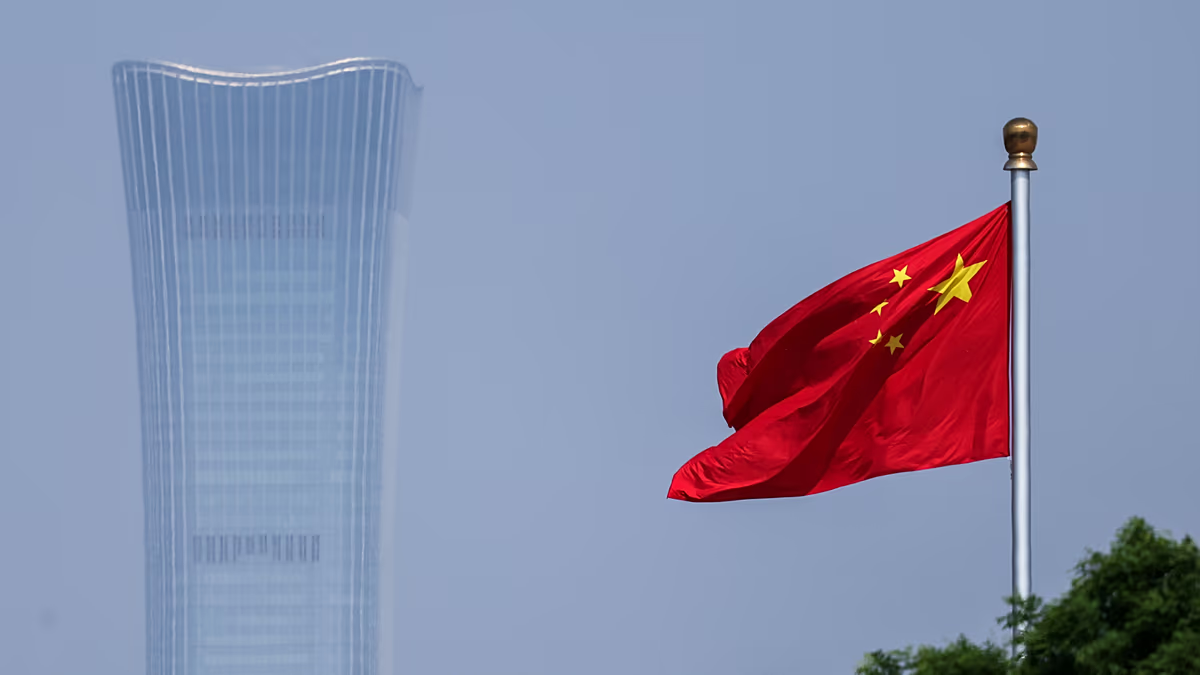
The upcoming meeting between US President Donald Trump and Chinese President Xi Jinping has sparked a lively and nuanced discussion among Beijing’s residents. As reported on December 5th, 2026, the city is buzzing with anticipation, yet the prevailing sentiment is not uniform excitement but a complex mixture of hope, caution, and seasoned realism. While the prospect of a high-level summit naturally brings aspirations for improved diplomatic ties and economic cooperation, many citizens approach the event with a measured perspective, reflecting years of navigating the起伏 (fluctuations) in US-China relations. This variety of opinion showcases a public that is deeply engaged with international affairs yet pragmatic about the potential outcomes.
Among the hopeful, there is a genuine desire for the meeting to serve as a turning point, a chance to ease recent tensions and establish a more stable framework for collaboration. These individuals speak of the mutual benefits that could arise from renewed dialogue, particularly in areas of trade, technology, and global challenges like climate change. They envision a future where pragmatic cooperation outweighs strategic rivalry, bringing tangible benefits to both nations’ economies and people. For them, the summit is a necessary and welcome opportunity to reset the tone and find common ground after periods of disagreement.
Conversely, a significant portion of the populace expresses well-founded skepticism. This sentiment is rooted in the observable pattern of recent years, where diplomatic engagements have sometimes been followed by renewed disagreements or policy shifts. Residents note that the path of international relations is rarely linear, and a single meeting, however high-profile, may not instantly resolve deep-seated structural issues. Their caution is not born of cynicism but of experience, reflecting an understanding that statecraft is a long and complex process. They emphasize that while dialogue is essential, sustained progress requires consistent effort and mutual respect from both sides over a much longer timeline.
The collective mood in Beijing, therefore, can best be described as watchful optimism. People are attentive and interested, recognizing the importance of the event, yet they hold their expectations in careful check. There is a widespread understanding that the relationship between two such powerful nations is multifaceted, encompassing both competition and cooperation. The public discourse reflects this duality, balancing a natural hope for positive developments with a realistic assessment of the challenges involved. It is a mature perspective that values the act of meeting itself as a positive step, while acknowledging that the subsequent journey will require diligent navigation.
This blend of hope and skepticism among ordinary residents mirrors the broader analytical view of experts and observers. The meeting is seen not as a potential panacea, but as a critical node in the ongoing narrative of US-China relations. Its value lies in reopening direct channels of communication at the highest level, providing a platform to articulate concerns, and possibly identifying specific areas for practical collaboration. The citizens of Beijing, living at the heart of these global dynamics, intuitively grasp this significance. They are not passive spectators but an informed community observing a process that will undoubtedly impact their nation’s future and the world’s stability.
Ultimately, the diverse voices in Beijing highlight a key reality: international diplomacy is watched closely and felt personally by people around the world. As Presidents Trump and Xi prepare to sit down together, they carry not only their own national mandates but also the quiet hopes and reasoned cautions of their citizens. The people of Beijing, with their mixed opinions, underscore that the most valuable outcome of any such summit may be the continuation of the dialogue itself—keeping the channels open for the hard, essential work of building understanding that must follow long after the meeting concludes. Their reflections remind us that the true measure of diplomatic success is found in the steady, patient progress that builds trust over years, not solely in the headlines of a single day.