


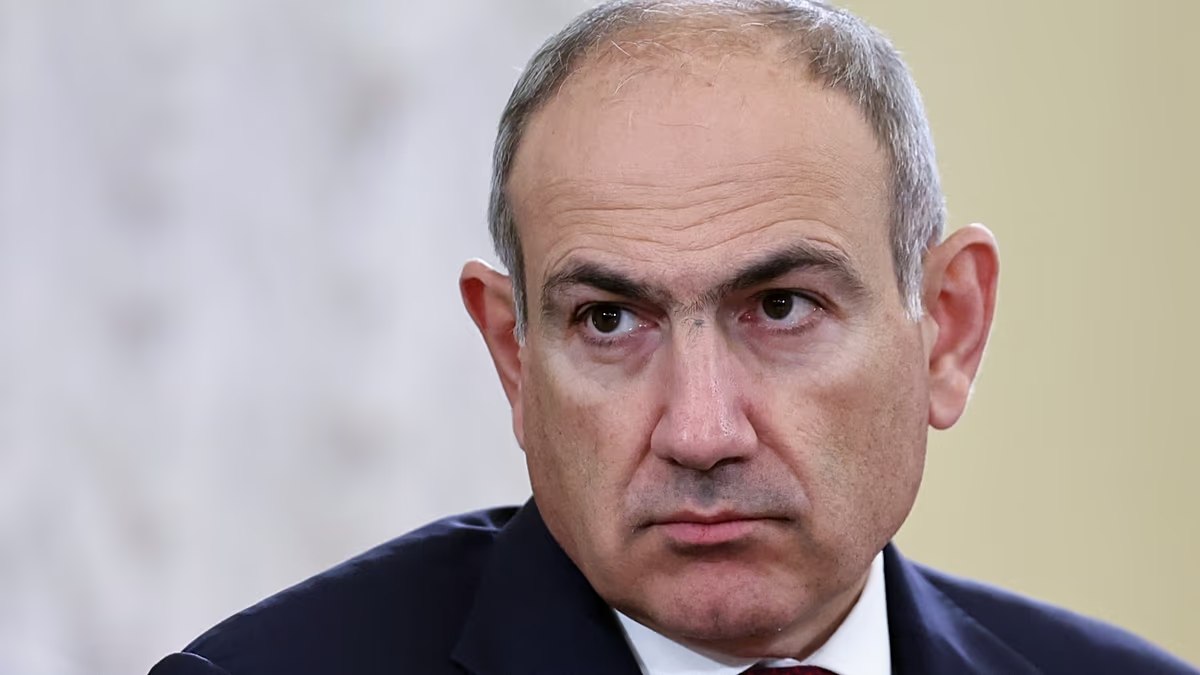
In a stunning and emotionally charged address that reverberated across Armenian communities worldwide, Prime Minister Nikol Pashinyan delivered a seismic shift in national rhetoric concerning the long-disputed region of Karabakh. Over the weekend, he publicly declared that Karabakh was not Armenian and labeled the decades-long national movement for its control as a “fatal mistake.” This profound break from the entrenched narrative was captured in a video where he passionately challenged critics, asking, “How was that land ours?” He questioned the tangible signs of Armenian ownership, pointing to the absence of sustained civilian development—schools, factories, and settlements—under Armenian stewardship. By stating, “It was not ours,” Pashinyan sought to reframe a painful chapter of history, urging a collective reckoning with the past to pave a new future.
This historic pivot is inextricably linked to Armenia’s bold geopolitical realignment towards Europe, a move vividly underscored during the recent European Political Community summit hosted in Yerevan. Just days before his remarks, the gathering served as a platform for Armenia to signal its decisive break from Russian-dominated spheres of influence, embracing instead a pro-European trajectory as it pursues a lasting peace with Azerbaijan. French President Emmanuel Macron captured the moment’s significance, praising Armenia’s conscious choice to join a Europe stretching “from Iceland to the Caucasus.” He observed that the country, once seen as wholly dependent on Moscow for security, is now opening a new era through its policy of peace and European orientation—a transformation rooted in the 2018 Velvet Revolution but accelerating amid recent regional shifts.
Simultaneously, Azerbaijan’s President Ilham Aliyev addressed his nation from the rebuilt city of Zangilan in Karabakh, warning against the resurgence of anti-Azerbaijani forces within Armenia’s political landscape ahead of its June elections. While reaffirming Baku’s commitment to peaceful relations, he cautioned that hatred-driven factions could harm the Armenian people themselves if they regained power. Aliyev’s speech also highlighted Azerbaijan’s focus on reconstruction and regional connectivity, presenting Zangilan as a future transport hub that would benefit not only Azerbaijan but the entire South Caucasus. His remarks subtly critiqued external actors portraying themselves as Armenia’s saviors, asserting that Azerbaijan had achieved its objectives without intending to threaten Armenia’s sovereignty, thus framing peace as a mutual necessity rather than a imposed condition.
The reverberations of Armenia’s westward shift were swiftly felt in Moscow, prompting a pointed response from Russian President Vladimir Putin. In the wake of Pashinyan’s snub of Russia’s Victory Day parade, Putin suggested it would be “logical” for Armenia to hold a referendum on its EU membership path, allowing its citizens a direct say in this pivotal choice. He framed this as a prelude to a “gentle, civilized separation” between the two nations but accompanied the proposal with a stark warning, drawing a parallel to Ukraine. Putin explicitly connected Ukraine’s conflict with its pro-EU aspirations, implying that similar choices carry profound consequences. This thinly veiled caution underscored the high-stakes geopolitics at play, as Armenia navigates between its historical ties with Russia and its European ambitions.
In response to Putin’s referendum suggestion, Pashinyan clarified that Armenia is not currently planning such a vote, describing the European integration process as a “transformation” rather than a matter of “political taste.” He emphasized that any future referendum would occur only when objectively necessary, thereby balancing strategic patience with political realism. Simultaneously, he sought to reassure regional partners, affirming Armenia’s continued membership in the Russian-led Eurasian Economic Union and its respect for those ties. This nuanced stance reflects the tightrope Pashinyan walks: championing a new, peaceful, and European-oriented destiny for Armenia while managing the practicalities of its existing alliances and the formidable pressures from a resentful Kremlin.
Together, these unfolding events paint a portrait of a nation at a historic crossroads, grappling with the painful legacy of conflict while striving to redefine its identity and alliances. Pashinyan’s blunt rhetoric on Karabakh, though politically risky, aims to sever an emotional anchor to a lost cause, enabling Armenia to focus on future prosperity through regional peace and European integration. The cautious yet optimistic tone from Baku, paired with Moscow’s ominous warnings, highlights the complex web of diplomacy and threat that Yerevan must navigate. As Armenia approaches its June elections, its people face a profound choice: whether to endorse this dramatic pivot toward a peaceful, connected, and European future, or to retreat into the familiar contours of a contested past. The outcome will resonate far beyond its borders, shaping the stability and future of the entire South Caucasus.