



Here is a humanized and expanded summary of the provided content, structured into six paragraphs.
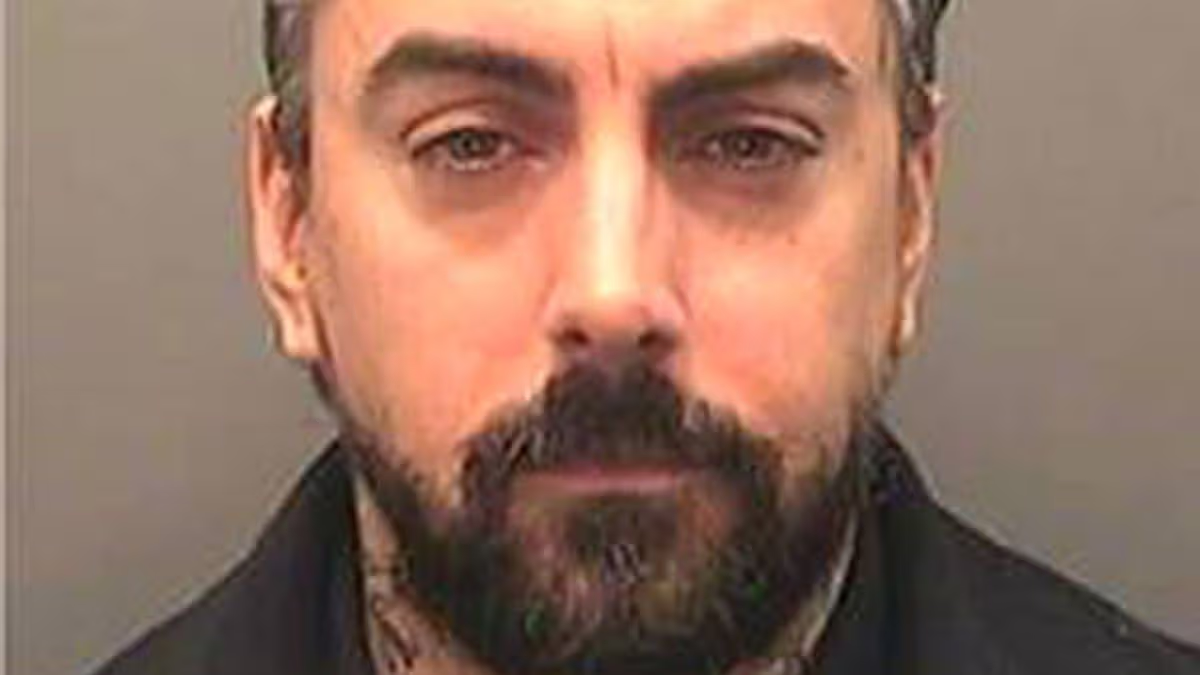
The sterile, echoing corridors of HMP Wakefield, one of Britain’s most secure prisons, held a man whose name had become synonymous with monstrous betrayal. Ian Watkins, the former frontman of the rock band Lostprophets, was serving a 29-year sentence, a punishment handed down in 2013 for a catalogue of child sexual offences so depraved they shocked the nation. His incarceration was not just a removal from society but an erasure, his artistic legacy forever poisoned by his crimes. On October 11 of last year, within the confines of his cell on B wing, this notorious chapter reached a violent and final conclusion. According to details emerging at Leeds Crown Court, Watkins was stabbed to death by a fellow inmate, an attack that laid bare the brutal, unforgiving hierarchy of prison life.
The man accused of carrying out the killing is 25-year-old Rico Gedel. The court heard that tensions had been simmering in the days leading up to the fatal encounter. Gedel, allegedly unhappy about being relocated from A wing to B wing the previous day, had made his discontent known to prison staff. He had reportedly threatened that if forced to move, he would “do something” to get himself placed in segregation—a common, often idle threat among inmates seeking to control their circumstances. On the day in question, the court was told, Gedel entered Watkins’ cell and attacked him with a makeshift knife, stabbing him three times in the head and neck. Jurors were shown footage of the aftermath, a grim tableau where Watkins stumbled from his cell, mortally wounded.
In the immediate chaos following the attack, as a “code red” alarm echoed through the prison, the behaviour of the accused began to paint a picture for officers and, now, for the court. Statements read aloud described Gedel not as panicked or remorseful, but as eerily composed and even smug. Officer Adam Laycock, who had been involved in the disputed wing transfer, stated that upon seeing Gedel being escorted after the incident, he “noticed Gedel was looking somewhat smug, and seemed to have a smirk on his face.” This demeanor was noted by several others, suggesting a chilling satisfaction with the act. Another officer, Justin Barrett, said he was not shocked to find Gedel at the center of the incident, given the prisoner’s earlier vocal resentment about the move.
The portrait of detached arrogance continued as Gedel was processed and searched following the attack. Officers from the prison’s dedicated search team recounted a bizarre and callous interaction. Patrick Wilson stated that Gedel was laughing as he was brought into a cell for a search. When probed about the location of the weapon, Gedel allegedly replied, “I used my hands,” and taunted the officers, saying this should be the “highlight of the day” for the search team. Bodyworn camera footage presented to the jury captured Gedel uttering the chilling phrase, “I hope he sleeps,” to the officers around him. Another officer, Anthony Whiteside, described Gedel as “calm and cold” throughout, seemingly “not bothered about what had occurred,” and repeating the ominous hope that his victim would “go to sleep.”
Rico Gedel, alongside a second inmate, 44-year-old Samuel Dodsworth, now stands trial, with both men pleading not guilty to charges of murder and possession of an improvised blade in prison. The proceedings are meticulously reconstructing the events of that October day, piecing together staff testimony, camera footage, and forensic evidence. For the public, the trial is a grim postscript to a story that had already plunged into the darkest depths of human conduct. Watkins’ crimes had ensured he would live out his days in infamy and isolation; his violent death inside the system meant to punish him adds another layer of tragic, brutal finality to the saga.
As the trial continues, it operates within the shadow of Watkins’ own heinous legacy, yet it must focus dispassionately on the facts of the killing. The court’s task is to determine criminal responsibility for the act of murder within prison walls, a separate justice from the moral reckoning society had already passed on Watkins. The case underscores the perilous environment of high-security incarceration, where dangerous individuals are concentrated and volatile conflicts can erupt with fatal consequences. The final gavel in this trial will close the legal case on Ian Watkins’ death, but the complex, disturbing narrative of his life and crimes—and now the violence of his end—will linger as a sobering study in notoriety, justice, and ultimate consequence.