



The fabric of daily life in Belgium is poised for a significant disruption this week as nationwide industrial action, organized by the country’s three major trade unions, brings critical transport hubs to a standstill. At the heart of this movement is a profound disagreement with the federal government’s proposed economic reforms, which unions argue will detrimentally alter pension schemes and working conditions for countless Belgians. This is not a localized grievance but a collective roar of discontent, translating into concrete action that will ripple from the tarmac of airports to the streets of the capital. The planned demonstrations symbolize a critical juncture, where the workforce is drawing a line, insisting that economic policy must safeguard dignity and security in retirement. It’s a story of protest that will have very real and immediate consequences for travelers, commuters, and the nation’s connectivity.
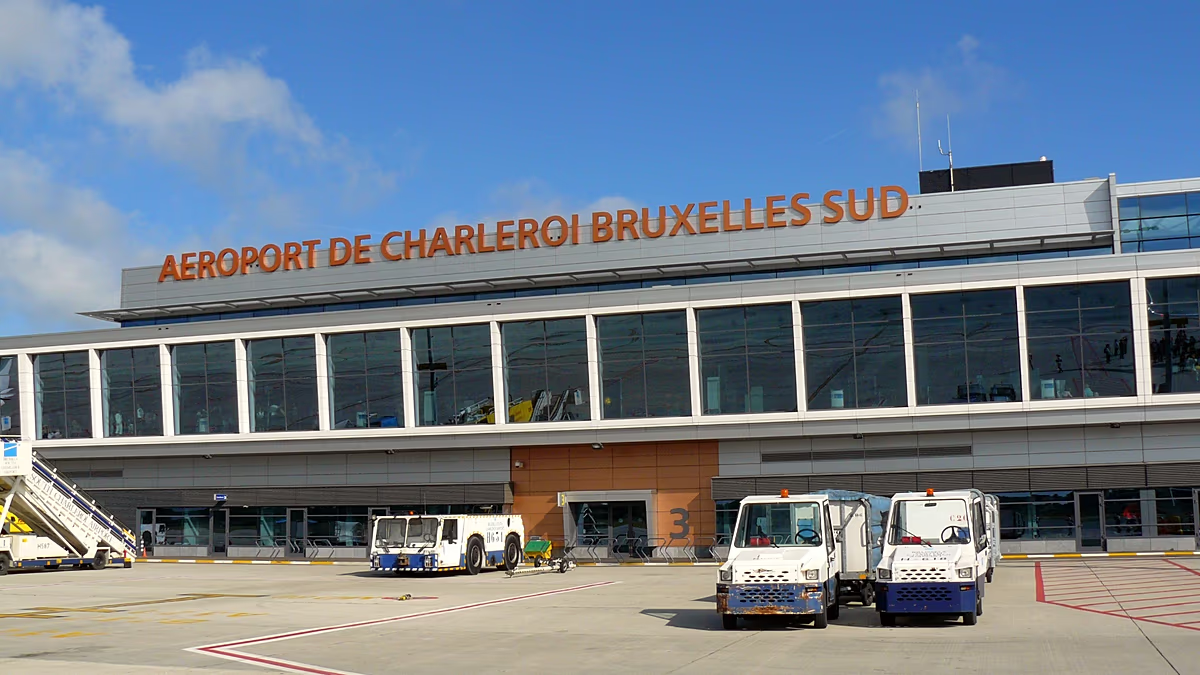
The most immediate and stark impact of this strike will be felt at Brussels South Charleroi Airport, the nation’s second busiest airport and a vital international hub for the Wallonia region. In a decisive move, the airport has announced that all flight operations will be forced to a complete halt for the duration of the action. This cancellation of all scheduled departures and arrivals stems not from a lack of will to operate, but from legitimate safety concerns. With union members from various essential services participating, staffing levels are expected to drop below the threshold required to ensure safe and secure operations. The airport has extended apologies to passengers, acknowledging the severe inconvenience caused to travel plans, and has pledged to contact affected individuals regarding rebookings or refunds. For many, this means disrupted holidays, missed business meetings, and family reunions postponed, painting a clear picture of how industrial action resonates far beyond the picket lines.
The disruption, however, is not confined to Charleroi. Belgium’s primary gateway, Brussels Airport, is also bracing for severe operational challenges. While a full closure has not been announced, a spokesperson indicated that over half of all departure flights may be cancelled on Tuesday. This pre-emptive scaling back of schedules is a pragmatic response aimed at managing the anticipated reduced workforce, ensuring that the flights that do operate can do so safely and without causing excessive delays for passengers on the ground or in the air. Airlines are being tasked with the difficult job of adjusting their complex schedules in the coming days and are urged to communicate directly and promptly with their customers about flight statuses and alternative options. This cascading effect highlights the vulnerability of modern air travel networks to coordinated labor action, underscoring the unions’ significant leverage in this dispute.
The demonstrations themselves are scheduled to converge in the capital, beginning in the morning and continuing until 2 pm local time. The unions—the socialist ABVV, the Christian ACV, and the liberal ACLVB—representing a broad cross-section of Belgian workers, have united behind a set of core demands. These extend beyond the immediate concerns over pensions and working conditions. Striking workers are also advocating for a fairer tax system and, crucially, for Belgium to retain its system of automatic wage indexation, which ties pay rises directly to inflation. This mechanism is seen by many as a fundamental pillar of purchasing power and social stability in the country. The march through Brussels is therefore more than a protest against specific reforms; it is a public manifestation of a struggle to preserve a social contract that workers feel is being eroded.
The impact of this national strike will not be limited to the skies. The ripple effects will be thoroughly felt on the ground across Brussels and beyond. The city’s public transport network, STIB/MIVB, which operates metro, tram, and bus services throughout the capital region, has warned passengers to expect significant disruptions. While the operator has stated it will aim to maintain at least a partial service, the reliability and frequency of connections cannot be guaranteed. The network has explicitly advised anyone with the ability to do so to seek alternative means of transport on Tuesday, suggesting options like bicycles or car-sharing. This advisory effectively acknowledges that the city’s usual rhythm will be profoundly altered, turning a regular Tuesday into a day of logistical challenge for residents and commuters alike, and amplifying the strike’s message through the resulting gridlock and inconvenience.
In summary, this coordinated action paints a picture of a nation at a crossroads with its workforce. The grounding of flights at Charleroi, the major disruptions at Brussels Airport, and the anticipated paralysis of much of the capital’s public transport are not mere inconveniences; they are deliberate demonstrations of the critical role these workers play in the functioning of society. The unions are using their most powerful tool—the withdrawal of labor—to voice a deep-seated concern that the government’s proposed path forward comes at an unacceptable cost to social welfare and economic fairness. For the stranded traveler, the frustrated commuter, and the watching public, this Tuesday will serve as a stark reminder of the tangible human and economic consequences when dialogue breaks down and collective voices rise in protest. The true resolution lies not just in restarting the engines of aircraft and metros, but in rebuilding a consensus on the values that will guide Belgium’s economic future.