


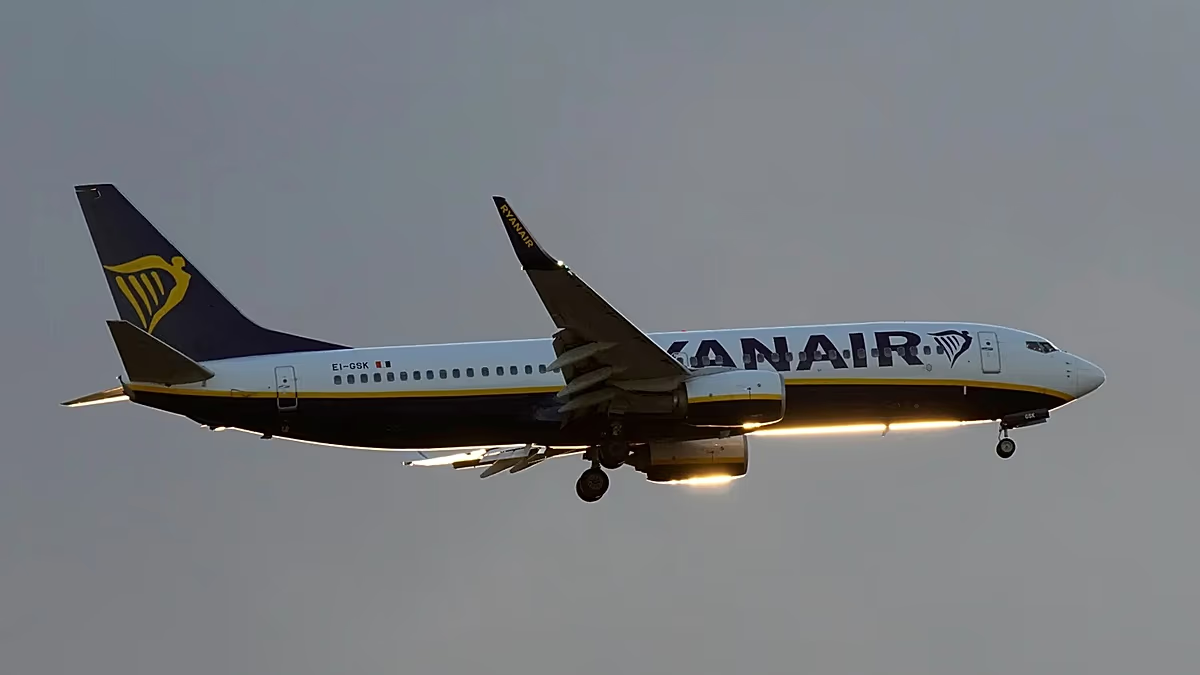
The European travel landscape is set for a significant shift, as Ryanair, one of the continent’s leading low-cost carriers, has made a sobering announcement regarding its future in Greece. In a move that highlights the delicate balance between airline operations and airport economics, the airline has confirmed it will cease operations at its base in Thessaloniki during the 2026 winter season. This decision involves the withdrawal of three aircraft that currently serve the region and coincides with a planned reduction in services at Athens International Airport. The airline frames this not as a strategic choice but as a forced retreat, attributing the pullback directly to what it describes as prohibitive and uncompetitive airport charges. This development signals a troubling contraction for Greek regional connectivity, particularly during the crucial winter months when tourism traditionally wanes.
At the heart of Ryanair’s decision is a stark financial complaint. The airline asserts that the “catastrophic loss of connectivity” is a direct result of excessively high fees imposed by Fraport Greece, which manages 14 regional airports including Thessaloniki, and by Athens International Airport itself. Ryanair points out that while the Greek government commendably reduced the Airport Development Fee (ADF) by 75%—from 12 euros to just 3 euros per passenger starting in November 2024—this relief has not been passed on to travelers. Instead, the airline claims, the benefit has been absorbed by the airport operators. Compounding this issue, Ryanair notes that Fraport Greece’s charges have soared by more than 66% compared to pre-pandemic levels, with Athens Airport planning further increases for the coming winter. In the competitive world of budget aviation, where fare margins are razor-thin, such increased operational costs become unsustainable.
The tangible consequences of this corporate decision are severe for Greek tourism and local economies. Ryanair’s new winter schedule for 2026 will see a drastic reduction of 700,000 passenger seats, representing a 45% decrease compared to the winter of 2025. Furthermore, a dozen routes will be eliminated entirely. The cuts are particularly deep in Thessaloniki, which will lose ten connections to cities like Berlin, Stockholm, Frankfurt-Hahn, and Venice. Athens will lose its route to Milan-Bergamo, and the airports of Chania and Heraklion on Crete will see their Ryanair winter operations suspended altogether. Jason McGuinness, Ryanair’s Chief Commercial Officer, emphasized the gravity of the situation for Thessaloniki, noting that the airline provided 90% of the city’s international low-cost capacity last winter. The removal of this service, he warned, will be “devastating” for the region, eliminating affordable travel options for residents and visitors alike and striking a blow to efforts for year-round tourism.
In a striking contrast, Ryanair has outlined where the withdrawn aircraft and capacity will be redirected: to markets it deems more competitive and cooperative. The airline explicitly named Albania, regional Italy, and Sweden as beneficiaries of this relocated business. The rationale, according to Ryanair, is that airports in these countries have proactively passed on similar government tax reductions to airlines, fostering an environment conducive to growth even in the off-season. This shift underscores a broader European competition for aviation investment and tourist euros. It presents a poignant lesson for Greece, illustrating how policy implementation at the operational level can directly influence where airlines choose to invest their finite resources, with winter connectivity and jobs following those investments.
However, Ryanair’s announcement is not merely a critique; it is also presented as a conditional proposal. Alongside the news of reductions, the airline presented the Greek government with an ambitious alternative development plan. This plan envisions growing passenger traffic in Greece to 12 million passengers per year over the next five years. To achieve this, Ryanair pledges to add 10 new aircraft, representing an investment of over $1 billion, and to launch 50 new routes. This vision promises significant economic benefits, including job creation and a powerful tool to combat Greece’s “chronic seasonality” by boosting off-peak travel. The catch, and it is a significant one, is that this entire plan is contingent upon a freeze on further airport charge increases and, critically, the full passing on of the Greek government’s ADF reduction to the airlines and, ultimately, to passengers.
The situation now rests in the hands of Greek authorities and airport operators. Ryanair’s stance, as voiced by Jason McGuinness, is clear: there remains a golden opportunity for Greece to secure year-round growth and connectivity. Solving the problem requires the “German-run Fraport Greece monopoly” to fully implement the government’s policy and allow airlines to offer the low fares that stimulate travel. This standoff transcends a simple business dispute; it is a test of Greece’s strategy for its vital tourism sector. The outcome will determine whether the country can successfully leverage its infrastructure to foster competitive aviation that supports regional economies in the north and on the islands year-round, or if it will cede winter market share to neighboring nations. The coming months of dialogue will be crucial in shaping the future of affordable air travel to and within Greece.