


In a significant shift within European Union foreign policy, member states agreed on Monday to impose sanctions on Israeli settlers responsible for violence against Palestinians in the occupied West Bank. This decision, which had been stalled for months due to political deadlock, was enabled by a crucial change in stance from Hungary’s newly installed government. The EU’s top diplomat, Kaja Kallas, announced the political agreement, stating, “Violence and extremism carry consequences.” The sanctions package includes asset freezes and travel bans targeting individuals and entities involved in violent acts. Notably, to secure unanimous support, the measures will also be applied to members of Hamas, which the EU designates as a terrorist organization. This move signals a growing willingness within the bloc to take tangible steps against actors perpetuating conflict, framing the violence not merely as a bilateral issue but as a matter of international concern requiring a unified European response.
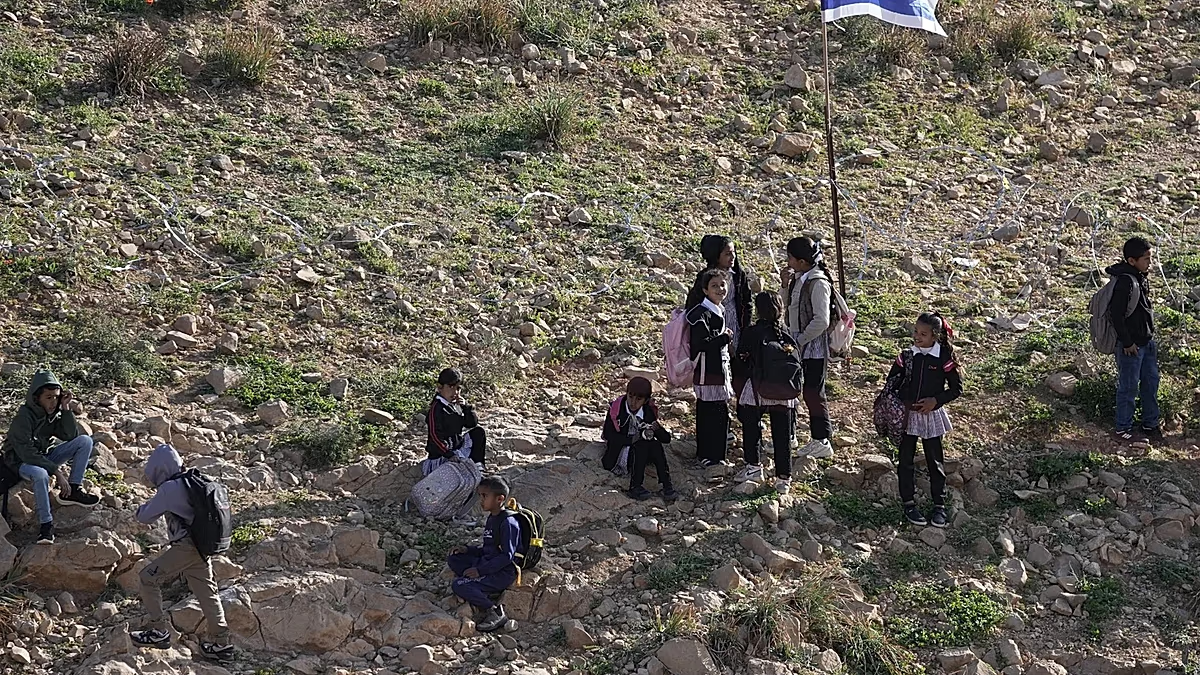
The decision arrives amidst escalating tensions and a stark humanitarian situation in the West Bank. United Nations officials have condemned what they describe as Israel’s “unlawful settlement expansion” and “annexation” of Palestinian land, a process that has intensified alongside the ongoing war in Gaza. While the EU had previously sanctioned a handful of settlers and entities in 2024 for human rights abuses, the push for broader, more impactful measures had been consistently blocked. The primary obstacle was former Hungarian Prime Minister Viktor Orbán, who prioritized maintaining strong ties with Israel. The swearing-in of new Prime Minister Péter Magyar last Saturday removed this veto, illustrating how internal EU politics are deeply intertwined with the bloc’s ability to act on the world stage. The sanctions thus represent a breakthrough, born from a specific political realignment within the union itself.
However, this action exists within a complex legal and diplomatic landscape. Under international law, all Israeli settlements in the West Bank are considered illegal, a position upheld by institutions like the International Court of Justice, which views Israel’s continued occupation as “unlawful.” Recent Israeli legislative moves aimed at tightening control over the territory concerning property and planning are seen by critics as further violations of the foundational Oslo Accords. The EU’s sanctions against violent settlers, therefore, are a direct challenge to these practices, targeting the most extreme manifestations of the settlement project. Yet, they stop short of addressing the core issue of the settlements’ legality or the occupation itself, focusing instead on penalizing individual acts of violence rather than the overarching policy of expansion.
Looking forward, the settler sanctions are perhaps just the first step in a potentially more contentious debate within the EU. Some member states are pushing for far more substantial economic measures, such as a trade ban on goods produced in settlements or the imposition of prohibitive tariffs. More dramatically, countries including Spain, Ireland, and Slovenia have advocated for suspending the EU’s overarching association agreement with Israel or sanctioning high-ranking Israeli ministers like Itamar Ben-Gvir and Bezalel Smotrich. These proposals, however, face steep hurdles, requiring either unanimous consent or a qualified majority—a threshold currently out of reach due to opposition from key nations like Germany and Italy. This internal division highlights the EU’s ongoing struggle to formulate a cohesive, robust policy that matches the severity of rhetoric from some of its member states with actionable, unified measures.
Unsurprisingly, the reaction from Israel was swift and critical. Foreign Affairs Minister Gideon Sa’ar denounced the sanctions as “arbitrary,” arguing that they target Israeli citizens “because of their political views and without any basis.” He reaffirmed Israel’s stance, writing, “Israel has stood, stands, and will continue to stand for the right of Jews to live in the heart of our homeland.” This framing squarely opposes the EU’s position, casting the sanctions not as a response to criminal violence but as an illegitimate attack on Jewish historical rights and national sovereignty. The clash underscores the profound narrative divide at the heart of the conflict: one side sees punitive measures as necessary accountability for violations of international law and human rights, while the other perceives them as politically motivated discrimination against Jewish presence in the land.
In conclusion, the EU’s agreement to sanction violent settlers marks a notable, albeit limited, evolution in its approach to the Israeli-Palestinian conflict. It demonstrates a renewed capacity for collective action following Hungary’s political transition and reflects deepening European concern over the destabilizing violence in the West Bank. Nevertheless, the path ahead is fraught with diplomatic challenges. The bloc remains internally divided on how to escalate pressure, balancing the forceful demands of some member states against the cautious diplomacy of others. As the humanitarian situation deteriorates, the EU’s ultimate test will be whether it can bridge these internal gaps to transform this incremental step into a coherent, effective strategy that addresses not only the symptoms of violence but also its root causes in the ongoing occupation and settlement expansion.