


Paragraph 1: The Eviction of Mariano Ordaz
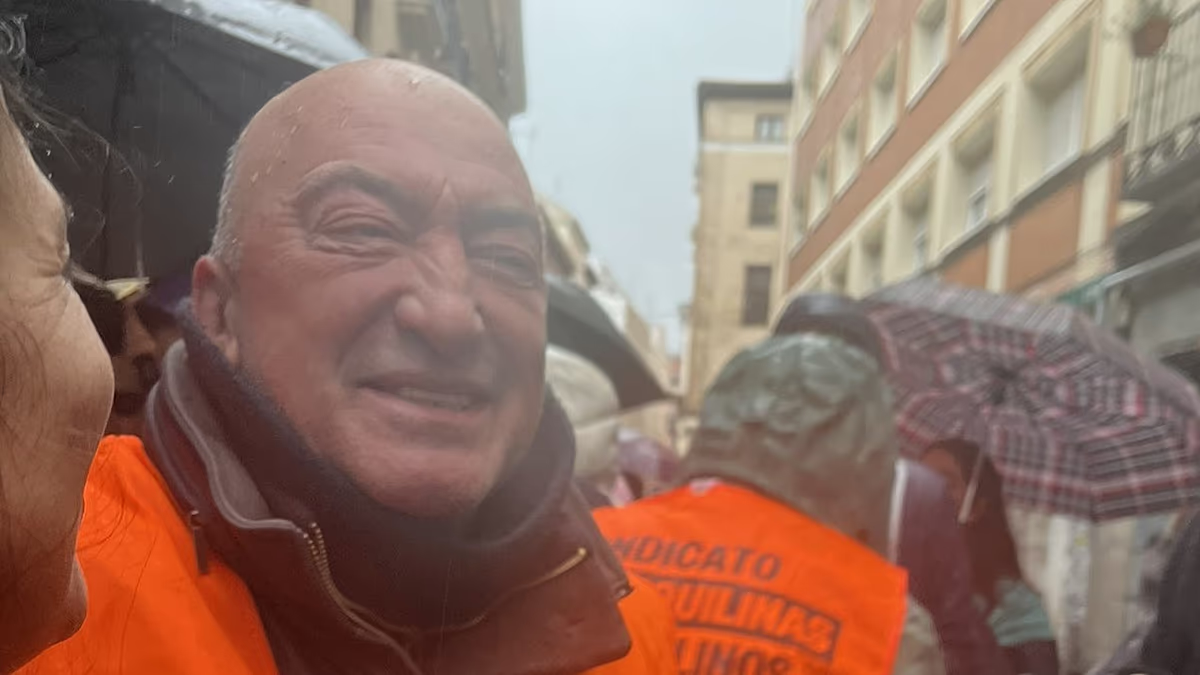
On a Thursday morning in Madrid’s historic Embajadores neighborhood, the life of 67-year-old pensioner Mariano Ordaz was irrevocably changed. After living in the same home his entire life, he was forcibly evicted by a substantial contingent of National Police officers—a deployment described by housing activists as disproportionately large for the task of removing a single elderly man from his residence. This was the fifth attempt to evict Ordaz; on four previous occasions, collective action by his neighbors had successfully halted the process, but this time, their solidarity was not enough. As the police vans cordoned off the street, Ordaz faced a profound uncertainty. With no family home to fall back on, his immediate future involves a temporary shelter and a friend’s offer of a room costing 400 euros—a significant sum for a man with only a pension to live on. His eviction is not merely a legal procedure; it is the violent unraveling of a lifetime’s roots in a community.
Paragraph 2: The Landlord: A Religious Order with a Portfolio
The entity evicting Mariano Ordaz adds a layer of profound irony and controversy to the story. The owner of the building is the Venerable Third Order of Saint Francis of Assisi (VOT), a religious institution whose members take vows of poverty. Yet, critics argue its asset management aligns more with a real estate investment fund than a charitable congregation. The Order owns over 300 flats in central Madrid alone. Tenants in VOT properties often recount a similar pattern: they were initially offered rents slightly below market rates in exchange for personally refurbishing dilapidated apartments. The promised maintenance of common areas was frequently neglected, leaving issues like leaks, broken fixtures, and rusted pipes unresolved. Ordaz’s story fits this mold precisely. After losing his job post-pandemic, he could no afford successive rent increases. When faced with a demand for 800 euros per month plus a 15,000-euro accumulated debt, he was forced to choose between paying rent and covering basic necessities like food, water, and electricity.
Paragraph 3: Justifications and Accusations
The Venerable Order justifies Ordaz’s eviction by citing the severe deterioration of the building and claiming necessary works. The Madrid Tenants’ Union, however, presents a starkly opposing narrative. They argue the “deplorable state” of the property is a direct result of the owner’s own systematic neglect of maintenance. This neglect, they claim, is then used as a pretext to empty buildings and pursue more lucrative opportunities. The case highlights a critical tension: the Order is not a struggling small landlord but a large, tax-exempt institution with vast property holdings, which also manages healthcare centers like the VOT San Francisco de Asís Hospital. This duality—professing vows of poverty while engaging in aggressive asset management—places the eviction within a moral framework, questioning the alignment of its actions with its professed Franciscan values of humility and care for the vulnerable.
Paragraph 4: The National Political Context
Mariano Ordaz’s personal crisis is inextricably linked to a national political moment. Just weeks before his eviction, an anti-eviction moratorium expired in Spain’s Congress after right-wing parties voted against its extension. This moratorium had been one of the few protective tools for vulnerable tenants facing homelessness. Its repeal, housing unions warn, has opened the door to a potential wave of up to 60,000 evictions across the country. Tenant organizations lay blame on multiple levels of government—from the central government for failing to repeal restrictive laws, to the regional and municipal authorities for inadequate housing policies. Ordaz’s case thus becomes a symbol of a systemic failure, demonstrating how a change in national policy can have immediate, devastating consequences at the individual level. In response, a major demonstration has been called in Madrid under the slogan “Housing is costing us our lives,” framing the issue as one of existential survival.
Paragraph 5: Madrid’s Broken Housing Market
This eviction is a stark symptom of a profoundly strained housing market, particularly in Madrid. The city has experienced 44 consecutive months of year-on-year rental increases, with prices soaring by 33% since March 2022. In the central district where Ordaz lived, rents have jumped 21% in just one year, rarely dipping below 2,000 euros per month. That a religious order with hundreds of flats in this lucrative area chooses to raise rents to unaffordable levels and then utilizes the courts for evictions transforms Ordaz’s story from a simple landlord-tenant dispute into a emblematic case of market failure. The rising costs are pushing not only pensioners but entire families out of the market, despite a general economic upswing. Wages have not kept pace, and factors like tourism boom and urban population growth have further constricted supply, turning housing into a privilege rather than a right.
Paragraph 6: The Human Cost and Collective Response
The culmination of these forces—a profit-driven landlord, a withdrawn legal protection, and a frenzied market—is a human cost measured in disrupted lives and eroded dignity. For Mariano Ordaz, it means the loss of his lifelong home and an uncertain, precarious future. For the community, it represents the erosion of neighborhood stability and the fear that anyone could be next. His eviction underscores a harsh reality: in today’s Madrid, a lifetime of residence offers no security. The planned demonstration on May 24th is a direct response to this reality, an attempt to translate individual despair into collective political demand. The case of the pensioner and the Franciscan Order ultimately serves as a powerful indictment of a system where housing, a fundamental human need, is subject to forces that too often disregard humanity itself. It asks a pressing question of society: when the mechanisms of market and law collide to displace a vulnerable elder, who are we, and what values do we truly uphold?