


In the landscape of European democracy, a powerful tool exists for citizens to directly shape the political agenda: the European Citizens’ Initiative (ECI). This mechanism, which allows one million people from at least seven member states to petition the European Commission, represents a bridge between institutional governance and direct public participation. Yet, despite its potential, it remains underutilized and often overlooked by the broader public. As of 2026, only twelve initiatives have successfully navigated the complex process to reach the European Parliament, a modest record for an instrument that has been available for fourteen years. One of these rare successes is the initiative “My Voice, My Choice,” spearheaded by Slovenian anthropologist and activist Nika Kovač, whose work through the “8 March” Institute has propelled reproductive rights onto the European stage.
Nika Kovač, recognized as Slovenia’s Woman of the Year in 2021, exemplifies the dedicated grassroots leadership required to mobilize such a pan-European campaign. “My Voice, My Choice,” formally presented to the European Parliament in December 2025, focuses on the critical issue of unequal access to safe and legal abortion across the Union. The initiative argues that restrictive access not only jeopardizes women’s physical health but also imposes severe economic and psychological burdens, disproportionately impacting marginalized groups. By December 2025, the campaign had gathered over 1.1 million signatures, meeting the stringent requirements to compel a formal EU response. The result was a significant political acknowledgment: the European Parliament called on the Commission to establish a voluntary, EU-funded mechanism to support individuals from countries with limited access, enabling them to seek abortions in other member states under those nations’ existing laws.
The journey to this outcome, however, highlights both the promise and the challenges of the ECI process. As Nino Kavelashvili, an Ambassador for the European Citizens’ Initiative, explains, the path is arduous. After registering a topic, organizers must build coalitions across at least seven countries, then collect the required million signatures within a single year—a daunting logistical and communicative task. Success depends on strong transnational networks, effective translation (both linguistic and cultural), and relentless local mobilization. For “My Voice, My Choice,” this meant Kovač’s Slovenian institute partnering with allies across Europe to frame abortion access not as a niche concern, but as a fundamental public health and equity issue. The campaign’s triumph was not in forcing immediate legislation—the Commission is not obligated to create new laws—but in shifting the political conversation and making reproductive rights a visible, urgent topic on the EU agenda.
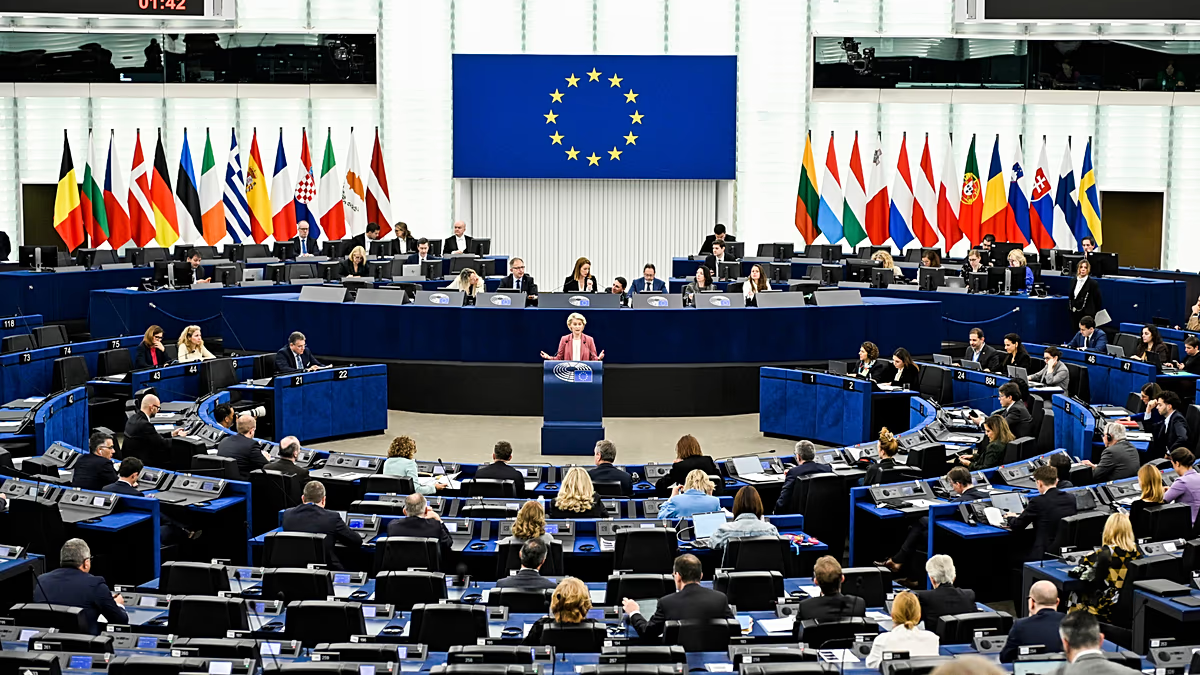
Kavelashvili, who recently gained the right to participate as a new German citizen after originating from non-EU Georgia, speaks passionately about the ECI’s democratic value. She notes that many Europeans remain unaware they possess this direct channel to influence 720 MEPs. To strengthen the instrument, she advocates for revitalized communication strategies, including leveraging social media and educational programs in schools. The preparatory work can be intimidating, and the one-million signature threshold is often a deterrent. Yet, she stresses that the core of any successful ECI is a “strong topic” made relatable and urgent across diverse cultural contexts. It is, as she metaphorically describes, “a soup cooked in seven countries,” requiring local ingredients and shared effort.
The broader context for such participatory democracy appears supportive. The Bertelsmann Stiftung’s Democracy Monitor 2026 indicates strong public commitment to democratic principles in Germany, with high regard for electoral processes, parliamentary representation, and civil rights. The 2024 European elections saw a turnout of over 50%, a notable increase from previous years. This suggests an electorate engaged with European governance, yet perhaps unaware of tools like the ECI that can deepen their agency. Kavelashvili argues that this moment calls not for frustration but for hopeful engagement: “It’s important that the voice for democracy is louder.” For her, the EU’s essence lies in the possibility that people from different nations can collaboratively build a more responsive union.
Currently, 129 initiatives are registered with the Commission, covering diverse themes from transport to animal welfare. Each represents a potential wave of citizen-driven change. The story of Nika Kovač and “My Voice, My Choice” serves as a compelling blueprint. It demonstrates that while the ECI may not always yield immediate legislation, it can irrevocably alter the political landscape, ensuring that critical, life-affecting issues are heard and addressed. It reaffirms that democracy in Europe is not solely a top-down institutional process but can be vibrantly complemented—and driven—by the organized will of its citizens, determined to make their voice their choice.