


The Brighton Trunk Murders of 1934: A Tale of Two Crimes
In the summer of 1934, the seaside resort of Brighton, typically associated with leisure and laughter, became the grim stage for a pair of shocking murders that captivated and horrified the nation. Within a matter of weeks, two female victims were discovered, each hidden within a trunk. The eerie similarity of these crimes—both involving concealed bodies in luggage—created an extraordinary and macabre coincidence. Despite initial assumptions of a connection, police investigations would ultimately reveal that the two tragedies were entirely separate, unrelated incidents, each stemming from distinct motives and circumstances. This duality of evil, unfolding almost simultaneously in the same town, plunged Brighton into a period of dark fascination and exposed the complex undercurrents of life beneath its cheerful veneer.
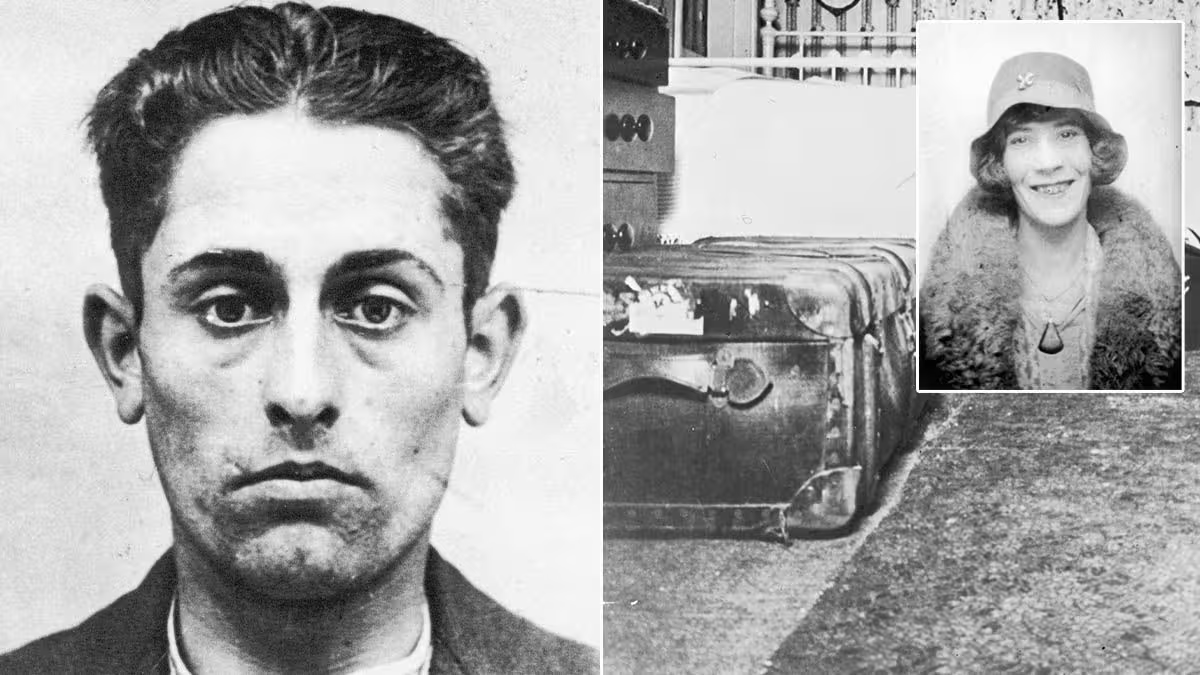
The first gruesome discovery occurred on June 17th, when a clerk at Brighton railway station’s left luggage office, William Joseph Vinnicombe, noticed a foul odor emanating from an unclaimed trunk. Metropolitan Police Chief Inspector Robert Donaldson was dispatched to investigate. Forcing the trunk open, he uncovered layers of blood-soaked paper and cotton wool, which concealed a parcel bound with sash cord. Inside were the torso and arms of a young woman. Alerts sent to other stations led to the discovery of a matching suitcase at London’s King’s Cross station, containing the victim’s legs. Her head was never found. The press, intrigued by the victim’s slender and well-formed feet, dubbed her “The Girl with the Pretty Feet.” A post-mortem by the renowned pathologist Sir Bernard Spilsbury estimated she was around 25 years old and, tragically, five months pregnant. Despite a massive investigation, neither this victim nor her murderer was ever identified, leaving her story an eternal mystery. This anonymous woman, her life and death shrouded in silence, became the first haunting chapter of Brighton’s trunk murder saga.
The intensive police search for the killer of “Pretty Feet” inadvertently led to the revelation of the second crime. While conducting door-to-door inquiries near the railway station, officers stumbled upon another set of remains in eerily similar circumstances. This victim was identified as 42-year-old Violette Kaye, a known prostitute and heavy drinker who had moved to Brighton in 1933 with her younger lover, Tony Mancini. Their relationship was volatile and fueled by jealousy. On May 10th, 1934, the couple had a furious public argument at the Skylark Café, where Mancini worked, after Kaye accused him of an affair with a teenage waitress. That was the last time she was seen alive. Mancini subsequently told friends Kaye had gone to Paris, and her sister-in-law received a telegram, supposedly from Violette, stating she was leaving for a job abroad. In reality, Kaye was already dead.
Mancini, unnerved by the police inquiries into the first trunk murder and Kaye’s disappearance, moved to a new lodging at 52 Kemp Street. He brought with him a large trunk, which he placed at the foot of his bed, draping it with a cloth and using it as a makeshift coffee table. Inside was Violette Kaye’s decomposing body. Visitors to his room began to complain of an unbearable smell and mysterious fluids leaking from the trunk. As suspicion grew, Mancini fled Brighton. However, police investigating the original trunk murder searched his vacant premises and made the ghastly discovery. Mancini was arrested in London on July 17th, and his trial for murder began at the Lewes Assizes in December 1934.
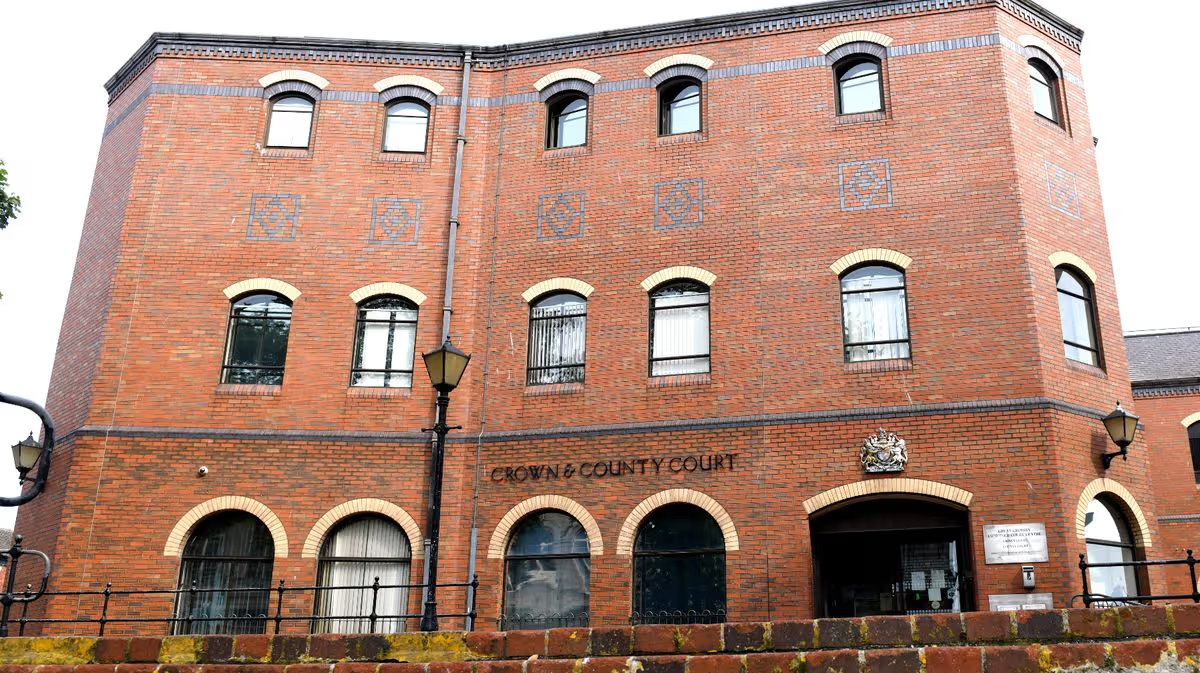
The trial was a sensational public event. The prosecution argued that Kaye had died from a fatal blow to the head and presented evidence, including handwriting analysis, linking Mancini to the fraudulent telegram. Witnesses testified about his violent boasts and his pleas for a false alibi. Mancini’s defence, led by the formidable Norman Birkett, took a different tack. They painted Kaye as a woman of tumultuous lifestyle, suggesting her death could have been an accident or even the result of an attack by a client. Mancini himself claimed he had simply found her dead in their flat and, terrified that his criminal record would make him the immediate suspect, panicked and hid her body. He insisted he was innocent of murder. After just over two hours of deliberation, the jury, seemingly swayed by Birkett’s persuasive narrative of panic rather than malice, returned a verdict of not guilty.
The story, however, did not end with the trial. In a startling confession to the News of the World in 1976, Mancini admitted he had indeed killed Violette Kaye. He claimed that during a violent row, she attacked him with a hammer; he wrestled it away and threw it at her, striking her temple and killing her instantly. While a prosecution for perjury was considered, the Director of Public Prosecutions ruled he could not be tried again for the same offense. Thus, justice was never formally served for Violette Kaye. Meanwhile, the “Girl with the Pretty Feet” and her killer remained forever unidentified. These two parallel tragedies, the one solved only by a belated confession and the other eternally mysterious, left a lasting shadow on Brighton’s history, a stark reminder of the fragile humanity and hidden violence that can exist anywhere, even in the most sunlit of places.